2025 Likely to Be 2nd or 3rd Warmest Year on Record, Warns World Meteorological Organization
2nd or 3rd Warmest Year on Record: In a concerning update released on November 8, 2025, the World Meteorological Organization (WMO) warned that the year 2025 is on track to become the second or third warmest year ever recorded. This prediction adds to the growing urgency around the accelerating pace of global warming, driven by human-induced greenhouse gas emissions and the ongoing El Niño climate pattern.
What Does the WMO Report Say?
Alarming Temperature Rise
- According to preliminary global temperature data, the first 10 months of 2025 have seen persistent warming trends.
- The global average temperature is projected to be 1.48°C above pre-industrial levels.
- Only 2016 and 2023 are likely to be hotter, making 2025 the third warmest year, with a high possibility of taking second place if current trends continue.
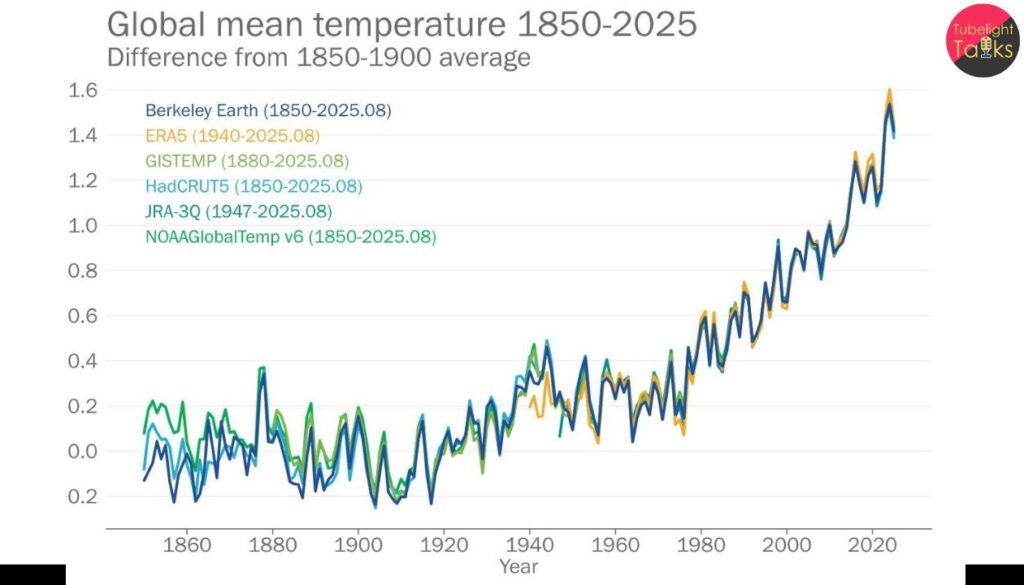
(Source: WMO Official Statement)
The Role of El Niño & Emissions
Dual Climate Drivers
- El Niño, the natural Pacific Ocean warming cycle, has strengthened throughout 2025, causing abnormal heatwaves and extreme weather.
- Combined with record levels of carbon dioxide, methane, and nitrous oxide, El Niño’s warming effect is exacerbated.
- The last significant El Niño event in 2016 also coincided with record global temperatures.
“What’s happening in 2025 is the result of both natural variability and sustained global emissions. The result is an overheating planet,”
— Secretary-General, WMO
Effects Already Being Felt Globally
Global Impacts Reported
- Europe: Persistent drought in Southern Europe affecting agriculture.
- Asia: Devastating floods in Southeast Asia displacing thousands.
- Africa: Crop failures due to heat and delayed rainfall in East Africa.
- North America: Wildfires in Canada and record heat in US Midwest.
- Antarctica: Shrinking sea ice levels hit historic lows in August 2025.
WMO’s Data Sources
- Temperature monitoring from over 6,000 meteorological stations, satellite observations, and ocean buoys support the analysis.
- Cross-verified by global partners such as NASA, NOAA, Copernicus Climate Change Service (C3S).
Implications for Climate Goals
Race Against the 1.5°C Threshold
- The Paris Agreement aims to limit global warming to well below 2°C, preferably 1.5°C above pre-industrial levels.
- 2025 being at 1.48°C already edges dangerously close to the 1.5°C ceiling.
- Scientists warn that exceeding this limit even temporarily could lead to irreversible ecological damage—including coral bleaching, glacial melt, and loss of biodiversity.
“What was once a distant climate target is now a flashing red signal,”
— Indian Institute of Tropical Meteorology
What Must Be Done Immediately
Urgent Global Actions
- Rapid Transition to Renewable Energy
- Solar, wind, hydro must replace coal and oil.
- Solar, wind, hydro must replace coal and oil.
- Massive Reforestation
- Forests act as carbon sinks.
- Forests act as carbon sinks.
- Urban Cooling Measures
- Green roofs, reflective surfaces, and tree planting to mitigate heat islands.
- Green roofs, reflective surfaces, and tree planting to mitigate heat islands.
- Strengthening Climate Policies
- Countries must revise and strengthen their Nationally Determined Contributions (NDCs).
- Countries must revise and strengthen their Nationally Determined Contributions (NDCs).
- Individual Responsibility
- Reduce meat consumption, energy usage, and carbon footprint.
- Reduce meat consumption, energy usage, and carbon footprint.
India’s Climate Role & Responsibility
National Implications
- India witnessed record-breaking summer temperatures in Rajasthan and Delhi NCR in 2025.
- Chennai, Mumbai, and Kolkata faced urban flooding due to intensified monsoon bursts.
- Despite a strong push for renewables, coal usage and vehicular emissions remain high.
Read Also: Death Valley India: 50°C Heatwave Exposes Nation’s Climate Emergency
India has committed to:
- Achieving net-zero by 2070
- Reducing carbon intensity of GDP by 45% by 2030
- Expanding non-fossil energy capacity to 500 GW by 2030
Climate Balance Through Sat Gyaan
Sant Rampal Ji Maharaj teaches that nature is a divine system gifted by the Supreme God, and humans are its stewards—not masters. Our misuse of Earth’s resources stems from spiritual ignorance and materialistic greed.
“When humans abandon their duties and chase desires, nature strikes back. Satbhakti (True Devotion) leads to spiritual and environmental balance.”
— Sant Rampal Ji Maharaj
The climate crisis is not only ecological but also spiritual. Adopting Sat Gyaan (True Spiritual Knowledge) inspires compassion, restraint, and harmony with nature.
🔗 Learn More at www.jagatgururampalji.org
📺 Watch: Sant Rampal Ji Maharaj YouTube Channel
A Collective Climate Responsibility
Now Is the Time for Climate Awakening
Everyone Must Act — Governments, Corporates, Individuals
- Governments must legislate, not just negotiate.
- Corporations must innovate responsibly, not greenwash.
- Citizens must educate themselves and reduce emissions.
Only a conscious, collective transformation—spiritually and practically—can reverse the climate emergency.
FAQs: 2025 Warmest Year
Q1. Why is 2025 becoming one of the warmest years on record?
Because of the combination of El Niño and record greenhouse gas emissions, according to WMO.
Q2. Is this an irreversible trend?
If global emissions are not curbed soon, warming may become irreversible, leading to permanent damage to Earth’s climate systems.
Q3. How close are we to the 1.5°C threshold?
2025’s average temperature is already 1.48°C above pre-industrial levels, alarmingly close to the 1.5°C limit set by the Paris Agreement.
Q4. What is India doing about climate change?
India has committed to net-zero by 2070 and is expanding renewable energy, though challenges remain in curbing industrial and vehicular emissions.
Q5. Where can I read the full WMO report?
At the official WMO website: wmo.int
Related Stories










Discussion (0)