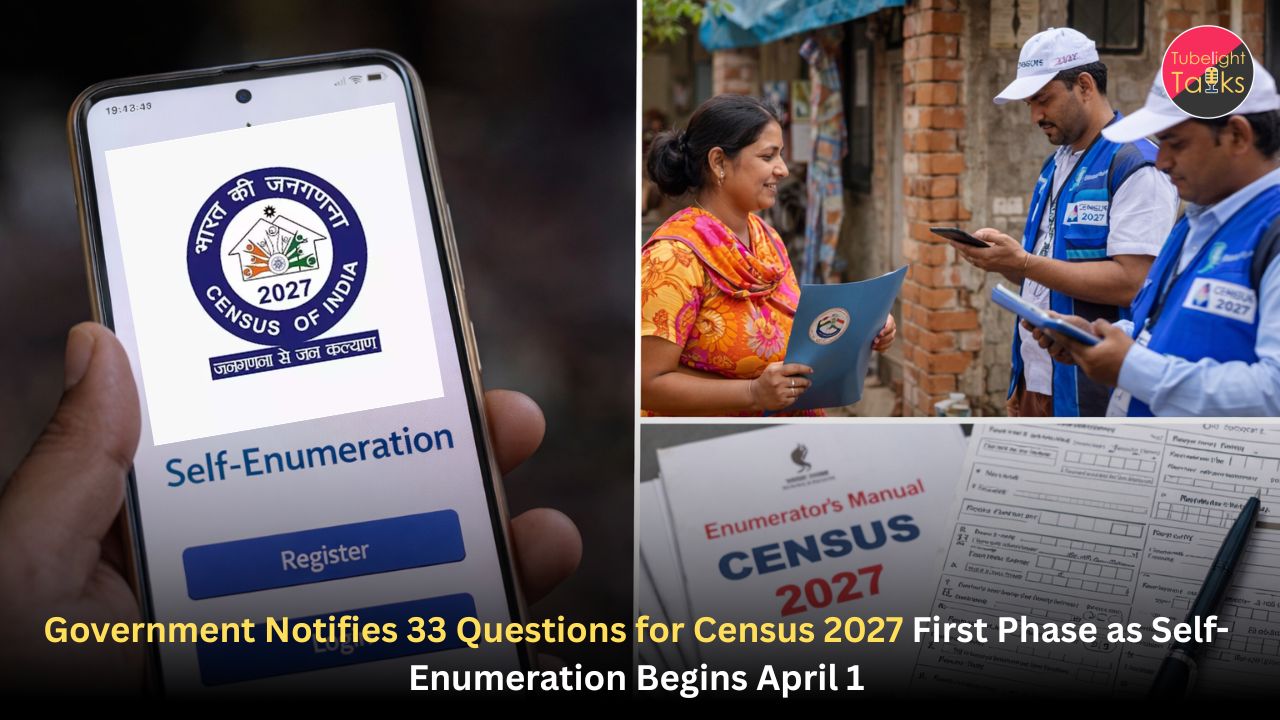
Government Notifies 33 Questions for Census 2027 First Phase, but the Door-to-Door Count Won’t Start Everywhere Tomorrow
33 Questions for Census 2027: The government’s move on Census 2027 is now official and immediate. The first phase of India’s next census formally begins on April 1, 2026, but the “commence tomorrow” line needs one crucial clarification: what starts tomorrow is self-enumeration, not a uniform nationwide door-to-door survey. The House Listing and Housing Census will roll out in 30-day windows across states and Union Territories between April and September 2026.
The first-phase questionnaire had already been notified in January 2026, and official records indicate it contains 33 questions focused on the condition of houses, household amenities, and assets. In short, the framework is notified, the technology is live, and the world’s largest census is entering execution mode.
Census 2027 First Phase Officially Opens on April 1, 2026
What begins tomorrow, and what does not
The Registrar General and Census Commissioner of India said on March 30, 2026 that Census 2027 will be conducted in two phases and that the first phase begins from April 1, 2026. The same official briefing makes clear that self-enumeration will run first, while the physical House Listing and Housing Census starts later in each state or Union Territory according to a staggered calendar. That means the headline is directionally correct, but incomplete unless it distinguishes between online self-reporting and the house-to-house field operation.
This distinction is not minor. Tomorrow, April 1, 2026, marks the opening of the self-enumeration window for the first group of areas, while door-to-door fieldwork in those jurisdictions begins on April 16, 2026. So the first phase is indeed commencing, but not as a single nationwide knock on every household door from day one.
The first states and Union Territories in the rollout
According to the official annex released by PIB, the first group to enter self-enumeration from April 1 to April 15 includes Andaman and Nicobar Islands, NDMC and Delhi Cantonment Board, Goa, Karnataka, Lakshadweep, Mizoram, Odisha, and Sikkim.
Their House Listing and Housing Census follows from April 16 to May 15. Madhya Pradesh, Andhra Pradesh, Arunachal Pradesh, Chandigarh, Chhattisgarh, and Haryana begin their self-enumeration on April 16 and their house listing from May 1 to May 30. Different windows then continue across other states through September 2026.
That staggered design reflects the enormous scale of the operation. The government has said more than 3 million officials, including enumerators and supervisors, will be involved across the country, and that the first phase will run across six months from April to September 2026 in 30-day state-specific blocks.
What the Government Has Actually Notified: The 33 Questions
The official notification already exists
The March 30 press briefing states that “Questions of the Phase I of the Census have been notified in January, 2026.” A separate Ministry of Home Affairs reply on Census 2027 safeguards, issued on March 24, also confirms that the questions for the first phase have been notified, while the second-phase questions will be notified later. This is important because it means the first phase is not beginning with a provisional questionnaire; the legal and procedural framework is already in place.
The strongest official pointer on the content comes from the ORGI gazette notification hosted through the Census system. Search snippets from that notification show the schedule includes 33 items and covers, among other things, availability of bathing facility, household vehicle ownership such as bicycle or scooter/motorcycle/moped and car, and mobile number as the 33rd item.
The PIB press conference separately describes the broader purpose of the phase as collecting information on house condition, amenities, and assets possessed by the household.
What kinds of information Phase I is designed to capture
Even where the full question-by-question gazette text is not reproduced in the press release, the official material makes the categories clear. Phase I is the House Listing and Housing Census, which means its emphasis is on the dwelling and the household rather than on the full demographic profile of every individual.
The government says this phase is meant to capture the condition of houses, amenities available to households, and assets they possess. Official search excerpts linked to the notified schedule show examples such as bathing facility, vehicles, and mobile number, which fits the longstanding houselisting logic of mapping living conditions and household infrastructure.
This matters because the first phase is not the same as the population enumeration phase. It is primarily about how people live: the physical structure they occupy, what services are available, and what material facilities the household can access. In policy terms, that makes Phase I central to housing, sanitation, energy access, asset mapping, infrastructure planning, and service-delivery design.
India’s First Fully Digital Census Changes the Process
A major shift from paper to mobile and web
One of the most significant features of Census 2027 is that it will be India’s first fully digital census. In the official March 30 release, the Registrar General said, “For the first time, the Census will be conducted digitally,” and also said that self-enumeration would be available for the first time. Enumerators will use a mobile app on smartphones, while respondents can submit information online through a secure self-enumeration portal before the field visit.
The government says both the mobile app and the self-enumeration portal will be available in 16 languages, including Hindi and English. A monitoring portal has also been built for field management tasks such as appointment letters, ID cards, training management, work allocation, block creation, dashboard monitoring, and auto-generation of certain records and abstracts. This signals that the digitisation is not limited to questionnaire collection; it extends to the entire field administration backbone.
How self-enumeration will work
The official process is straightforward. Respondents can log into the self-enumeration portal using their mobile number and basic details, identify their location on a map, fill in household information, and submit the schedule. Once submitted, they receive a Self-Enumeration ID that must be shared with the enumerator during the field visit. The enumerator then confirms the information and includes it in the census workflow.
That model is meant to give households flexibility while preserving verification through the field system. In practice, it may particularly benefit urban families, digitally comfortable respondents, and households that prefer to complete the form at their own pace before the enumerator arrives. At the same time, the government has emphasized that self-enumeration is an additional option, not a substitute for door-to-door enumeration.
Why the First-Phase Questionnaire Matters Beyond Statistics
Housing data shapes real governance
The first phase of the census is often overshadowed by the population count, but it has powerful policy consequences. Information on the condition of houses, basic amenities, and household assets helps governments understand gaps in sanitation, water, mobility, communications, and housing quality. This is the kind of data that later informs targeting, budgeting, and infrastructure decisions across ministries and state governments.
Because the first phase is about the lived condition of homes, the 33-question schedule is not administrative trivia. It is a structured national snapshot of how Indian households are equipped, where service deficits remain, and which regions are moving faster or slower in material development. In a country of India’s scale, even a question on a household amenity can influence future resource prioritisation.
The legal and financial framework is already in place
The March 30 PIB release says Census 2027 is being conducted under the Census Act, 1948 and Census Rules, 1990, and notes that the government had notified its intention to conduct the census in the Gazette on June 16, 2025. It also says the Union Government has approved an outlay of ₹11,718.24 crore for Census 2027, including honorarium, training, IT infrastructure, and logistics. A pre-test of the first phase was already conducted in about 5,000 blocks across all states and UTs in November 2025.
That combination of legal notification, funding, pre-testing, and digital tooling suggests the operation has moved well beyond announcement stage. India is not just planning Census 2027 anymore; it is entering phased implementation with a notified Phase I schedule and field machinery already activated.
Safeguards, Privacy, and the Next Phase
What the government says about confidentiality
The Ministry of Home Affairs has stated that Census 2027 will be conducted digitally and that individual data collected in the census will be kept confidential, with only aggregated data published at administrative levels. Separate official material also says all necessary provisions have been made to ensure data security. In a digital census, public trust will depend not only on law and technology, but on how clearly these safeguards are communicated to ordinary households.
What is still pending for Phase II
The government has been clear that the second phase is different and not yet fully notified. A Rajya Sabha reply on March 25, 2026 stated that the questions for the second phase, including questions on caste, will be notified before the commencement of that phase. The March 30 press conference added that Phase II will collect information on demographic, socio-economic, education, migration, fertility and related indicators, and that exact dates and questions for that phase will be notified in due course.
That means the current moment belongs to Phase I alone. The 33-question notification is about houselisting and housing census, not the full person-level population schedule. Confusing the two could easily distort public understanding.
Good Governance Begins with Truthful Counting
A nation cannot plan wisely if it does not first see itself honestly. That is why a census is more than a government exercise; it is an act of truthful accounting. This links naturally with the teachings of Sant Rampal Ji Maharaj, who emphasizes that right action begins with truth, discipline, and moral clarity in daily life.
When households answer honestly and society values transparency over convenience, governance becomes more just and effective. Material development needs accurate data, but lasting progress also requires inner integrity. A truthful count of homes and conditions is one step toward fair policy; a truthful life, as spiritual wisdom teaches, is the foundation of a fair society.
Call to Action
Know your census window and participate carefully
Citizens should not rely only on dramatic headlines saying the census starts “tomorrow.” They should check whether their state or Union Territory is entering self-enumeration, door-to-door houselisting, or a later phase in the official schedule. Households should keep basic home-related information ready, use the self-enumeration option where convenient, and cooperate with enumerators when they visit.
Since Phase I data will help shape planning on housing and amenities, accurate responses matter. A well-conducted census is not only the government’s job. It also depends on informed, honest public participation.
The bigger picture starts with one informed response
Census 2027’s first phase is India’s chance to build a sharper picture of its homes, infrastructure, and living conditions. Participation should therefore be treated as a civic responsibility, not as a bureaucratic inconvenience. Read the official timetable, understand whether your area’s window has opened, and respond carefully whether online or in person. The better the first phase data, the stronger the foundation for future governance.
FAQs: Government Notifies 33 Questions for Census 2027 First Phase as Self-Enumeration Begins April 1
1. Has the government really notified 33 questions for the first phase of Census 2027?
Yes. Official Census system search results tied to the January 2026 gazette notification show a 33-item first-phase schedule, and the March 30 PIB press conference says the Phase I questions were notified in January 2026.
2. Is Census 2027 starting nationwide on April 1, 2026?
Phase I begins on April 1, 2026, but what starts first is self-enumeration in the initial group of states and UTs. Door-to-door houselisting begins on April 16, 2026 for that first group and rolls out state-wise later elsewhere.
3. What does the first phase mainly ask about?
The government says Phase I collects information on the condition of houses, amenities available to the household, and assets possessed by the household. Official gazette-linked snippets show examples including bathing facility, vehicle ownership, and mobile number.
4. Will Census 2027 be digital?
Yes. The government says Census 2027 will be conducted digitally for the first time, with enumerators using a mobile app and households also getting a self-enumeration option through a web portal.
5. In how many languages will self-enumeration be available?
The self-enumeration portal and mobile app will be available in 16 languages, including Hindi and English.
6. Has the second-phase questionnaire also been notified?
No. The Ministry of Home Affairs has said the questions for the second phase, including caste-related questions, will be notified before that phase begins.
Related Stories









Discussion (0)