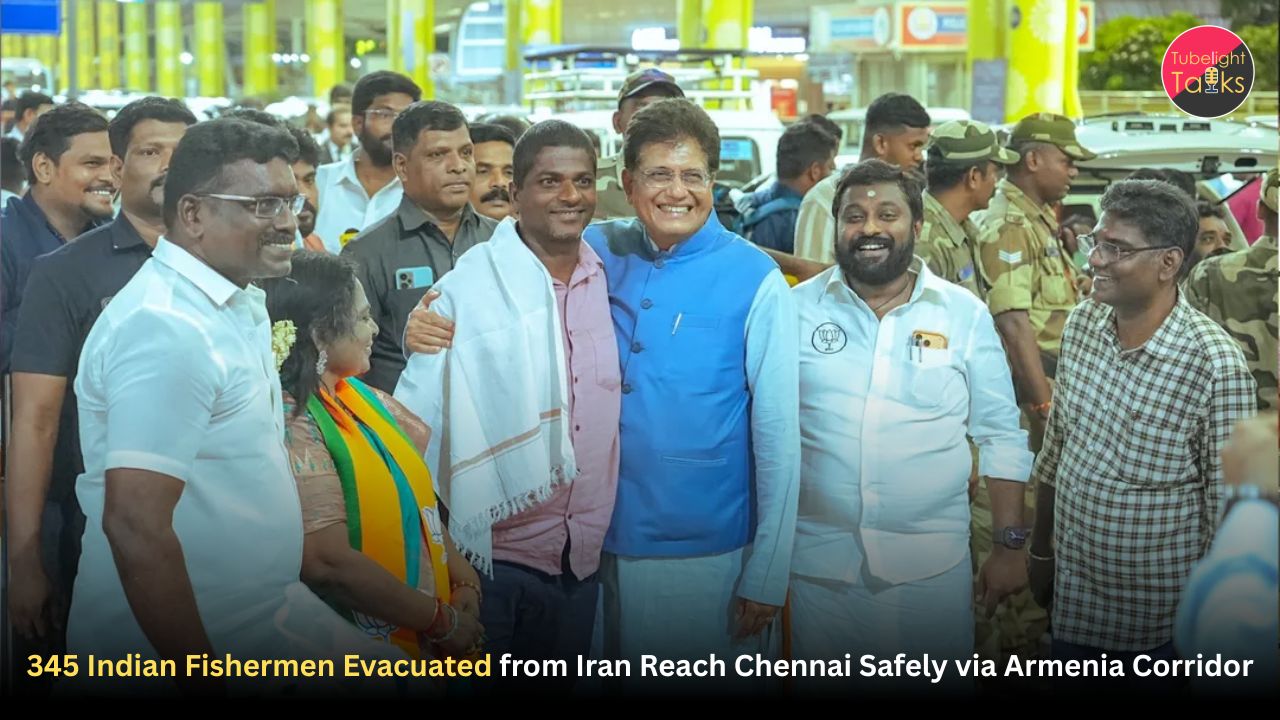
Rescue Operation Brings 345 Indian Fishermen Home from Iran via Armenia
A total of 345 Indian fishermen stranded in Iran have arrived safely in Chennai after a multi-stage evacuation through Armenia. The biggest factual nuance in this story is timing: the strongest current reports say the group reached Chennai on Saturday evening, not early this morning. News on Air, Indian Express, and multiple other current reports are consistent on both the number and the route through Armenia.
The evacuation has been publicly confirmed
News on Air reported that 345 Indian fishermen arrived in Chennai “this evening,” while a later News on Air update dated April 5 said they had arrived safely in Chennai “yesterday evening” after being evacuated through Armenia. Indian Express likewise reported that 345 Indian fishermen reached Chennai airport on Saturday evening after being brought out of Iran via Armenia.
That makes the core of the headline correct: the fishermen were evacuated successfully and reached Chennai safely. But the phrase “early this morning” does not match the strongest available reporting I checked. The more accurate wording is that they arrived on Saturday evening and their safe return was being reported and discussed the following morning.
Also Read: 345 Indian Fishermen Return Safely to Chennai After Iran Evacuation via Armenia
Armenia played a central role in the rescue route
External Affairs Minister S. Jaishankar publicly thanked Armenian Foreign Minister Ararat Mirzoyan and the Government of Armenia for facilitating the evacuation of Indian fishermen from Iran through Armenia to India. News on Air’s report specifically highlights this diplomatic acknowledgment, showing that Armenia was not just a transit stop but a key enabler of the evacuation corridor.
This fits with the broader Indian evacuation architecture from Iran. A recent PIB briefing said the Embassy of India in Tehran had already facilitated the movement of more than 1,100 Indian nationals out of Iran through Armenia and Azerbaijan, including a very large share through Armenia. That wider pattern helps explain why Armenia became the route for the fishermen’s safe exit as well.
Most of the returnees were from South India
Indian Express reported that the flight landed in Chennai because most of the fishermen were from Tamil Nadu. Times of India and other reports said the returnees were primarily from Tamil Nadu, with some also linked to neighboring southern states. That regional concentration explains why Chennai became the natural arrival point for the operation.
The human significance of that detail is easy to understand. For families waiting in coastal districts, the return to Chennai meant the uncertainty was finally over. The evacuation was not only a diplomatic success. It was also a direct relief moment for households that had been waiting anxiously for their relatives to get out of a war-affected zone.
The operation reflects India’s wider response to the West Asia crisis
The fishermen’s return is part of a larger Indian effort to bring home nationals caught in the West Asia conflict. News on Air and other reports frame the operation as one more example of India coordinating safe exits through neighboring countries as conditions inside Iran became more difficult. The Indian government has been relying on embassy coordination, land-border movement, and onward flights to bring citizens back.
That broader context matters because it shows this was not a one-off rescue improvised at the last minute. It was part of an ongoing crisis-management effort in which diplomatic channels, partner-country support, and rapid movement planning all had to work together. The successful arrival of all 345 fishermen is therefore both a humanitarian outcome and a test of institutional coordination.
Also Read: Rescue Success: Indian Woman Trekker Safely Brought Back After Three Days Lost in Kodagu Hills
Relief after uncertainty and fear
Times of India’s coverage of similar return flights described weeks of uncertainty, disrupted livelihoods, and the fear caused by conflict conditions. Even where individual details differ between reports, the larger picture is consistent: the fishermen had been stuck in an unstable environment and needed a coordinated evacuation route to get home.
That is what makes this story important beyond the numbers. Rescue operations are often judged by logistics, but their real meaning lies in human safety. In this case, 345 people who were trapped by conflict have been brought back to India alive and safely, and that is the main fact that matters.
Safe return is the real success
In times of war, the best outcome is often not political advantage but the safe return of ordinary people to their families. A successful evacuation reminds us that timely coordination, humane decision-making, and international cooperation can save lives even when the wider region remains unstable.
Call to Action
Readers should rely on verified government and major-news updates during evacuation operations, because timing and route details can easily get misstated in fast-moving crises. This case is a good example: the safe return of 345 fishermen is confirmed, but the arrival time is more accurately reported as Saturday evening rather than early morning.
FAQs: 345 Indian Fishermen Evacuated from Iran Reach Chennai Safely via Armenia Corridor
1. How many Indian fishermen were evacuated from Iran?
A total of 345 Indian fishermen were evacuated and reached Chennai safely.
2. Did they arrive early this morning?
The strongest current reports say they arrived on Saturday evening, not early this morning.
3. Which route was used for the evacuation?
They were evacuated from Iran through Armenia before being flown to India.
4. Where did they land in India?
They arrived at Chennai airport.
5. Did India officially acknowledge Armenia’s help?
Yes. S. Jaishankar publicly thanked Armenia and its foreign minister for facilitating the evacuation.
6. Was this part of a wider evacuation effort from Iran?
Yes. Current government-linked reporting says India has been moving nationals out of Iran through Armenia and Azerbaijan as part of a larger evacuation effort.
Related Stories







Discussion (0)