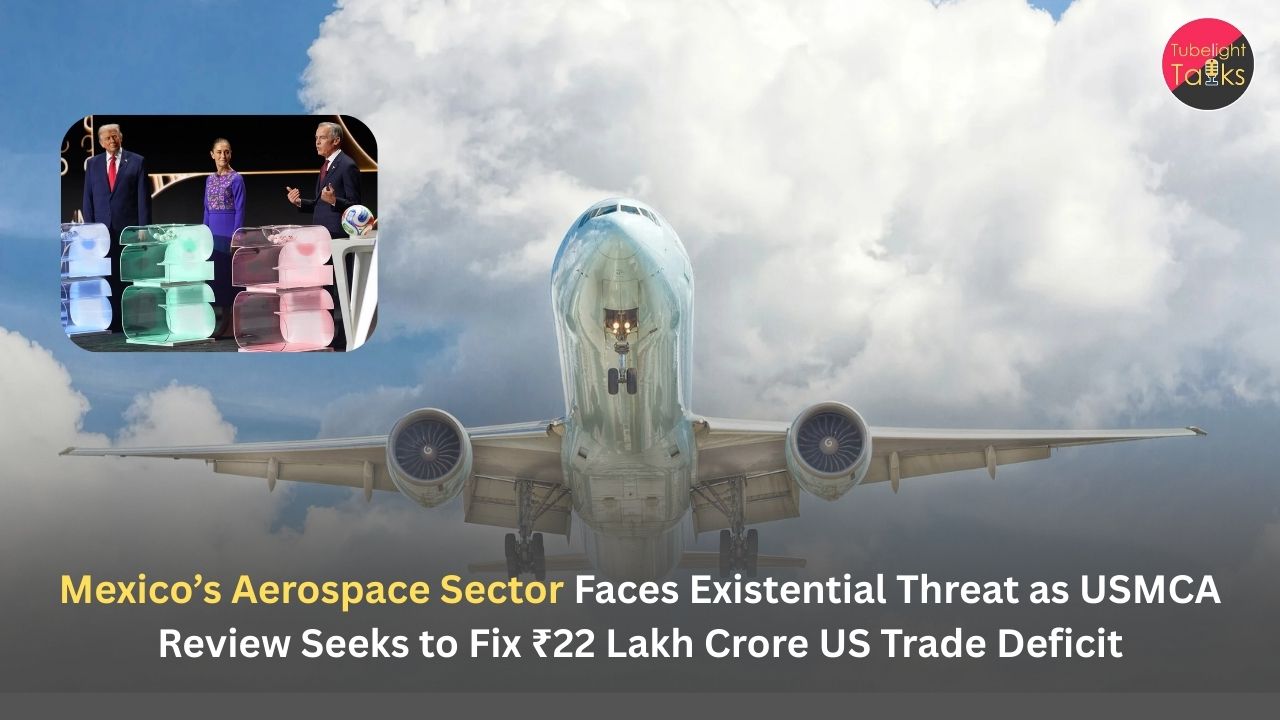
Mexico’s Aerospace Sector Faces Existential Threat as USMCA Review Seeks to Fix ₹22 Lakh Crore US Trade Deficit
Mexico Aerospace Boom: Will political pressure and protectionist sentiment dismantle one of the greatest success stories of North American economic integration? Mexico’s highly sophisticated aerospace sector, a thriving industry that has reported an average annual growth rate of over 10%, now finds itself in the direct crosshairs of the mandated USMCA (United States-Mexico-Canada Agreement) 2026 review.
What was once seen as an assurance of tariff-free access and regional supply chain stability – a direct legacy of the initial trade pacts – is now a point of high-stakes political contestation. The core issue is the dramatic widening of the US trade deficit with its North American partners, which is projected to have reached a Shocking Report 2026 value of $263 billion in 2025 (a $138 billion increase since the USMCA was signed).
This imbalance, largely fueled by manufacturing imports from Mexico (including aerospace parts), creates immense pressure to renegotiate the terms of trade, threatening to undercut Mexico’s hard-won position in global aviation manufacturing.
The USMCA Aerospace Juggernaut
The aerospace industry in Mexico is a direct result of decades of North American free trade, which incentivized US and European giants like Safran, Bombardier, and Honeywell to establish manufacturing and assembly hubs in Mexico, primarily in clusters like Queretaro and Chihuahua.
This integrated supply chain allows for co-production of complex aircraft components (fuselage parts, landing gear, turbine blades) that are then exported duty-free to the US and Canada for final assembly. Mexico exports approximately 80% of its aircraft parts to the US and Canada, making the industry critically dependent on the USMCA framework.
The USMCA Article 34.7 mandates a “sunset review” by July 2026, where all three countries must agree to extend the pact for another 16 years. Failure to agree sets the agreement on a path to termination by 2036, leading to immediate tariff volatility and the fracturing of continental supply chains. With the current political administration in Washington prioritizing American jobs and deficit reduction, the review is expected to be a contentious test of North American solidarity.
The Low-Wage Shock and Chinese Exploitation
The biggest vulnerability for Mexico’s aerospace success is the massive wage gap and the trade deficit.
A Shocking Report 2026 confirms that Mexican manufacturing wages, averaging just $2.76 per hour (roughly 10% of US manufacturing wages), remain the central economic driver for corporate offshoring. This low-wage, low-standard environment has led to US and Canadian investment in transportation equipment production exceeding $56 billion since the USMCA took effect, fueling the trade deficit.
The political pressure to impose tougher Labor Value Content (LVC) requirements – similar to those applied to the automotive sector – could severely disrupt the economics of aerospace manufacturing in Mexico.
Furthermore, US industry stakeholders have raised alarms that non-market economies, specifically China, are exploiting the USMCA by increasing their direct investment in Mexico and routing raw materials and components through the country for minimal processing before qualifying for duty-free access to North American markets. This creates a powerful political narrative that USMCA is failing to protect American industry from third-party competition, increasing the likelihood of aggressive, protectionist measures being taken in the 2026 review.
North American Competitiveness and Supply Chain Resilience
Despite the political tensions, there is broad consensus among industry leaders and strategic thinkers that the USMCA must be preserved. This perspective offers a strong counter-narrative to the deficit-focused politics.
Global Competitiveness: The Ground Reality is that the integrated North American supply chain, facilitated by the USMCA, is essential for competing with global rivals, particularly Europe and Asia. Without the USMCA, companies operating outside the agreement face tariffs that can range from 25% to 30%, crippling their competitiveness. The low-cost, high-skill synergy offered by Mexico is a competitive advantage that US manufacturers cannot afford to lose.
Security and Nearshoring: The USMCA provides a vital framework for “Fortress North America” – a strategy to secure critical supply chains (including those for defense and aerospace) from external geopolitical shocks, particularly from China.
Experts argue that the 2026 review is a strategic opportunity to strengthen rule-of-origin requirements, not to dismantle the agreement, thereby reinforcing the region’s self-reliance. Maintaining Mexico’s aerospace hub is key to this economic and national security strategy.
Also Read: F404-IN20 Engine Handover Glory: GE-HAL Pact Powers New India’s Tejas Triumph
Mexico’s Preemptive Strike
Mexico is not passively waiting for the USMCA review. The Ministry of Economy (SE) has been conducting extensive public and private consultations to consolidate a strategic “position paper” ahead of the July 2026 deadline.
This strategy focuses on three key areas:
- Tariff Stability: Urging all parties to secure a renewed commitment to full tariff-free trade, preventing the rate volatility experienced in 2025.
- Flow of People: Advocating for simplified rules regarding the movement of US certifiers and technical personnel in high-security areas to prevent delays in aerospace approvals.
- Regional Alignment: Strengthening technical support for SMEs and aligning industrial policy to move beyond acting merely as a manufacturing hub to becoming a full-value-chain partner.
- This preemptive diplomatic action aims to frame the 2026 review as a constructive modernization effort rather than a destructive renegotiation, demonstrating Mexico’s strategic alignment with the long-term goals of North American integration.
The Threat of Policy Whiplash
The uncertainty surrounding the review is already impacting long-term investment decisions in Mexico.
Mr. Ricardo Salas, Senior Trade Lawyer, Mexico City: “The risk of policy whiplash is enormous. The aerospace sector operates on decades-long investment cycles. The possibility of the US withdrawing its agreement, or imposing punitive LVC requirements that require massive, costly operational restructuring, paralyzes new investment. The Ground Reality is that the USMCA review must lead to a definitive 16-year extension. Anything less introduces fatal uncertainty.”
Dr. Elizabeth Warren (Name changed), Labor Economist: “The core problem remains the wage differential. Any honest review must preserve and expand the USMCA’s labor reforms, ensuring that the cost-effectiveness of Mexican manufacturing is based on efficiency and talent, not exploitation of workers earning just $2.76 an hour. If the review doesn’t fix the systemic labor issues, it will only perpetuate the unsustainable trade deficit, setting up an even bigger crisis in the future.”
Fair Wages and International Harmony
The spiritual wisdom (Satgyan) of Sant Rampal Ji Maharaj stresses the foundation of all righteous governance (dharma) as being based on justice and fair wages (uchit vetan). The Shocking Report 2026 on the mere $2.76 per hour wage for Mexican manufacturing workers, a key component of the aerospace supply chain, highlights a severe failure of ethical economic policy. Exploiting low wages for corporate profit, even under the guise of free trade, is fundamentally adharma (unrighteous).
Sant Rampal Ji Maharaj advocates for an international economic system built on Parhit (mutual benefit) and Satya (truth). The USMCA review, if guided by true righteousness, would not merely seek to protect American jobs, but to raise the living standards of all workers in North America, closing the unjust wage gap.
Only when all parties operate with ethical concern for the laborer, ensuring that economic benefits are shared equitably, can international trade agreements like the USMCA achieve true harmony and stability, providing a sustainable model for global prosperity.
USMCA Review & Aerospace Stakes (2025-26 Data)
- USMCA Review Deadline: July 1, 2026 (to decide on 16-year extension).
- US Trade Deficit (Projected 2025): $263 Billion (Up from $125 Billion in 2020).
- Mexico Aerospace Sector Growth: Over 10% average annual growth (pre-2020: over 14%).
- Mexico Export Dependency: 80% of Mexico’s aircraft parts exported to the US and Canada.
- Mexican Manufacturing Wage (Shocking Report 2026): $2.76 per hour (approx. 10% of US wages).
- Key Concern: Increased LVC (Labor Value Content) requirements and heightened risk of tariff volatility.
FAQs: Mexico Aerospace Boom & The Future of North American Trade
Q: What is the USMCA Sunset Clause?
A: Article 34.7 is the clause that requires the three member countries to decide every six years whether to extend the agreement for another 16-year term. The first review is in July 2026.
Q: Why is the US trade deficit with Mexico an issue under USMCA?
A: The trade deficit (when imports exceed exports) is a political lightning rod. The US administration views the widening deficit, largely driven by manufacturing imports from Mexico, as proof that USMCA is not working as intended to protect US industry and jobs.
Q: How does the aerospace sector benefit from USMCA?
A: The agreement ensures tariff-free cross-border trade of components and finished products, facilitating the integrated, cost-efficient regional supply chain necessary for aircraft manufacturing.
Q: What are the risks if the USMCA is not extended in 2026?
A: Failure to extend introduces massive uncertainty and sets the pact on a path to termination by 2036. This would trigger the immediate return of tariffs, shattering the North American supply chain and impacting millions of jobs.
Q: How does the USMCA review affect India’s trade strategy?
A: As North American trade policy becomes volatile, India’s push for new trade agreements and a stable Viksit Bharat 2047-led manufacturing supply chain becomes more attractive as a reliable alternative to the fractured Western frameworks.
Related Stories










Discussion (0)