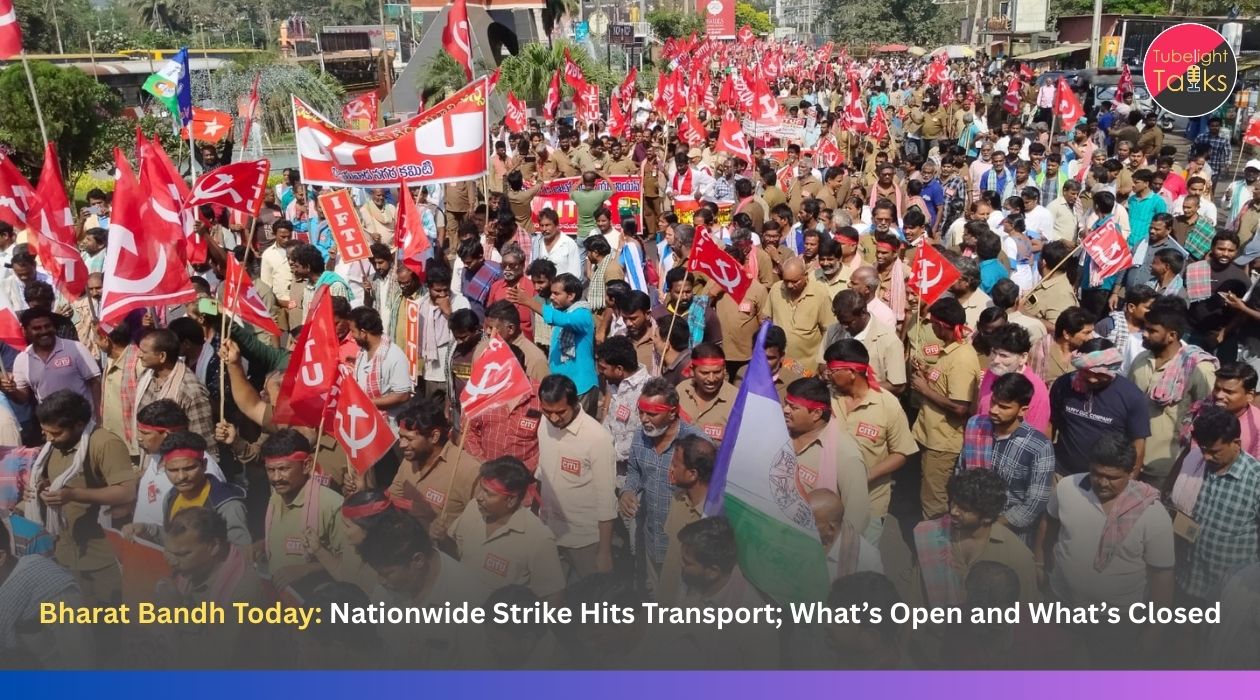
Bharat Bandh Today: Nationwide Strike Hits Transport; What’s Open and What’s Closed
India is observing a nationwide Bharat Bandh today, February 12, 2026, following a general strike call by a joint platform of central trade unions, with support from farmer organisations like the Samyukt Kisan Morcha (SKM). The bandh is being framed around opposition to the new labour codes and other policy issues, including concerns raised about an India–US trade deal, electricity and seed-related bills.
The scale and intensity vary by state, but commuters in several cities are already reporting transport disruptions, while bank customers are being advised to expect limited branch-level impact in some areas.
Bharat Bandh today (12 February 2026): What’s happening and why
Who called the nationwide strike?
The Bharat Bandh is linked to a nationwide strike call by a joint forum of central trade unions, with multiple farmer groups backing the protests. Reports estimate participation could run into tens of crores of workers across sectors, making it one of the largest coordinated industrial actions in recent years.
Key demands driving the protest
While the bandh’s local triggers differ from state to state, the most cited demands include:
- Rollback/scrapping of the four new labour codes (unions argue they dilute worker protections).
- Opposition to the Electricity (Amendment) Bill 2025 and wider concerns about privatisation in power distribution.
- Objections linked to the Seed Bill 2025 and other rural-economy proposals flagged by farmer groups.
- Calls around social security, wages, pensions (including Old Pension Scheme in some narratives), and rural job security concerns (MGNREGA-related).
- Opposition from farmer bodies to aspects of a newly announced India–US trade arrangement, which they say could affect domestic agriculture and procurement.
Live impact snapshot
Transport disruption: where commuters are feeling it most
Transport is the first pressure point in most bandh days, and today is no different. In parts of Punjab, transport workers joining the bandh have affected bus movement locally—Moneycontrol reported bus services being hit in areas such as Moga as transport workers backed the strike call.
In the Northeast, updates also flagged stoppages around key entry/exit points—Moneycontrol reported commercial vehicles being halted at Khanapara as bandh impact reached Guwahati.
State road transport and private bus networks may see uneven operations through the day depending on local participation and law-and-order arrangements, so the most practical approach for commuters is to treat all non-essential travel as “time-buffer required” (leave early, keep alternate routes).
Banks: open on paper, patchy on the ground
One of the biggest questions this morning is “Are banks closed today?” The short answer: there is no blanket “bank holiday” announced for February 12, but branch-level services can be disrupted depending on participation by bank unions and local staffing.
Bank customers should be prepared for slower counter service, delays in cheque clearing, and limited in-branch processing in some places—especially where public-sector bank union participation is stronger. Most reports expect digital banking (UPI, mobile apps, netbanking, cards) to remain functional.
Markets, offices, and daily services
Bandh impact on markets and offices typically depends on whether local trade bodies and transport networks cooperate. Some areas may see partial market closures and thin attendance in government-facing services if employees participate. National-level reports have warned that multiple sectors—banking, insurance, electricity, transport and others—may see partial disruption during the strike window.
Schools and colleges: mostly open, but watch transport-linked closures
There is no single nationwide school-closure order tied to the Bharat Bandh; decisions often depend on state advisories, transport availability, and district-level risk assessments.
In Karnataka, however, the Department of School Education and Literacy has clarified that schools are to function normally today, even as authorities monitor participation by support staff and mid-day meal workers.
Parents are still advised to check individual school messages—especially where private bus/auto services are disrupted—because many schools may switch to late start, allow flexible attendance, or adjust transport routes.
State spotlight: Kerala reports a sharper shutdown effect
Kerala is witnessing a stronger bandh footprint in several districts, with local reporting describing paralysed public transport as KSRTC employees, private bus operators, auto-rickshaw and taxi workers join the strike. Shops and markets were reported closed in many areas.
Notably, Kerala’s government response has also been highlighted: Onmanorama reported the state declared a “dies non” warning and signalled salary deduction for employees who fail to report for duty without valid reasons—an attempt to keep government offices functioning despite the strike call.
What’s open and what’s closed
What’s likely to remain OPEN (and why)
Even on major strike days, essential services are generally kept out of the protest ambit. Multiple reports note emergency services—hospitals, ambulances—are expected to function normally.
Typically open/operational in most places:
- Hospitals, emergency care, ambulance services
- Airports and flights (with possible road delays en route)
- Utilities and essential supply chains (water, basic groceries) though local delivery timing may vary
What may be CLOSED or DISRUPTED (location-dependent)
The bandh’s real-world effect is rarely uniform. Expect “partial disruption” rather than a universal shutdown—except in districts where unions have strong mobilisation and transport is heavily affected.
Most likely to face disruption:
- Public transport: state buses, private buses, shared autos in high-participation zones
- Bank branch operations (especially public-sector branches in some regions)
- Government office footfall and some public-facing counters (variable)
- Local markets/shops in select areas depending on local bandh call compliance
Railways, highways, flights: how to plan travel today
There’s no single advisory that fits all cities on a bandh day—your risk is less about rail/flight operations and more about road access to stations/airports due to blockades, marches, or slow traffic. Hindustan Times specifically urged travellers to check their plans via airline channels or the IRCTC app and factor in possible congestion.
Practical commuter checklist (works in most cities):
- Leave earlier than usual (30–90 minutes buffer depending on city).
- Keep two routes ready (main + alternate).
- Prefer metro/rapid transit where available (less exposed to road blocks).
- If you must drive, keep fuel topped up and avoid protest-heavy junctions.
- For intercity travel, confirm last-mile transport to/from terminals.
Banking: the official notices that matter most today
SBI: “may be affected to a limited extent”
One of the most actionable updates for customers is that banks themselves have flagged possible service impact. Moneycontrol reported that SBI, in a filing to the BSE, said it had been informed (via IBA) about the strike notice and that while arrangements were being made, work “may be affected to a limited extent.”
Separately, Reuters also carried a brief update about SBI flagging the scheduled nationwide bank strike for February 12.
Bank of Baroda: strike notice received, contingency steps underway
Bank of Baroda has also confirmed receipt of a strike notice and warned that branch activities may be affected, even as it takes steps to ensure operations. This was reported in the context of the bank’s regulatory filing.
What bank customers should do (quick wins)
If you have urgent branch work today (cash deposit/withdrawal, cheque-related, KYC updates):
- Call the branch before leaving (or check the bank’s app/alerts).
- Use digital channels for routine tasks—UPI, netbanking, card payments are expected to continue.
- If a branch visit is unavoidable, go early (first half of the day) when staffing is more predictable.
Why labour codes and the India–US trade deal are central to today’s bandh
Labour codes: the core flashpoint
Trade unions argue the new labour codes replaced a large set of older labour laws and weaken worker protections while giving employers more flexibility in hiring and firing. This is a key reason repeatedly cited across reports explaining the strike call.
Also Read: India-US Mega Trade Breakthrough: US Cuts Tariffs on Indian Goods to 18%
Farmers’ angle: SKM’s push for worker–farmer unity
Farmer bodies have linked their support to fears about rural employment, electricity pricing, seed sovereignty, and trade arrangements. In a widely reported quote to ANI, SKM convenor Hannan Mollah called the trade deal “a betrayal against farmers,” as the organisation urged mobilisation.
SKM messaging has also emphasised worker–farmer unity and opposition to policy changes like the Electricity Bill 2025, the Seed Bill 2025, and changes related to rural employment guarantees.
Not everyone is on board: dissenting union voices
It’s also important to note that the strike does not have unanimous support across all unions. PTI reporting carried by The New Indian Express noted that the Trade Union Co-ordination Centre (TUCC) rejected the strike call, calling it ill-conceived and politically motivated—highlighting that today’s bandh also sits within a broader debate about methods and outcomes.
Peaceful protest and responsible living
Sant Rampal Ji Maharaj’s teachings repeatedly emphasise disciplined conduct, non-violence, truthfulness, and social reform—changing society through awareness, right knowledge, and clean actions rather than chaos. In the context of a Bharat Bandh, this lens encourages two things at once: (1) citizens can stand for rights and justice through peaceful, lawful, and compassionate protest, and (2) daily life should be protected by ensuring essential services are not harmed and vulnerable people are not put at risk.
The idea is simple—social change should uplift everyone, not create fear—aligning with the broader “social reforms” focus highlighted in Sant Rampal Ji Maharaj’s public teachings and initiatives.
Take action today: Stay informed, stay safe, and support peaceful civic participation
If you’re stepping out today, plan with patience: confirm local transport availability, keep extra travel time, use digital banking where possible, and follow verified local updates from your school/office and district authorities. If you support the cause, keep it peaceful and lawful—avoid rumours, respect emergency access, and remember that a bandh’s real credibility comes from discipline and dignity, not disruption for disruption’s sake.
And if you’re not participating, treat the day like a “low predictability” commute: protect your schedule, check routes early, and help others (elderly neighbours, patients, students) who may need an extra hand getting through the day smoothly.
FAQs: Bharat Bandh
1) Is Bharat Bandh today a public holiday?
Not automatically. It’s a strike call, so closures depend on local participation and district-level conditions.
2) Are banks closed today (Feb 12, 2026)?
There is no blanket bank holiday, but some branches may face limited service disruption depending on union participation.
3) Will UPI and online banking work during the Bharat Bandh?
Most reports expect digital banking to remain available even if branch operations are slowed in some places.
4) Are schools closed because of Bharat Bandh?
There’s no nationwide closure order. Some states have indicated normal functioning (for example, Karnataka), but parents should check local advisories and school messages.
5) What services usually remain open during a bandh?
Emergency and essential services—hospitals and ambulances—are generally expected to operate normally.
6) What should travellers do today?
Add buffer time, check airline messages, and verify train/route updates via the IRCTC app, because road congestion or blockades can affect last-mile access.
Related Stories




Discussion (0)