Silver Price Today: Silver Eases Near ₹2.68 Lakh/kg After a Volatile Run — Should You Buy the Dip?
Silver price today is slightly lower in early trade on February 12, 2026, after a volatile week that pushed chandi rates close to record territory. One widely tracked reading showed silver around ₹2,68,128 per kg, down about 0.69% from the previous close, while other dashboards reflected a softer all-India benchmark near ₹2,61,940 per kg later in the morning—differences largely explained by timing and the exact market source (spot vs futures vs compiled city rates).
The immediate trigger is global: stronger US jobs data strengthened the dollar and cooled rate-cut expectations, pressuring spot silver.
What happened in the last 12–24 hours
The headline move: a small dip after a hot streak
Silver’s slide today is modest in percentage terms, but it stands out because it comes right after rapid up-and-down swings. Early today, a key market snapshot put silver at about ₹2,68,128 per kg (−0.69%).
At about 11:00 AM IST, another widely used “silver rate today in India” compilation pegged 1 kg at ₹2,61,940 (−0.51%).
That gap doesn’t mean one is “wrong.” It usually comes down to (1) time of capture, (2) whether you’re looking at a futures contract like MCX silver futures or a spot/compiled physical rate, and (3) the methodology used to estimate all-India prices vs exchange prints.
The key trigger: strong US jobs data, stronger dollar, softer metals
Multiple market updates today tied the dip in gold and silver to robust US jobs data, which supported the US dollar and reduced hopes of quick interest-rate cuts. That matters because silver is globally priced in dollars; a stronger dollar often makes commodities feel “costlier” for non-US buyers, dampening demand at the margin.
MCX silver futures: what the exchange contract showed
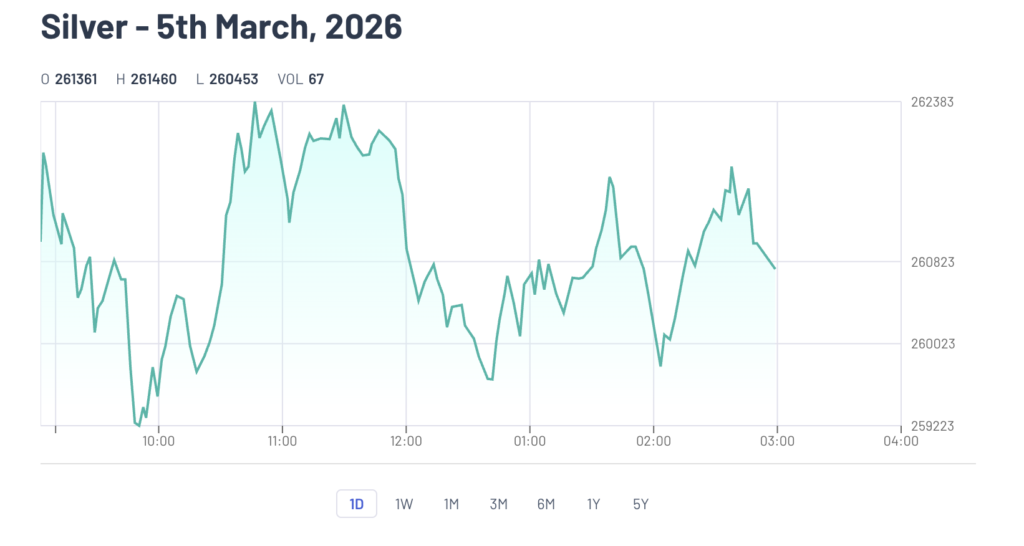
On MCX, one widely cited print for the March 5, 2026 silver futures contract showed a drop of about 1% (down ₹2,565) to ₹2,60,453 per kg in early trade today.
This is why people searching “MCX silver” may see levels closer to ₹2.60 lakh while others searching “silver price in India” may see ₹2.62–₹2.68 lakh depending on source, location, and time.
International spot silver: the $83/oz zone is back in focus
Globally, spot silver was cited around the low-$80s/oz range today, with some reports putting it near ~$82.87 and others referencing ~$83/oz with a ~1% decline.
For Indian investors, this global price action matters because domestic silver rate trends typically mirror international spot moves plus the rupee’s direction and import duty impacts.
IBJA benchmark: why it’s important for “silver rate” watchers
In India, many jewellers and financial institutions track IBJA benchmark rates. IBJA itself describes its gold rates as benchmark rates and notes IBJA gold and silver rates are also used as benchmarks for lending against jewellery as per RBI notifications (as referenced on IBJA’s site).
One market update stated IBJA’s standard price for 1 kg silver was ₹2,66,449 at the 6:30 PM session on Feb 11, after a sharp move in the previous 24 hours.
“Tight supply” headlines are not random: China inventories are a big clue
A major reason silver is behaving like a high-octane asset is supply tightness narratives—especially in Asia. Recent data highlighted that silver available for delivery on the Shanghai Futures Exchange fell to around 350 tonnes, the lowest level since 2015. It cited CEIC data showing inventories at 318.546 tonnes on Feb 9, 2026, down from 349.900 tonnes on Feb 6, 2026, and more than 88% below the 2021 peak.
When inventories shrink that fast, even routine macro triggers (like US jobs data) can produce oversized price swings because the market feels “thin.”
The bigger picture: 2026 is still a deficit year, per industry estimates
Beyond daily noise, industry estimates continue to point toward structural tightness. A Reuters report citing the Silver Institute said the silver market is heading for a sixth consecutive year of structural deficit in 2026, with a preliminary deficit estimate of 67 million troy ounces, alongside expectations of rising retail investment demand.
That’s the core tug-of-war: macro pressure (rates/dollar) vs physical tightness (inventory/deficit).
Should you invest now?
First, decide what “silver investment” means for you
When someone asks, “Is this a dip-buying opportunity?”, the honest answer depends on your goal. Silver behaves differently based on why you own it:
- Portfolio hedge (diversification vs inflation/geopolitics)
- Tactical trade (short-term moves in MCX silver futures)
- Consumption need (jewellery/silverware purchase timing)
- Theme bet (EVs/solar/electronics demand narrative)
Silver price today is not just a “metal price.” It’s a mix of precious-metal sentiment and industrial-metal reality—which is why it can rise fast and fall fast.
Why silver is more volatile than gold (and why that matters today)
Gold is mostly monetary/hedge demand; silver is both investment and industrial. Reuters lists silver uses across jewellery, electronics, EVs, and solar panels.
That dual identity amplifies volatility:
- If global growth looks shaky → industrial demand worries can hit silver.
- If inflation/geopolitics rise → safe-haven demand can lift silver.
- If supply is tight → small demand changes create large moves.
So, if your temperament doesn’t tolerate big swings, the “best time” is rarely “right now.” The better plan is staged buying.
Also Read: India’s Foreign Exchange Reserves Mark Strong Upturn Amid Global Uncertainty
The levels traders watch (support/resistance) — and what they mean for investors
One market readout placed near-term support around ₹2,54,115 and resistance around ₹2,68,545, noting that a sustained move above resistance could lift prices further while a break below support could invite deeper downside.
How to use that information without becoming a full-time trader:
- If you’re buying physical silver (coins/bars): use levels to pace purchases instead of chasing spikes.
- If you’re using ETFs: levels help you avoid lump-sum entries on euphoric days.
- If you’re trading futures/options: levels are only step one—risk limits matter more.
Best ways to invest in silver in India (ranked by simplicity)
1) Silver ETFs (simple, transparent, no storage headache)
For many retail investors, Silver ETFs are a practical route because they avoid storage and purity concerns. SEBI’s framework discussion for Silver ETFs highlighted that ETFs can reduce worries about “storage and purity,” and specified that physical silver exposure can be through 30 kg bars of 99.9% purity conforming to LBMA good delivery standards.
Why this matters: when you buy a regulated ETF, you’re outsourcing purity, vaulting, and audit processes to a regulated structure.
What to watch:
- Tracking error and expenses (ETFs aren’t free)
- Liquidity (bid-ask spread)
- Whether your holding period is long enough to justify costs
2) Physical silver (coins/bars) for long-term holders
If your goal is tangible ownership, physical silver is fine—just treat it like a “real asset,” not a quick trade.
Practical checklist:
- Buy from reputed sellers, insist on bill/invoice and purity marking
- Store safely (bank locker/secure vault)
- Factor in indirect costs: GST and making charges
IBJA’s rates page explicitly notes that published rates can be without 3% GST and making charges, which is a reminder that your “actual buy price” can be higher than the headline.
3) Digital silver (convenient, but read the fine print)
Digital silver is convenient for small tickets and recurring buys, but quality varies by platform. Before you commit, confirm:
- Is it backed by allocated physical silver?
- Are there storage fees?
- Can you take delivery, and what are charges?
- What is the spread between buy and sell?
If those answers are unclear, prefer ETFs or physical.
4) MCX silver futures and options (powerful, but high risk)
This is where many people get hurt. Futures are leveraged instruments; small price moves can create outsized P&L swings.
SEBI’s commodity derivatives FAQ explains that futures are standardized exchange contracts to buy or sell a specified amount of an underlying at a future date for a price agreed today.
And MCX’s own investor “do’s & don’ts” emphasise process discipline—like insisting on a contract note with full trade details and understanding your rights and duties.
If you’re not ready to track margins daily, futures are not “investment,” they’re “active trading.”
What’s driving “silver rate today” day-to-day (your quick decoder ring)
If you want a practical way to read daily moves, track these five factors:
- US dollar index & yields (strong dollar often pressures silver)
- US inflation data / Fed expectations (rate-cut hopes can boost metals)
- China inventory and import/export flow (tight stocks can squeeze prices)
- Industrial demand narratives (solar/EV/electronics cycles)
- India-specific factors: rupee moves + import duties + local premiums/discounts (physical market dynamics)
If you’re buying for jewellery or household needs: timing matters differently
For consumers, the question isn’t “Will silver rally?” It’s “Do I need to buy now?”
- If you have a near-term function/purchase: lock partial quantity and leave the rest flexible.
- If you can wait: use staggered buying across days to reduce regret.
In other words, for consumption, the best strategy is not prediction—it’s risk-reduction.
A sensible “dip-buying” plan (without giving financial advice)
If you’re considering silver investment now, here’s a conservative framework:
- Rule 1: Don’t go all-in on one day.
Silver can swing hard; today’s small dip could be followed by another big move. - Rule 2: Define your holding period.
If it’s less than 3–6 months, you’re speculating more than investing. - Rule 3: Pick one clean vehicle.
If you want simplicity → Silver ETF.
If you want possession → physical silver.
If you want to trade → futures (with strict risk limits). - Rule 4: Size it right.
Treat silver as a satellite allocation, not your whole portfolio.
The real meaning of “value” in a precious-metal rush
When silver prices swing wildly, the biggest danger is not the dip—it’s the emotion: greed while buying and fear while selling. Sant Rampal Ji Maharaj’s teachings, rooted in Sat Gyaan, repeatedly caution against coveting wealth and encourage contentment with rightful earnings. One teaching page states that a person should consider their destined wealth sufficient, refrain from greed, and not covet others’ wealth.
In the same spirit, the Bhagavad Gita commentary on this platform warns that greed is spiritually harmful and should be abandoned. Applied to silver investment, the message is practical: build wealth ethically, avoid “get rich quick” thinking, and choose steady, disciplined steps (like staged buying) over impulsive speculation.
Take action: Track the right signals and invest in silver with discipline
If you’re planning to act on silver price today, do three things before you buy: (1) check whether the move is in global spot silver or just a local premium shift, (2) compare MCX silver futures with your preferred buying route (ETF/physical/digital), and (3) write down your holding period and allocation limit so you don’t improvise under volatility.
For safer participation, prefer regulated products and official guidance—SEBI’s material on commodity derivatives and ETF norms can help you understand what you’re buying, while MCX’s client awareness points reinforce basic trade hygiene.
FAQs: Silver Price Falling
1) Why is silver price today falling after rising recently?
Today’s dip is being linked to strong US jobs data strengthening the dollar and cooling rate-cut expectations, which can pressure precious metals.
2) Why do different sites show different silver rates (₹2.61 lakh vs ₹2.68 lakh)?
Differences usually come from timing and whether the rate is from MCX futures, spot, or compiled physical/city benchmarks.
3) What are key support and resistance levels for silver right now?
One market update cited near-term support near ₹2,54,115 and resistance near ₹2,68,545, with scenarios mapped for breaks on either side.
4) Is the global silver supply really tight?
Recent data showed SHFE deliverable silver around 350 tonnes (lowest since 2015) and inventories falling sharply versus 2021 peaks, reinforcing tightness headlines.
5) What’s the safest way for beginners to invest in silver in India?
For many beginners, Silver ETFs can be simpler than physical storage, and SEBI’s framework highlights regulated physical standards (99.9% purity, LBMA good delivery).
6) Are commodity derivatives like silver futures risky?
Yes. SEBI explains futures as standardized contracts and MCX advises process discipline like ensuring proper contract notes and understanding rules—both underscore that derivatives require active risk management.
Related Stories









Discussion (0)