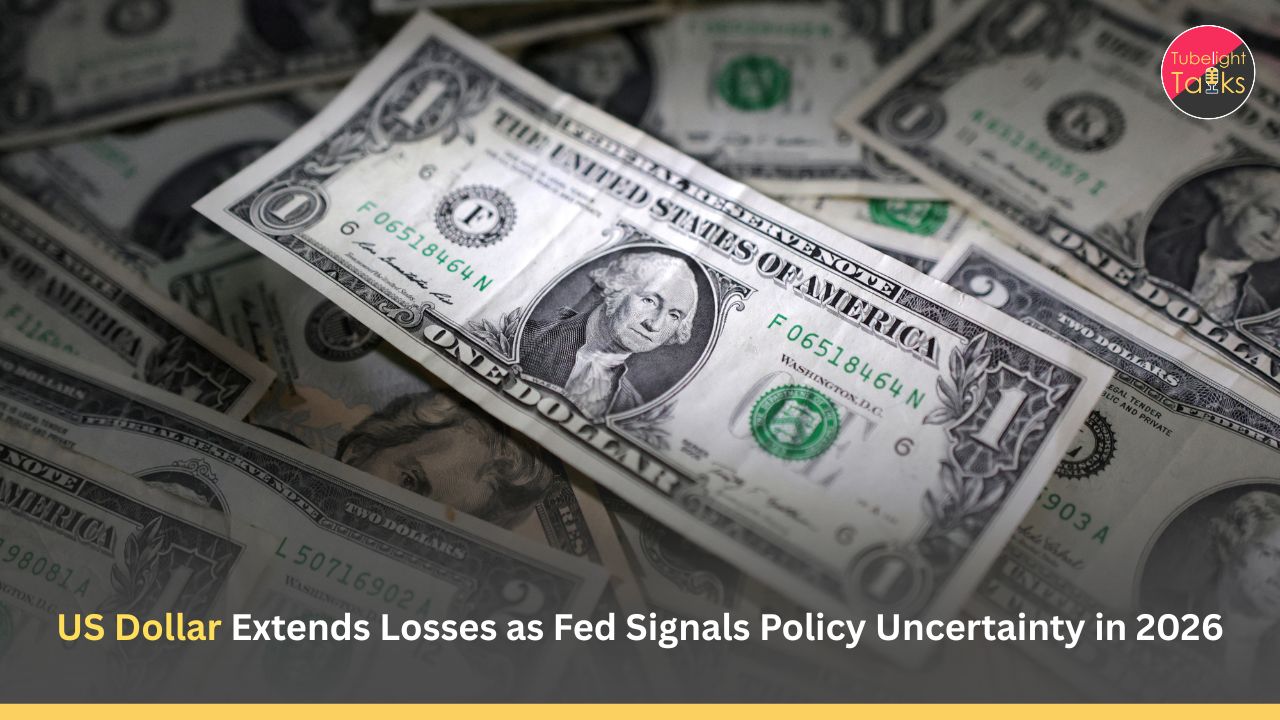
US Dollar Extends Losses as Fed Signals Policy Uncertainty in 2026
The US Dollar extends losses on February 14, 2026, following fresh comments from Federal Reserve officials that signaled continued uncertainty over future interest rate policy. The greenback weakened against major currencies including the euro, Japanese yen, and British pound, triggering renewed volatility in global financial markets. Analysts are now debating whether the US dollar’s decline represents a short-term correction or the beginning of a broader structural shift in global currency leadership.
Dollar Index Slides Further
The US Dollar Index (DXY) fell nearly 1.6% during early Asian trading hours, reaching its lowest level since late 2023.
Key currency movements:
- EUR/USD rose to 1.18
- USD/JPY dropped to 136.90
- GBP/USD strengthened to 1.34
Currency traders reported heavy selling pressure following cautious remarks from Federal Reserve officials during a closed-door economic briefing.
Federal Reserve’s Mixed Signals
Recent US economic data showed inflation hovering near 4.8%, higher than the Fed’s 2% target. At the same time, labor market growth appears to be slowing.
Fed Chair Jerome Powell stated in a recent address:
“We remain data-dependent and cautious. The path forward is not yet clear.”
This lack of clarity has unsettled investors who were expecting clearer signals regarding interest rate cuts.
Also Read: US Dollar Falls Sharply in Global Forex Markets Amid Economic Concerns
Impact on Global Markets
Gold and Oil Rise
- Gold prices surged 2.1%, reaching $2,105 per ounce.
- Crude oil climbed 1.8% amid currency fluctuations and Middle East tensions.
- US stock futures dipped slightly as bond yields adjusted upward.
Emerging Markets React
Emerging economies experienced mixed effects:
- The Indian rupee weakened slightly, increasing pressure on import bills.
- Export-heavy economies like Vietnam saw temporary advantages due to a softer dollar.
Central banks in Asia are reportedly monitoring currency stability closely.
Why Investors Are Concerned
Some analysts suggest the dollar’s weakening trend may reflect:
- Reduced confidence in US fiscal stability
- Diversification into euro and yuan reserves
- Growing interest in BRICS-led financial initiatives
If sustained, this could challenge the dollar’s traditional dominance as the world’s reserve currency.
What This Means for Businesses and Consumers
A weaker dollar has several implications:
- US imports become more expensive, fueling inflation.
- Exports become more competitive, helping American manufacturers.
- Global commodity pricing may remain volatile.
For everyday consumers, the effects are felt through fuel prices, food costs, and fluctuating stock markets.
Ethical Finance and Stability: A Deeper Reflection
Economic instability often exposes more than financial weakness—it highlights the importance of ethical discipline, transparency, and responsible leadership. When markets are driven by excessive speculation, short-term gains, and policy ambiguity, volatility becomes inevitable.
Spiritual teacher Sant Rampal Ji Maharaj emphasizes that sustainable prosperity requires moral responsibility in both governance and personal conduct. According to His teachings, economic systems built on fairness, honesty, and restraint create long-term stability, while greed and corruption sow the seeds of crisis.
Such value-based principles, when practiced collectively, can strengthen institutions and reduce recurring financial turmoil.
Call to Action
Currency markets may fluctuate, but discipline and awareness protect individuals and societies.
Diversify investments wisely and stay updated with credible economic insights.
Advocate for transparency and accountability in financial governance.
In volatile times, resilience comes not just from strategy—but from values.
FAQs on US Dollar Extends Losses – February 2026
Q1. Why is the US dollar weakening in February 2026?
Due to Federal Reserve policy uncertainty, persistent inflation, and mixed economic growth indicators.
Q2. How does this impact global markets?
It increases forex volatility, affects commodity prices like gold and oil, and influences emerging market currencies.
Q3. Will the Federal Reserve cut interest rates soon?
The Fed has indicated it remains data-dependent, offering no clear timeline yet.
Q4. How does a weak dollar affect consumers?
It can increase import prices and contribute to inflation, but may boost exports.
Q5. Is the dollar losing its global dominance?
Some analysts suggest diversification trends may challenge dominance, but it remains the primary reserve currency.
Q6. How can individuals prepare for currency volatility?
By staying informed, diversifying assets, and focusing on long-term financial planning with ethical considerations..
Related Stories










Discussion (0)