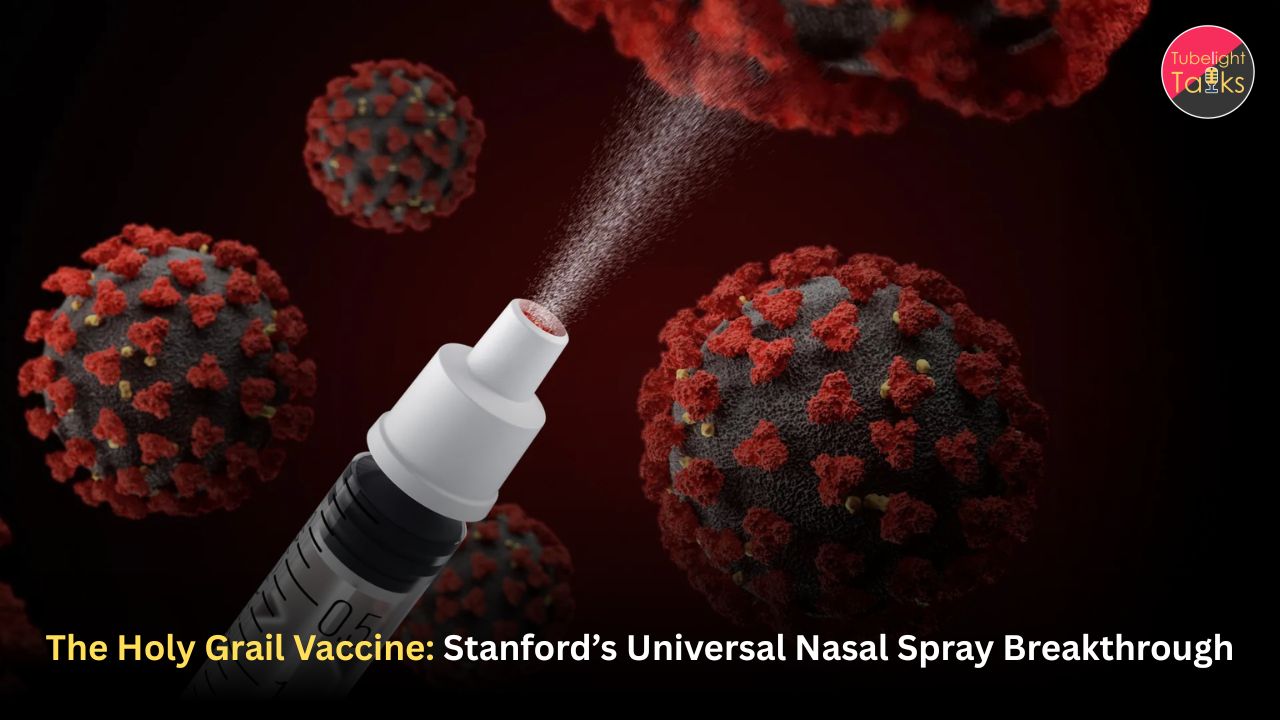
The Holy Grail Vaccine: Stanford’s Universal Nasal Spray Breakthrough
Holy Grail Vaccines have long been designed to train the immune system against one specific pathogen at a time. But researchers at Stanford Medicine have introduced a radically different idea—one that could transform global immunization strategies. Instead of mimicking a virus, their experimental nasal spray mimics the signals immune cells use to communicate and coordinate defense.
Early results in preclinical trials show broad protection against multiple respiratory viruses, harmful bacteria, and even allergens for several months. If these findings hold in human trials, this innovation could dramatically reduce reliance on annual booster shots and enhance preparedness for future pandemics.
Why Traditional Vaccines Need Constant Updating
The challenge of virus mutation
Influenza viruses mutate rapidly, which is why flu vaccines must be reformulated annually. Similarly, COVID-19 variants required updated booster strategies. Traditional vaccines work by teaching the immune system to recognize specific viral proteins. When those proteins change, protection weakens.
The pandemic lesson
The COVID-19 pandemic exposed a major limitation in global vaccine systems: speed. Even with rapid development, mass production and distribution take months. By the time vaccines are widely deployed, variants may already have emerged.
A universal approach that strengthens general immune defense—rather than targeting one virus—could close this vulnerability gap.
What Makes Stanford’s Approach Different
Mimicking immune communication, not pathogens
The Stanford team’s innovation does not introduce weakened viruses or fragments of specific pathogens. Instead, it mimics the molecular “signals” immune cells naturally use to activate broad protective responses.
In essence, rather than preparing the body for one intruder, the nasal spray activates a wider defensive state in respiratory tissues. This could offer temporary but powerful protection against a variety of airborne threats.
Delivered directly to the respiratory system
Unlike traditional injections, this vaccine is administered as a nasal spray. That matters because most respiratory infections enter through the nose and upper airway.
By stimulating immunity at the entry point, the spray may stop infections before they spread deeper into the lungs.
Early Trial Results: Why Scientists Are Calling It Astonishing
Preclinical trials reportedly showed:
- Broad protection against multiple respiratory viruses
- Defense against certain harmful bacteria
- Reduced allergic inflammation
- Protection lasting several months after administration
This kind of cross-protection is rare in traditional vaccine science. Instead of reacting to a single threat, the immune system appears to enter a heightened state of readiness.
What This Could Mean for Global Health
Fewer annual boosters
If human trials confirm the findings, this nasal spray could reduce the need for yearly flu shots and repeated COVID boosters. Instead, people might receive periodic immune “boosts” that protect against a range of threats.
Faster pandemic response
In the face of a new respiratory virus, a universal nasal spray could serve as an immediate defensive shield—buying time while specific vaccines are developed.
Accessibility and ease
Nasal sprays are easier to administer than injections. They require less training, reduce needle-related fear, and may improve vaccination rates—especially among children.
Also Read: Pan Coronavirus Vaccine Breakthrough by Indian Scientists
Scientific Caution: What Still Needs to Happen
While the results are promising, several steps remain before public use:
- Human clinical trials for safety and efficacy
- Regulatory approvals
- Large-scale manufacturing validation
- Monitoring for unintended immune overactivation
The immune system is powerful but delicate. Overstimulating it could cause inflammation or unintended side effects. Careful testing is essential.
A Shift in Vaccine Philosophy
This research represents a philosophical shift in immunology: from pathogen-specific defense to immune-environment conditioning.
Instead of chasing every mutation, scientists may focus on strengthening the body’s natural protective communication pathways. This approach could also inspire new treatments for autoimmune disorders or allergic conditions.
Why This Story Is Trending
At a time when global headlines are dominated by geopolitical tensions and economic shifts, a scientific breakthrough offering pandemic resilience feels unifying.
The promise of a universal nasal spray vaccine touches on shared human concerns: health, safety, and preparedness. It represents collaboration, innovation, and hope—qualities that transcend borders.
The Broader Lesson: Strengthening from Within
Modern medicine constantly evolves, but one timeless principle remains: resilience begins from within. In spiritual teachings shared by Sant Rampal Ji Maharaj, emphasis is placed on strengthening the inner self—building stability, discipline, and awareness to face life’s challenges.
Just as this nasal spray seeks to activate the body’s internal defense communication system, true well-being also requires internal alignment and balance. External solutions protect us physically, but inner strength protects us emotionally and spiritually.
Scientific progress and spiritual awareness both point to the same truth: preparation and resilience are more powerful than reaction alone.
FAQs: Stanford’s Holy Grail Vaccine
1. What is unique about Stanford’s nasal spray vaccine?
It mimics immune communication signals instead of targeting a specific virus.
2. How is it administered?
It is delivered as a nasal spray rather than an injection.
3. What did early trials show?
Broad protection against multiple respiratory viruses, bacteria, and allergens for several months.
4. Is it available for public use?
No. Human clinical trials and regulatory approval are still required.
5. Could it replace annual flu shots?
If successful in human trials, it may reduce the need for yearly booster vaccinations.
Related Stories










Discussion (0)