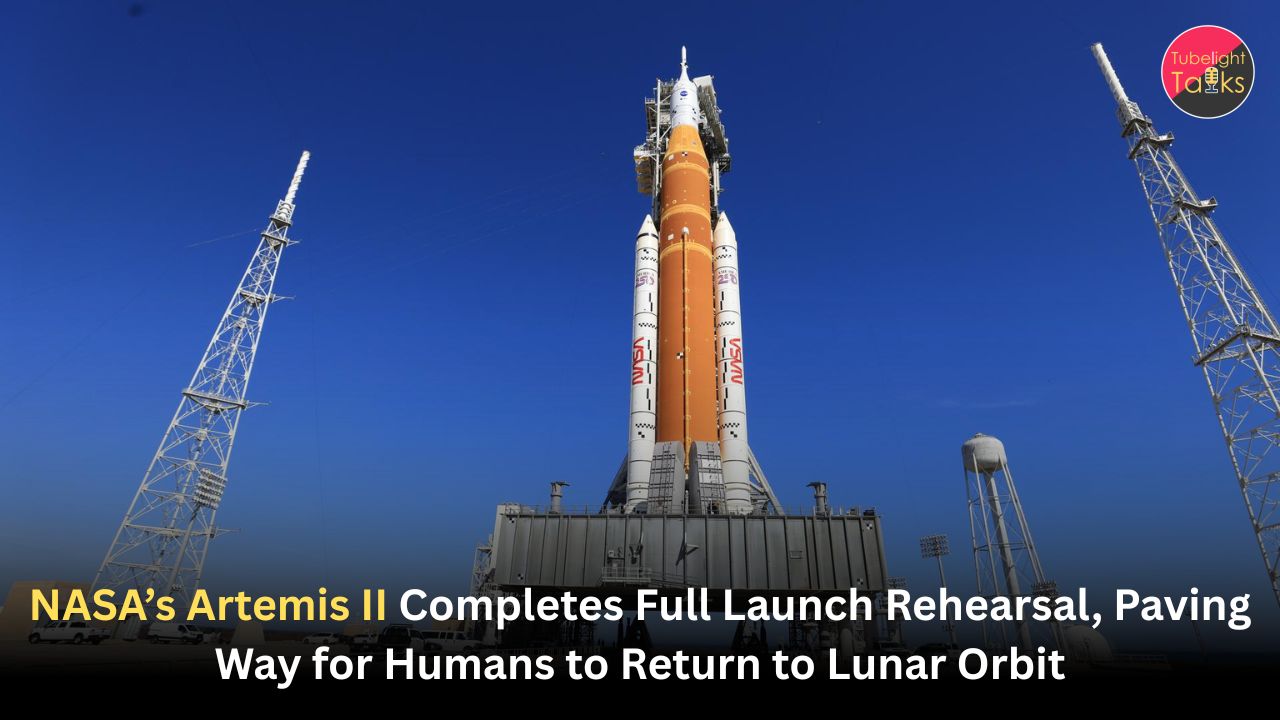
NASA’s Artemis II Success: One Step Closer to the Moon
NASA’s Artemis II Launch Rehearsal: More than five decades after the Apollo era, NASA is preparing to send humans back around the Moon. The recent successful full launch rehearsal for Artemis II marks a critical milestone in that journey. This rehearsal validated key systems—including the Orion spacecraft’s life support and mission operations protocols—ensuring readiness for the first crewed lunar mission of the Artemis program.
Unlike Artemis I, which was uncrewed, Artemis II will carry astronauts on a journey around the Moon and back to Earth. The achievement signals not just technological readiness, but a renewed era of human deep-space exploration.
What Is Artemis II?
The second step in NASA’s Artemis program
Artemis II is part of NASA’s broader Artemis program, designed to establish a sustainable human presence on the Moon.
- Artemis I (2022): Uncrewed test flight around the Moon.
- Artemis II: First crewed mission, sending astronauts on a lunar flyby.
- Artemis III: Planned mission to land astronauts on the lunar surface.
Artemis II serves as the bridge between robotic testing and human lunar return.
The Importance of the Full Launch Rehearsal
Testing every system before liftoff
A full launch rehearsal simulates the entire countdown process—from fueling the rocket to validating spacecraft communications and environmental controls.
For Artemis II, this rehearsal confirmed:
- Orion’s life support systems are operational
- Crew environmental controls are functioning
- Launch pad coordination procedures are aligned
- Emergency protocols are in place
Such rehearsals reduce risk by identifying potential weaknesses before astronauts board the spacecraft.
Why life support matters most
Unlike uncrewed missions, Artemis II will carry humans. Life support systems must maintain breathable air, proper pressure, temperature control, and waste management for days in deep space.
A successful rehearsal indicates NASA is confident in Orion’s ability to sustain human life during the mission.
Why This Mission Is Historically Significant
First crewed lunar orbit since Apollo
The last time humans traveled beyond low Earth orbit was during the Apollo missions in the early 1970s. Artemis II will mark the first time in over 50 years that astronauts leave Earth’s immediate neighborhood for lunar orbit.
This is not simply a symbolic return—it represents technological evolution. Modern spacecraft incorporate advanced computing, materials science, and safety systems unimaginable during Apollo.
A stepping stone to Mars
NASA’s long-term goal includes human missions to Mars. The Moon serves as a testing ground for deep-space living, resource utilization, and sustainable exploration systems.
Artemis II is a proving ground for those ambitions.
Global Collaboration and Unity
The Artemis program includes international partnerships. Agencies from Europe, Canada, and other nations contribute technology and expertise.
Space exploration often transcends geopolitical divisions, offering a shared human aspiration: exploration beyond Earth.
In times of global tension, the sight of a rocket launching toward the Moon reminds humanity of its collective potential.
Technological Advances in Artemis II
Compared to Apollo-era missions, Artemis II features:
- Advanced avionics and digital navigation systems
- Enhanced radiation protection
- Improved propulsion technologies
- Expanded mission data transmission capabilities
These upgrades enhance safety and mission flexibility.
The Emotional Power of Returning to the Moon
For many, the Moon landings symbolize human courage and innovation. A new generation will now witness astronauts once again traveling around our nearest celestial neighbor.
The mission carries not just scientific value but cultural significance—rekindling curiosity about space science among students worldwide.
The Bigger Vision: Becoming a Multi-Planetary Species
Artemis II is not an endpoint. It is preparation for sustained lunar presence, scientific research, and eventually, interplanetary travel.
Human survival and advancement may one day depend on expanding beyond Earth. Each successful rehearsal brings that possibility closer.
Exploration Outside, Reflection Inside
Space exploration pushes physical boundaries, but it also invites reflection. In spiritual teachings shared by Sant Rampal Ji Maharaj, the vastness of the universe is described as a reminder of human humility and responsibility. Just as astronauts prepare meticulously before leaving Earth, individuals are encouraged to prepare their inner selves with discipline and awareness.
Technological progress expands our reach into space; spiritual awareness deepens our understanding of purpose. Both journeys require courage, preparation, and clarity.
FAQs: NASA’s Artemis II Launch Rehearsal
1. What is Artemis II?
It is NASA’s first crewed mission of the Artemis program, sending astronauts around the Moon.
2. Has the Moon been visited by humans recently?
No. Artemis II will be the first crewed lunar orbit mission in over 50 years.
3. What was tested in the recent rehearsal?
Launch procedures, life support systems, and spacecraft readiness.
4. Why is the Moon important for future missions?
It serves as a testing ground for technologies needed for Mars exploration.
5. When will Artemis II launch?
NASA will announce the final launch schedule after completing all readiness checks.
Related Stories










Discussion (0)