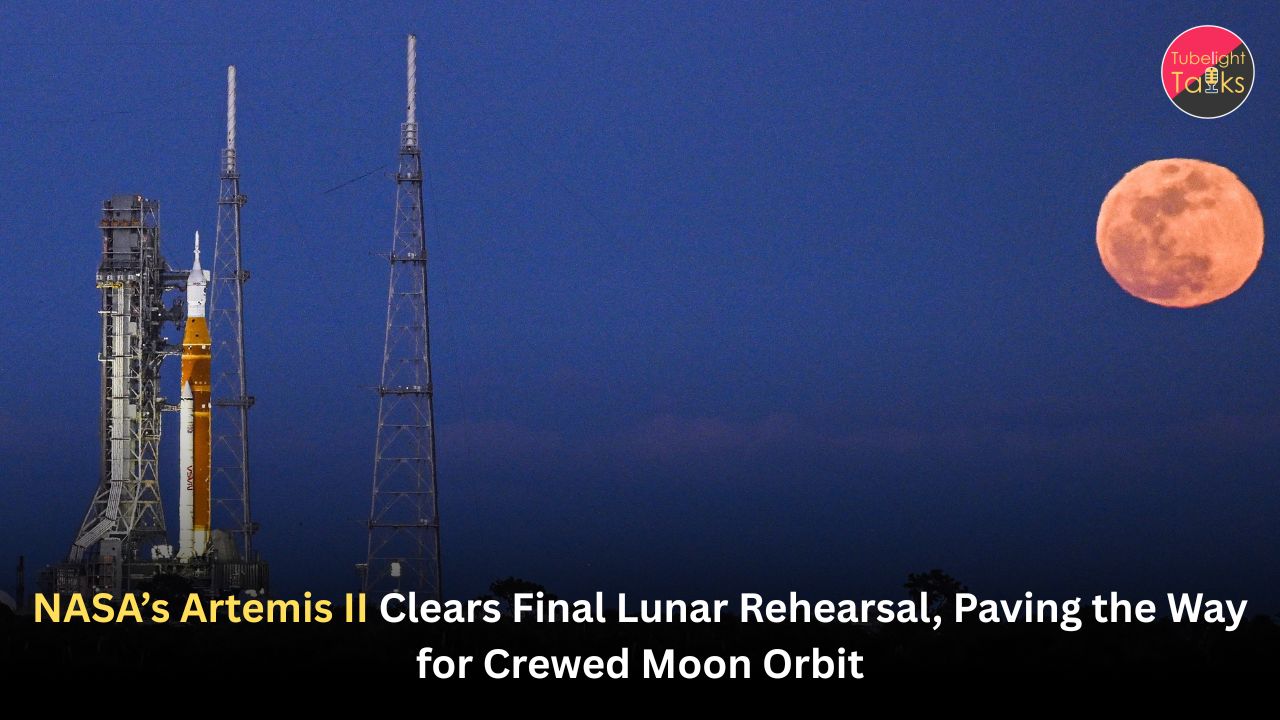
NASA’s Artemis II Success: A Flawless Lunar Rehearsal
Artemis II Final Lunar Rehearsal: In a major milestone for global space exploration, NASA has successfully completed the final full-scale integrated rehearsal for the Artemis II mission. This rehearsal simulated every critical phase of launch and mission operations, validating the readiness of the Space Launch System (SLS) rocket, the Orion spacecraft, and onboard life-support systems.
The data collected during the simulation reportedly met all mission expectations, confirming that the first crewed lunar orbit mission in over five decades remains on schedule. As nations face geopolitical tensions on Earth, this progress toward deep space exploration stands as a unifying symbol of human curiosity and scientific determination.
What Is Artemis II?
A historic return to lunar orbit
Artemis II is NASA’s first crewed mission under the Artemis program. Unlike Artemis I – which was uncrewed – Artemis II will carry four astronauts on a journey around the Moon and back to Earth.
The mission marks the first time humans will orbit the Moon since the Apollo era ended in 1972.
The crew
The mission will carry four astronauts representing both NASA and international collaboration, reflecting a renewed spirit of global partnership in space exploration.
This mission is not a lunar landing, but it serves as a crucial test flight before future Artemis missions aim to return astronauts to the lunar surface.
The Full-Scale Integrated Rehearsal
Simulating launch day
The rehearsal replicated actual launch conditions, including fueling procedures, countdown sequences, system diagnostics, and life-support functionality.
Engineers tested how the rocket, spacecraft, and ground systems interact under real-world stress conditions. This ensures that no component is operating in isolation – every subsystem must perform as one unified structure.
Life-support systems validated
Perhaps the most critical aspect of the rehearsal was verifying the Environmental Control and Life Support System (ECLSS).
This system ensures astronauts have breathable air, stable cabin pressure, temperature control, and safe waste management during the mission. Confirmation that these systems are “go” significantly reduces mission risk.
Also Read: NASA’s Artemis II Success: One Step Closer to the Moon
Why This Is a Major Milestone
Precision engineering at its best
Modern lunar missions require millions of coordinated components. A flawless rehearsal suggests that years of engineering design, simulations, and component testing are aligning successfully.
It reflects the maturation of next-generation deep-space hardware capable of supporting human life beyond low Earth orbit.
Confidence for launch timeline
Positive rehearsal data means fewer technical unknowns. While space missions always involve risk, successful simulations strengthen confidence that Artemis II can proceed as planned later this year.
A Symbol of Global Unity
In times when global headlines often focus on trade disputes and political tensions, space exploration offers a rare collective aspiration.
The Artemis program involves partnerships with international space agencies and symbolizes cooperation beyond borders.
Returning to lunar orbit is not only a scientific milestone – it is a reminder of humanity’s shared curiosity and ambition.
The Road Ahead
Following the rehearsal success, NASA teams will:
- Conduct final system evaluations
- Review simulation data in detail
- Prepare the spacecraft for the official launch window
If all remains on track, Artemis II will serve as the gateway to future lunar landings under Artemis III and beyond.
The Bigger Meaning of Exploration
Human exploration has always required courage, discipline, and unity. In spiritual teachings shared by Sant Rampal Ji Maharaj, determination guided by wisdom is emphasized as essential for meaningful progress. Just as astronauts prepare rigorously before venturing into space, humanity must align purpose with responsibility.
Space exploration reflects not only technological achievement but also collective aspiration – proof that when humanity focuses on discovery rather than division, extraordinary progress becomes possible.
FAQs: Artemis II Final Lunar Rehearsal
What is Artemis II?
NASA’s first crewed mission of the Artemis program, orbiting the Moon and returning to Earth.
What did the rehearsal confirm?
That life-support systems, spacecraft controls, and rocket operations are functioning as expected.
Will Artemis II land on the Moon?
No. It will orbit the Moon and return, serving as a test mission before future landings.
When is the launch expected?
Later this year, pending final evaluations and approvals.
Why is this mission significant?
It marks the first crewed lunar orbit in more than 50 years, symbolizing renewed human exploration beyond Earth.
Related Stories










Discussion (0)