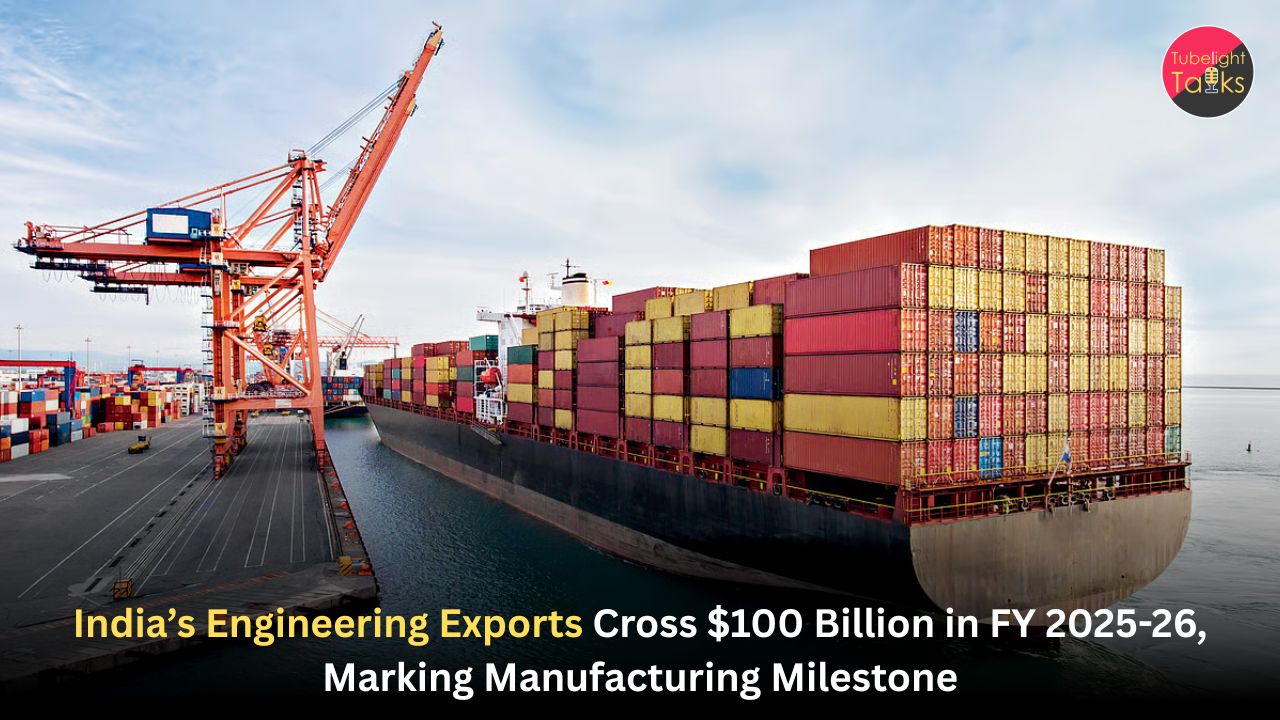
Engineering Exports Cross Record $100 Billion Mark
India’s engineering sector has achieved a historic milestone, with exports surpassing the $100 billion mark within the first 10 months of the current fiscal year (2025-26). The growth, reported at approximately 4.5% year-on-year, reflects rising global demand for Indian-manufactured machinery, automobile components, and industrial equipment.
This achievement underscores India’s transformation from a services-dominated economy toward a stronger manufacturing and export-driven model. At a time when global trade remains volatile, crossing this benchmark signals resilience, competitiveness, and increasing trust in Indian engineering capabilities.
Breaking Down the Numbers
$100 Billion in 10 Months
Reaching the $100 billion milestone before the fiscal year’s end highlights the sector’s sustained momentum.
A 4.5% year-on-year growth may appear modest, but in a challenging global trade environment, steady expansion reflects stability and market strength.
Key contributors
The export growth has been driven primarily by:
- High-end industrial machinery
- Automobile components
- Electrical equipment
- Heavy engineering goods
- Process plant equipment
These segments indicate a shift toward higher-value manufacturing rather than low-cost bulk exports.
Also Read: MSME Export Surge 2025 Glory: From Local Looms to Global Leaders
Why This Milestone Matters
Strengthening “Make in India”
The achievement reinforces the government’s push to expand domestic manufacturing under flagship industrial initiatives.
Indian factories are increasingly producing goods that meet international quality standards, allowing them to compete globally.
Diversification of export basket
India’s export portfolio is gradually moving beyond traditional sectors into advanced engineering categories.
This diversification enhances resilience against sector-specific global downturns.
Global Market Expansion
Strong demand in key markets
Indian engineering goods are finding growing demand in:
- North America
- Europe
- Middle East
- Southeast Asia
Strategic trade agreements and improved logistics infrastructure have contributed to smoother export operations.
Supply chain realignment benefits
As global companies diversify supply chains, India has positioned itself as a reliable manufacturing alternative.
Competitive pricing, skilled labor, and improved production standards support this shift.
Impact on Employment and Economy
Job creation
The engineering and manufacturing sectors collectively generate millions of direct and indirect jobs. Increased exports often lead to capacity expansion and workforce growth.
Strengthening MSMEs
Many small and medium enterprises (MSMEs) operate within engineering supply chains. Export growth benefits these businesses, enhancing financial stability at the grassroots level.
Why This Story Is Trending
Crossing the $100 billion mark is more than a statistical milestone—it symbolizes India’s industrial maturity.
In an era of global economic uncertainty, steady export growth reflects policy stability, industrial competence, and market adaptability.
Industry leaders describe it as one of the most significant manufacturing achievements of the fiscal year.
A Reflection on Productive Growth
Sustainable prosperity arises from honest effort and disciplined production. In spiritual teachings shared by Sant Rampal Ji Maharaj, earning through integrity and constructive work is emphasized as a pathway to balanced progress. When industries expand responsibly and provide livelihoods, growth benefits not just corporations but entire communities.
India’s engineering export milestone reflects this principle—progress rooted in productivity and dedication.
FAQs: India’s Engineering Exports Cross $100 Billion
1. How much have India’s engineering exports reached?
They have crossed $100 billion in the first 10 months of FY 2025-26.
2. What is the growth rate?
Approximately 4.5% year-on-year.
3. Which sectors drove the growth?
Machinery, automobile components, electrical equipment, and heavy engineering goods.
4. Why is this milestone significant?
It reflects India’s transition toward a manufacturing and export-driven economy.
5. How does this impact employment?
Higher exports often lead to increased production capacity and job creation.
Related Stories










Discussion (0)