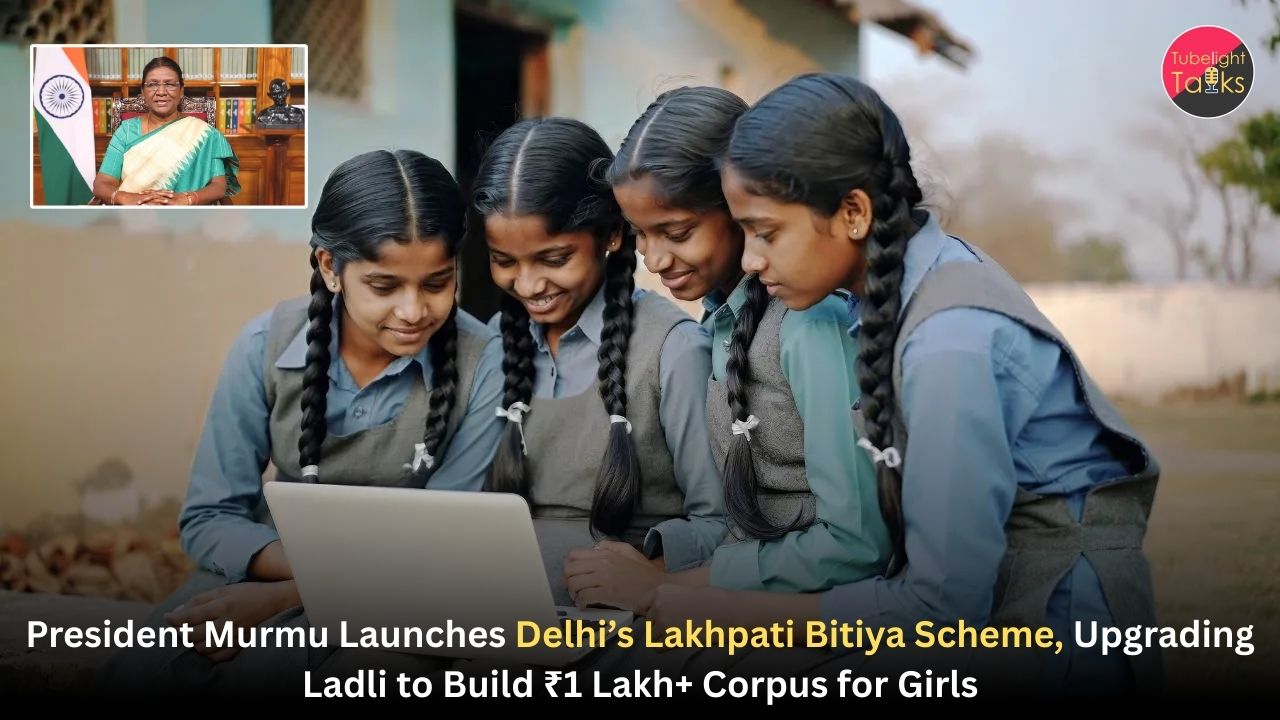
President Murmu Launches Lakhpati Bitiya Scheme for Delhi’s Daughters
Delhi’s biggest message today isn’t symbolic – it’s structural. At a mega programme titled “Sashakt Nari, Samriddh Delhi” at the Indira Gandhi Indoor Stadium, President Droupadi Murmu is launching the Delhi Lakhpati Bitiya Scheme, a redesigned version of the 2008 Ladli scheme.
The upgraded model aims to create a long-term savings corpus for girls, linked to school and higher-education milestones, with phased government deposits that can mature to over ₹1 lakh.
At a time when education costs and household stress can force girls out of opportunity early, this scheme is being discussed as a rare “prevention-first” social security net.
Why Delhi Needed a Stronger “Girl Child Corpus” Policy
The quiet crisis: dropout pressure hides inside family budgets
For many low-income families, the “cost of a daughter’s education” is not a single bill – it’s an accumulating pressure: transport, books, uniforms, coaching, exam fees, devices, and the opportunity cost of a girl not working early. The tragedy is that when money gets tight, education becomes negotiable, and girls are often the first to be asked to compromise.
Delhi’s new scheme tries to confront this reality with a blunt tool: cash support that grows with time, held in the girl’s name, linked to her progress through school and higher education.
Ladli had a promise – but execution gaps created a backlog
One of the most important reasons the scheme was overhauled is what the Delhi government itself said it discovered: over 1.86 lakh maturity accounts under the earlier Ladli scheme were lying unclaimed – money that existed on paper but didn’t reach beneficiaries on time.
That backlog became a credibility issue. The upgraded plan, therefore, isn’t only about increasing amounts – it’s also about cleaning old delays, shifting to a more trackable system, and ensuring delivery.
What the “Lakhpati Bitiya” Scheme Actually Offers
The core design: up to ₹56,000 deposited in stages, maturing to ₹1 lakh+
Under the upgraded policy, Delhi will provide financial assistance of up to ₹56,000 per eligible girl, deposited in phased instalments tied to education and age milestones.
With time and accrued interest, the maturity value is expected to exceed ₹1 lakh when the beneficiary reaches maturity conditions.
This matters because the scheme is designed like a ladder: each deposit is a “step reward” that keeps the child moving forward in education – while the total corpus strengthens the girl’s financial foundation at adulthood.
The milestones: how support is spread across childhood to higher education
Government briefings and reporting describe a milestone-linked structure that begins early (including a birth-linked deposit) and continues through schooling, then higher education (graduation/diploma).
This staged structure is not just financial; it is behavioral policy: it aims to make staying in school the default.
Maturity: when the girl can claim the amount
The scheme allows the maturity amount to be claimed when the beneficiary:
- turns 18 and passes Class XII, or
- completes graduation/diploma and turns 21.
That framing is crucial: it ties the biggest payoff to educational continuity – because the scheme’s deeper goal is not just money, but staying in the education pipeline.
Eligibility and Coverage: Who This Scheme Is Built For
The target group: economically weaker families in Delhi
Eligibility conditions reported for the revamped scheme include:
- Delhi domicile/residency for at least 3 years, and
- annual family income up to ₹1.2 lakh.
This matters because it positions the scheme as a direct tool for those most vulnerable to educational dropout due to cost.
Two daughters per family and inclusion of vulnerable girls
The policy retains a cap of two girls per family, while also relaxing conditions for girls living in child care institutions under government protection, widening inclusion for those often excluded by paperwork barriers.
This is one of the most human parts of the redesign: it acknowledges that vulnerability is not always “income proof” – sometimes it’s the absence of parents, stable documents, and safe homes.
Coverage beyond Delhi for higher studies
One important expansion in the upgraded design: girls pursuing graduation or professional diplomas in government-recognised institutions anywhere in India are included, not only those studying within Delhi.
That detail matters because it removes a major ceiling: ambition should not be punished by geography.
Delivery and Transparency: Why “How It Pays” Is as Important as “How Much”
“Fully online” and Aadhaar-linked transfer to reduce leakage and delays
The Delhi government has said the process – from application to payment – will be fully online, eliminating the need for beneficiaries to run between offices.
Funds are designed to go into the beneficiary’s Aadhaar-linked bank account via direct benefit transfer, especially at maturity.
This matters because social schemes often fail not due to intent, but due to friction: documentation burden, repeated visits, and the “cost of chasing your own benefit.” Online systems don’t solve everything – but they can reduce the worst forms of delay and discretion.
Clearing the backlog: the scheme also repairs the past
The government has highlighted ongoing steps to clear unclaimed maturity accounts – citing identification of tens of thousands of beneficiaries and disbursal plans running into hundreds of crores.
This is important because trust is built when governments don’t only announce new schemes, but also fix old failures.
Why This Is Being Called a “Transformative Social Security Net”
Because it tackles two battles at once: education continuity and financial independence
Most schemes do either/or – scholarship now, or savings later. Lakhpati Bitiya attempts both:
- it nudges families to keep girls in school, and
- it creates an adulthood buffer that reduces dependence.
A corpus in a girl’s name has psychological power too: it tells the household, repeatedly, that the girl has a future worth investing in.
Because it redefines what “empowerment” looks like
Empowerment is not only speeches. In real life, empowerment is:
- the ability to say yes to college,
- the ability to delay early marriage pressure,
- the ability to pay for exams, travel, training, or a skill course,
- the ability to enter adulthood without begging for permission.
That is why social media is calling it “transformative” – because it addresses the mechanics of independence.
What Success Will Depend On
1) Awareness: schemes fail when people don’t know they exist
Even well-designed programs collapse if families don’t understand eligibility, timelines, and how to apply. A citywide scheme needs school-level communication and local help desks, not just online portals.
2) Ease of application and speed of verification
If families have to struggle with documents, the most vulnerable will be excluded first. The promise of “fully online” must also mean “simple and assisted,” especially for families without digital literacy.
3) Predictable payouts and grievance redressal
The most “heavy” test of this scheme will be the same test every welfare policy faces:
Will beneficiaries actually receive the money at the promised time – without running after it?
Dignity Through Financial Independence
A strong society is one that raises daughters with equal dignity, equal opportunity, and equal protection from helplessness. In the teachings shared by Sant Rampal Ji Maharaj, there is repeated emphasis on social reform, equality, and removing practices that weaken women’s dignity – including urging a life built on responsibility, compassion, and justice in daily conduct.
Viewed through that lens, a scheme like Lakhpati Bitiya becomes more than a deposit schedule: it becomes a public statement that a daughter’s education and independence are not optional. When society invests in girls without discrimination, it reduces suffering across generations – because empowered women build stronger families, stronger communities, and a more humane future.
FAQs: Delhi Lakpati Bitiya Yojana 2026
1. What is the Delhi Lakhpati Bitiya Yojana?
It is an upgraded version of the Ladli scheme that deposits up to ₹56,000 in phases for girls, designed to mature to over ₹1 lakh with interest.
2. Who is launching the scheme and where?
President Droupadi Murmu is launching it at the Indira Gandhi Indoor Stadium during the “Sashakt Nari, Samriddh Delhi” programme.
3. Who is eligible for the scheme?
Reported eligibility includes Delhi residency for at least 3 years and annual family income up to ₹1.2 lakh, with benefits capped at two girls per family.
4. When can the beneficiary claim the maturity amount?
After turning 18 and passing Class XII, or after completing graduation/diploma and turning 21.
5. What’s new compared to the older Ladli scheme?
Higher structured deposits, wider coverage up to graduation/diploma (including recognised institutions across India), relaxed conditions for girls in childcare institutions, and a fully online process.
Related Stories








Discussion (0)