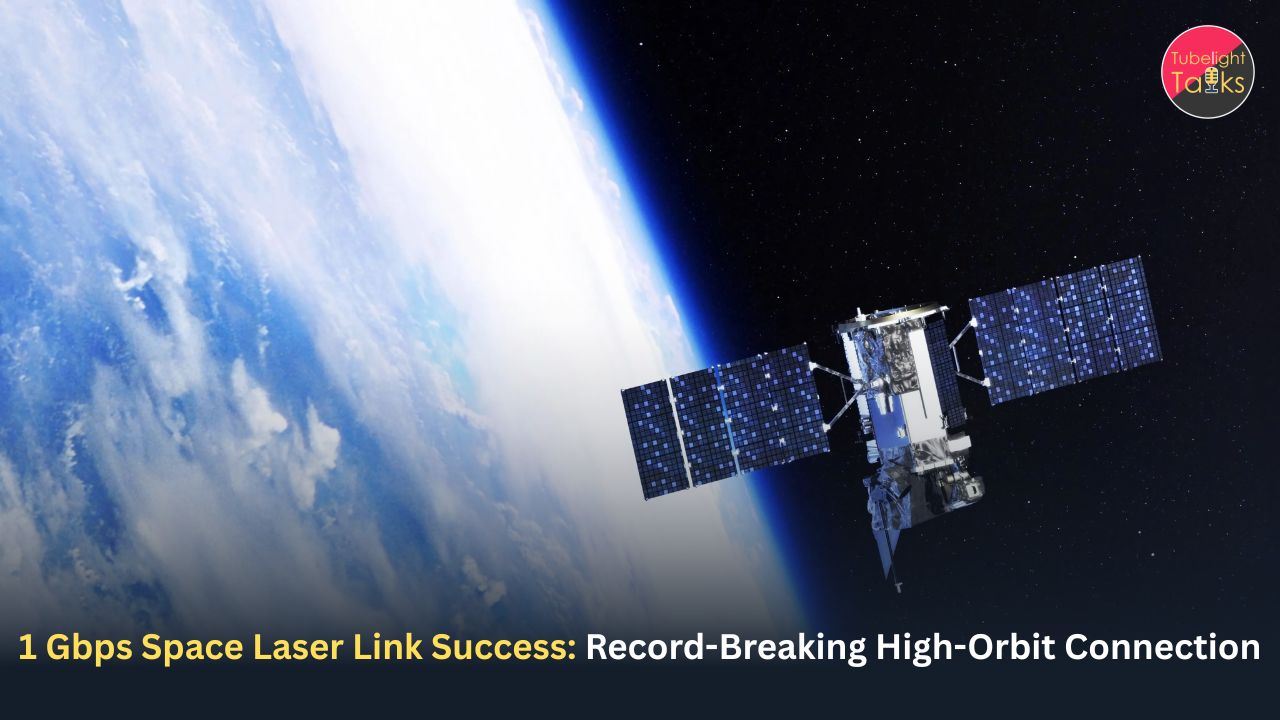
1 Gbps Space Laser Link Breakthrough: Two-Way Connection Held for 3+ Hours Over 40,000 km
Space internet usually brings to mind thousands of low-Earth-orbit satellites. But this week’s most consequential connectivity headline comes from the other extreme: high orbit.
Researchers have established a stable 1 Gbps space laser link, a two-way laser communication link between a ground station and a geosynchronous satellite, achieving 1 Gbps uplink and downlink at distances of up to 40,740 km, and sustaining the link for more than three hours – a major leap beyond earlier demonstrations that often lasted minutes.
The work, led by the Chinese Academy of Sciences’ Institute of Optics and Electronics with multiple partner institutions, is being described as a critical step toward an integrated Earth-space network that could support real-time interaction with space assets.
What Exactly Was Achieved
A two-way laser link, not just a one-direction “download”
Most headline-grabbing laser comms tests focus on blasting data down from space as fast as possible. This achievement stands out because it did both directions – uplink and downlink – at 1 Gbps, across high-orbit distances.
That “two-way” detail changes the meaning. Downlink alone is great for sending photos and files. Two-way is what makes a satellite interactive: it can receive instructions, adjust payloads, and coordinate with other spacecraft in near real time.
Distance: up to 40,740 km (slant range)
The experiment reported distances up to 40,740 km, consistent with a geosynchronous satellite viewed from a ground site (the path is longer than “altitude” because the satellite is rarely directly overhead).
Duration: from minutes to hours
The most operationally meaningful record is not speed – it is stability. The link reportedly remained uninterrupted for more than three hours, a step change compared to earlier “short window” trials.
Rapid link establishment: ~4 seconds
Researchers also reported a record of about 4 seconds for rapid link establishment. In laser comms, finding and locking onto a tiny beam across tens of thousands of kilometers is often the hardest part – so faster acquisition is a big signal of maturity.
Why High-Orbit Laser Communication Is Hard
The beam is narrow, the target is far, the atmosphere is messy
Laser beams carry far more information than radio at similar power, but the trade-off is unforgiving precision. The beam spreads far less than radio – meaning your pointing and tracking must be extremely accurate. Then the atmosphere adds turbulence, scattering, and distortion.
That is why the ground system described in reporting is not “just a telescope.” It is a precision optical station designed to detect weak signals and keep the beam locked despite atmospheric interference.
Adaptive optics: correcting the sky in real time
ECNS reported the system used adaptive optics and precision pointing control to correct atmospheric interference and maintain stable, high-speed transmission. Adaptive optics is essentially “real-time correction” that reshapes the beam/wavefront to counter the atmosphere’s distortions – one of the key technologies that can make hours-long laser links feasible.
Also Read: UC Davis Night-Time Solar Breakthrough: Stirling Engine Generates Power from the Cold of Space
Who Did It and Where It Was Done
Institutions involved
The work was attributed to the Chinese Academy of Sciences’ Institute of Optics and Electronics, working with the Beijing University of Posts and Telecommunications, the China Academy of Space Technology, and others.
A ground observatory in Yunnan and a geosynchronous satellite
Reporting describes a stable laser link between an observatory in Yunnan Province and a geosynchronous satellite.
This detail matters because it signals the team was not “simulating” high orbit – they were dealing with the actual pointing and atmospheric realities of an Earth-to-GEO path.
Why This Breakthrough Matters for the World
1) It advances the idea of an “Integrated Earth-Space Network”
Xinhua and China Daily explicitly frame this as a step toward an integrated Earth-space network, enabled by long-duration, stable, two-way, real-time capability in high orbit.
What does that mean in practical terms? A future architecture could look like this:
- Low-Earth-orbit satellites collect data or provide regional connectivity
- High-orbit satellites act as persistent “backbone nodes” (always visible to large areas)
- Laser links move data between layers at high speed
- Ground stations connect the network into terrestrial fiber backbones
This sort of layering is how you turn “many satellites” into a coherent global system rather than isolated moving points.
2) It makes high-orbit satellites more than relay boxes
The reporting notes that the breakthrough could let satellites not only transmit data, but receive complex commands in real time, opening a pathway to upgrade high-orbit platforms into more intelligent processing or interaction hubs.
That capability is critical for:
- rapid tasking of Earth observation (disaster imaging, wildfire mapping)
- dynamic spectrum/traffic management
- time-sensitive security and navigation updates
3) It hints at future deep-space laser links
Both Xinhua and China Daily note researchers see this as validating deep-space communication capabilities of ground stations, paving the way toward future high-speed laser links with the Moon, Mars, and distant probes.
This is a big deal because deep space is where radio links become painfully slow and bandwidth-limited. Optical comms offers a path to higher data rates for future planetary missions – though many engineering hurdles remain.
What This Could Mean for “Internet to the Remote Corners”
The promise: bandwidth where fiber will never reach
The user-level dream is simple: high-speed connectivity for remote islands, mountains, ships, and disaster-hit zones. Laser backbone links can increase the capacity of satellite networks so that user terminals on the ground aren’t fighting over scarce bandwidth.
But it’s important to state the truth: this kind of GEO-to-ground laser record doesn’t instantly become consumer internet. It becomes infrastructure – the high-capacity trunk lines that make future services more robust.
The practical near-term winners
Even before everyday consumers feel it, the first beneficiaries are likely to be:
- disaster response agencies needing rapid imagery + coordination
- scientific observatories and remote research stations
- high-bandwidth governmental or enterprise links
- next-gen satellite operators needing better backbone capacity
The Reality Check: What Still Must Be Solved
Weather dependence
Laser links are line-of-sight and can be degraded by cloud cover and atmospheric conditions. That means operational networks will require:
- multiple ground stations in diverse climates
- smart routing and redundancy
- hybrid backup links (radio + optical)
Scaling from “record” to “network”
A record-setting experiment is not the same as a network that runs 24/7 globally. Scaling will require manufacturing reliability, standardized terminals, security hardening, and cost reduction.
Governance and trust
When communication becomes faster and more capable, questions of security, transparency, and responsible deployment rise alongside the technical triumph. “Can we do it?” becomes “How should we do it?”
A Deeper Lesson: Precision Wins Over Noise
This breakthrough is a story about discipline: a beam held steady across tens of thousands of kilometers for hours. In the teachings shared by Sant Rampal Ji Maharaj, there is strong emphasis on self-control, clarity, and right action – because real progress comes when the mind is steady and the effort is precise, not impulsive.
In that sense, laser communication is a powerful metaphor: if alignment is even slightly off, everything fails; when alignment is correct, the impossible becomes routine. Scientific progress that is guided by discipline – and used to uplift society – becomes more than technology. It becomes service.
FAQs: 1 Gbps space laser link
1. What record was achieved in this space laser experiment?
A stable two-way laser link at 1 Gbps between ground and a high-orbit satellite over distances exceeding 40,000 km.
2. How far was the satellite link?
Reported distances were up to 40,740 km.
3. How long did the connection last?
It maintained the link for over three hours, extending stability from minutes to hours.
4. Who conducted the experiment?
It involved the Chinese Academy of Sciences’ Institute of Optics and Electronics with partners including Beijing University of Posts and Telecommunications and the China Academy of Space Technology.
5. Why is this important for future connectivity?
It’s described as a step toward an integrated Earth-space network, enabling high-orbit satellites to transmit high-speed data and receive complex commands in real time.
Related Stories









Discussion (0)