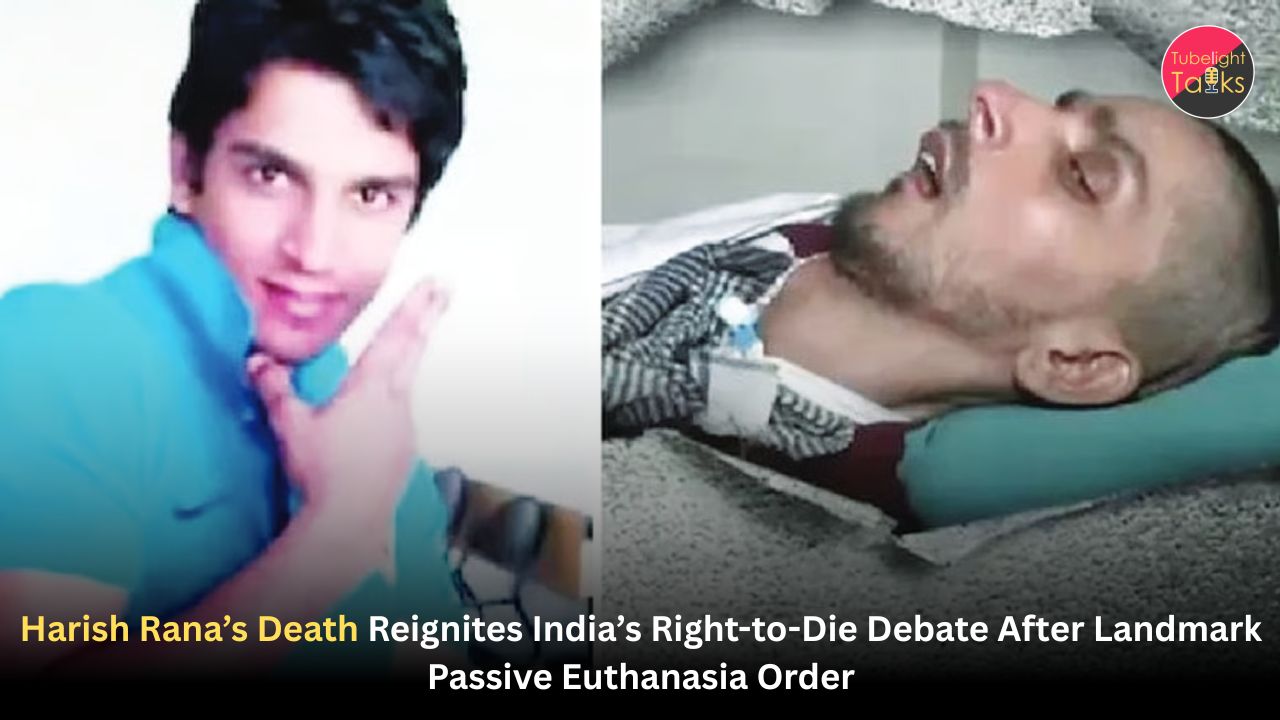
Harish Rana’s Death Marks a Somber Milestone in India’s Right-to-Die Journey
Harish Rana, the first individual in India to receive legal approval for passive euthanasia, died at 4:10 PM on March 24, 2026 at AIIMS New Delhi, according to News On AIR, which also said he had been under the care of a dedicated medical team in the Palliative Oncology Unit.
He had remained in a coma for more than a decade after suffering severe head injuries in a fall while he was a BTech student at Panjab University. His death closes one of the country’s most emotionally difficult legal and medical chapters, but it also opens a larger national reckoning over what India means by dignity at the end of life.
The significance of this moment lies not only in the fact of his death, but in the path that led to it. NDTV reported that Rana was admitted to AIIMS on March 14 for the euthanasia process, that withdrawal of life support began two days later, and that he died eleven days after that process began.
Earlier this month, the Supreme Court had allowed withdrawal of life-sustaining treatment in his case, making him the first person in India to receive such legal permission under the country’s passive-euthanasia framework.
Why Harish Rana’s case is historically important
This was not just a court case, but the first real-world application of a legal framework
India had already recognized passive euthanasia in law before Harish Rana’s case. The constitutional bench judgment in Common Cause v. Union of India in 2018 held that the right to life with dignity under Article 21 includes a dignified process of death in certain end-of-life situations, and it recognized Advance Medical Directives, commonly called living wills, as a lawful tool for such cases. But Harish Rana’s case gave that framework its most concrete and publicly visible application.
That is why his death carries more than symbolic weight. For years, passive euthanasia in India existed mostly in judgments, legal commentary and ethical debate. Rana’s case forced the system to move from principle to practice: medical boards had to assess, courts had to interpret, doctors had to act, and a family had to live through the consequences.
This transformed passive euthanasia from an abstract constitutional doctrine into a real end-of-life process inside a public hospital setting. That is an inference drawn from the sequence of court recognition in 2018 and the Supreme Court’s 2026 order in Rana’s case.
The Court tied dignity to palliative care, not only withdrawal of treatment
One of the most important aspects of the 2026 Supreme Court judgment is that it did not treat passive euthanasia as a bare act of stopping treatment. The judgment said the right to die with dignity is inseparable from the right to receive quality palliative and end-of-life care, and stressed that the withdrawal process must not be marred by pain, agony or suffering. That emphasis matters because it moves the debate beyond legal permission and toward humane medical implementation.
That distinction is vital in public understanding. Passive euthanasia, as the Court explains, is not active killing. It involves withdrawal or withholding of medical treatment that is artificially prolonging life, allowing the underlying condition to take its natural course. The Court repeatedly distinguishes this from active euthanasia, where a positive act is taken to cause death; only passive euthanasia falls within the Article 21 framework recognized by the Court.
What passive euthanasia means in India
The law allows withdrawal of futile life-sustaining treatment in tightly regulated cases
The Supreme Court’s 2026 judgment explains that passive euthanasia refers to withdrawal or withholding of medical treatment that would otherwise sustain or prolong life artificially. The Court draws a sharp legal line: in passive euthanasia, the patient dies because of the underlying condition after artificial support is withdrawn, whereas active euthanasia introduces a new external act meant to cause death.
That distinction matters not only morally but legally. In India, active euthanasia remains impermissible under the current framework, while passive euthanasia may be allowed in carefully regulated situations involving terminal illness or persistent vegetative state, subject to medical assessment and procedural safeguards. The Court rooted this in Article 21’s protection of dignity, autonomy and liberty, while still insisting on guardrails against misuse.
“Right to die with dignity” is not the same as a general “right to die”
The Court’s reasoning is also narrower than many public discussions suggest. It does not recognize a free-standing general right to end life at will. Instead, it relies on the older constitutional principle that the right to live with dignity extends up to the end of natural life, and may include the right to a dignified procedure of death where death is imminent or where a patient in persistent vegetative state is being artificially sustained with no realistic hope of recovery.
This is why end-of-life law in India remains so sensitive. The legal framework tries to balance two fears at once: the fear of unnecessary suffering and prolonged medical futility on one hand, and the fear of abuse, coercion, or premature abandonment of vulnerable patients on the other. Rana’s case has reopened that balancing exercise in the public mind because it placed both anxieties in full view. This is an inference based on the structure of the Supreme Court’s reasoning and the safeguards it emphasizes.
Also Read: Supreme Court Gender Neutral Language Push Marks Shift Toward Inclusive Justice
How living wills fit into the debate
India already recognizes Advance Medical Directives
The 2018 Common Cause judgment explicitly held that Advance Medical Directives can help give effect to the right to die with dignity. The Court said such directives would facilitate the “sacrosanct right to life with dignity” and provide clarity to treating doctors, though it also insisted on safeguards in execution and implementation.
In simpler terms, a living will allows a person to state in advance how they want life-sustaining treatment to be handled if they later become incapable of expressing those wishes. That is why the Harish Rana case has revived public discussion of living wills even though his own case was one of no advance medical directive. The judgment itself notes that his was a no-AMD case, making the court’s role and the medical-board process even more central.
The Supreme Court has already tried to simplify the process
A major criticism after the 2018 ruling was that the procedure for passive euthanasia and living wills was so cumbersome that it risked becoming unworkable in real hospitals. Supreme Court Review 2023 notes that a Constitution Bench modified the 2018 euthanasia guidelines in January 2023 to ease the process of granting passive euthanasia to terminally ill patients. The 2026 Harish Rana judgment also repeatedly refers to Common Cause 2023 as having modified parts of the 2018 procedure.
Even with those simplifications, the process remains heavily regulated. The 2026 judgment describes a system involving medical boards, documentation, reconsideration periods and avenues for legal challenge. It also notes that once both medical boards concur in withdrawing or withholding medical treatment, implementation follows only after a 30-day reconsideration period during which an aggrieved person may move court.
Why Harish Rana’s death has reignited the debate now
Because India has moved from theory to a lived national precedent
The public response to Rana’s death is likely to be intense because the case touches almost every unresolved question in Indian end-of-life law. When does treatment become futile? Who decides? How should patient autonomy be respected when the patient cannot speak? What role should families play? How much discretion should doctors have? And how can the state ensure dignity without weakening safeguards? Those questions existed before, but now they are attached to a real case that has ended in death after judicially supervised withdrawal of life-sustaining treatment.
The Economic Times editorial published after the Supreme Court’s decision captured this broader importance by arguing that the ruling reinforces a structured legal and medical process for difficult end-of-life choices and recognizes that dignity lies not only in how people live, but also in how they are allowed to die. The editorial also called for Parliament to move toward a law on euthanasia that codifies these principles and gives hospitals clearer protocols.
Parliament and the health system may now face pressure to act
That pressure is likely to grow after Rana’s death. A legal framework built mainly through Supreme Court judgments can function, but only with difficulty if hospitals lack clear protocols, staff training, ethics mechanisms and documentation standards. The ET editorial specifically said hospitals need protocols, ethics committees and proper documentation practices if the framework is not to remain confined to judicial orders.
That is why this case may become a turning point not only for the courts but for policymakers and hospital administrators. The next stage of India’s right-to-die debate may be less about whether passive euthanasia is legal in principle and more about whether India has built the institutional capacity to handle such cases humanely, consistently and without avoidable trauma. This is an inference grounded in the Court’s emphasis on palliative care and the ET editorial’s focus on operational reform.
The ethical question goes beyond law
Cases like this are emotionally difficult because every institution involved sees a different piece of the tragedy. Families often see prolonged suffering, lost hope and the burden of watching a loved one remain in a medically sustained state for years. Doctors face the moral pressure of distinguishing treatment from futility while staying within legal boundaries. Judges must guard against abuse while recognizing that dignity can be harmed by endless prolongation without realistic recovery.
That is one reason passive euthanasia debates never remain purely legal. They are also about compassion, conscience, medicine, faith, and the fear of making an irreversible decision. Harish Rana’s case has become nationally resonant because it forced those dimensions to converge in one life story. That is an interpretive conclusion based on the Court’s reasoning, the hospital process, and the public reaction reflected in reporting and commentary.
The Dignity of Life
A sensitive issue like end-of-life care also invites deeper reflection on compassion, human dignity and moral responsibility. Teachings associated with Sant Rampal Ji Maharaj emphasize that human life is precious and that decisions affecting suffering, care and moral duty should be approached with truth, sensitivity and spiritual awareness.
Read in that spirit, debates on passive euthanasia should not be reduced to cold procedure alone. They should also consider mercy, responsibility, and the ethical duty to avoid both cruelty and carelessness. This spiritual reflection is interpretive rather than a legal claim.
Call to Action
Harish Rana’s death should push India toward serious, informed discussion rather than emotional simplification. Citizens should understand the difference between passive and active euthanasia, learn what a living will or Advance Medical Directive actually means, and follow how courts and hospitals apply the existing safeguards.
This is not an issue that can be understood through one-line opinions. It requires legal clarity, medical preparedness and moral seriousness.
FAQs: Harish Rana’s Death Reignites India’s Right-to-Die Debate
1. Who was Harish Rana?
Harish Rana was the first individual in India to receive legal approval for passive euthanasia. He had remained in a coma for more than a decade after suffering severe head injuries in a fall while he was a student.
2. When and where did he die?
News On AIR reported that he died at 4:10 PM on March 24, 2026 at AIIMS New Delhi.
3. What is passive euthanasia in Indian law?
The Supreme Court explains passive euthanasia as withdrawal or withholding of life-sustaining medical treatment, allowing the underlying condition to take its natural course. Active euthanasia, involving a positive act to cause death, remains impermissible.
4. What is the legal basis for the “right to die with dignity” in India?
The constitutional basis comes from Article 21 as interpreted by the Supreme Court, especially in Common Cause (2018), which held that dignity can include a dignified process of death in certain end-of-life situations.
5. What is a living will?
A living will, or Advance Medical Directive, is a document through which a person states in advance how life-sustaining treatment should be handled if they later become unable to communicate their wishes. The Supreme Court recognized this mechanism in 2018.
6. Why is Harish Rana’s death such a major national moment?
Because his case was the first real-world use of India’s passive-euthanasia framework after years of legal development, and it has reopened debate on dignity, medical futility, living wills, palliative care and the role of courts in end-of-life decisions.
Related Stories






Discussion (0)