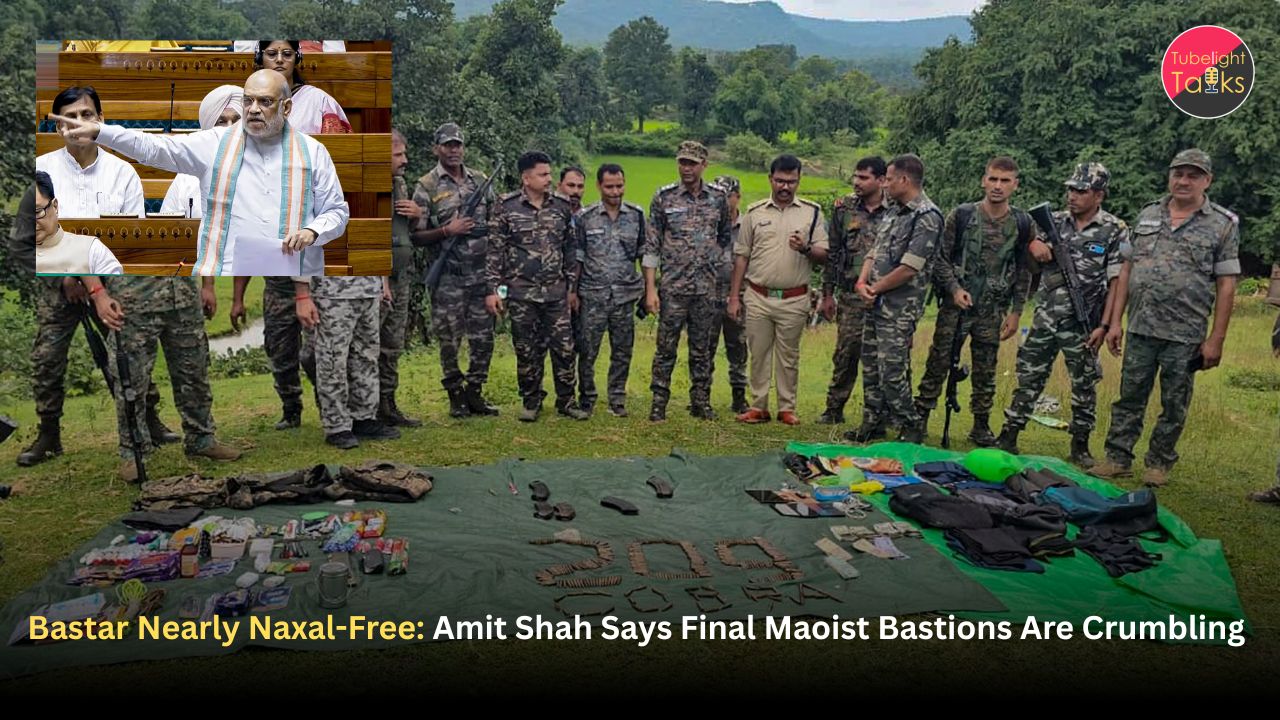
Home Minister Amit Shah Says Bastar Is Almost Naxal-Free as Final Maoist Bastions Crumble
Bastar, once the beating heart of India’s Maoist insurgency, is now being presented by the government as the site of one of its biggest internal security victories. Replying in the Lok Sabha on March 30, 2026, Union Home Minister Amit Shah said Naxalism has been “almost completely eradicated” from Bastar and that the broader target of making India free from Left-Wing Extremism had been achieved.
Yet the full story is more layered: state officials say roughly 96% of Bastar is now free from Naxal influence, while the final stretch in places like Abujhmarh remains difficult, sensitive, and crucial for the future of tribal peace and governance.
Amit Shah’s Bastar Statement Marks a Defining Political and Security Moment
What the Home Minister said in Parliament
In the Lok Sabha debate on Left-Wing Extremism, Amit Shah said that Naxalism had been “almost completely eradicated from Bastar” and that a campaign had already begun to build schools and open ration shops in every village there. The same official release said the “shadow of Red Terror has been removed” and that Bastar is now developing.
This framing is important because it shows the Centre is no longer speaking only in terms of combat operations; it is tying counter-insurgency success directly to governance restoration, welfare delivery, and state presence in villages long kept outside routine administration.
Shah’s statement also carried a broader national claim. In the same Lok Sabha intervention, he said the CPI (Maoist) central structure had been broken, that the Politburo and Central Military Commission had been wiped out, and that the target to make the country Naxalism-free by March 31, 2026, had been achieved. For the government, Bastar is not merely another district-level success. It is the symbolic collapse of the last major fortress of the old Red Corridor.
Why Bastar mattered so much
Bastar mattered because it was not just an affected zone; it was the most enduring psychological centre of Maoist influence in India. For decades, its dense forests, difficult terrain, weak road access, and poor state penetration made it ideal for underground leadership, weapons movement, training, and parallel authority. Government officials and ground reports describe Abujhmarh in particular as the “last bastion” and the Maoists’ “capital,” underscoring how central this geography had become to the insurgency’s survival.
That is why the language around Bastar has changed so dramatically. In April 2025, Shah had already said, “Bastar has now become a symbol of the future, not fear,” linking the region’s recovery to a deeper shift from armed domination to civic revival. Read alongside his March 2026 Lok Sabha remarks, that quote captures the government’s current message: Bastar is no longer being described as a battlefield first, but as a territory being reclaimed for ordinary life.
Also Read: PM Modi Targets LDF-UDF “Corruption” and Promises “Viksit Keralam” at Palakkad Rally
How the Final Maoist Bastions Were Pressured
Security operations and leadership breakdown
The government’s own explanation of this turnaround is blunt: sustained pressure, better intelligence, tighter coordination, and a refusal to leave remote pockets untouched. PIB’s December 2025 explainer said only three districts remained “most-affected” by Naxalism by 2025, down from 36 in 2014, while total affected districts had dropped from 126 to 11. It also listed 361 new security camps, 586 fortified police stations, more than 12,000 km of roads, and 8,500-plus mobile towers as part of the architecture that narrowed Maoist space over time.
The leadership damage has been equally significant. The March 30, 2026 PIB release records Shah saying that, from the leadership network counted at the beginning of 2024, arrests, surrenders, killings, and negotiations had broken the Maoist central structure. His claim that the top command had been neutralised is politically loaded, but it also reflects how the state sees the conflict now: not as a mass guerrilla movement with deep strategic depth, but as a fragmented remnant operating in shrinking pockets.
Surrenders changed the tempo in Bastar
Another major shift has come through surrender and rehabilitation. In his April 2025 Bastar remarks, Shah said 521 Naxalites had surrendered that year so far and 881 had surrendered in 2024. Later official summaries for 2025 said 1,973 Naxals surrendered across the year, alongside large numbers of arrests and neutralisations.
Ground reporting from February 2026 added that more than 2,400 Maoist cadres had left the organisation in the previous two years in Bastar alone. These numbers matter because insurgencies often weaken not only when leaders are killed, but when rank-and-file faith in survival, ideology, and local control begins to collapse.
Recent reporting from Chhattisgarh suggests this phase accelerated sharply in March 2026. The state government said nearly 96% of Bastar’s geographical area was now free from Naxal influence and that the remaining presence was confined to small, difficult pockets. Separate reporting said fewer than 40 cadres remained in Bastar. That does not mean risk has vanished, but it does show why the Centre has become more confident in describing Bastar as almost Naxal-free rather than merely improved.
Abujhmarh remains the hardest final stretch
Even amid celebratory claims, the final zone still demands caution. Reporting from March 31, 2026 described Abujhmarh as a roughly 4,000 sq km region spread across Narayanpur, Bijapur, and Dantewada, and said security forces still viewed it as the final stretch where Maoist influence had not vanished in a simple, clean manner. Officials told reporters that the campaign was about “peace, trust and development,” not only firepower. That nuance is important. On paper, the insurgency may be broken. On the ground, the last transition from presence to absence, and from camp control to normal civilian confidence, can take longer.
Another report noted that the eighth and final security camp planned for 2026 in Abujhmarh had been opened, with the express goal of securing roads, health services, connectivity, and administration. That signals the state’s intended endgame: hold territory long enough for governance to become routine, not episodic. In conflicts like Bastar, that is often the true difference between tactical success and durable peace.
The Numbers Behind the Anti-Naxal Campaign
National decline in Left-Wing Extremism
Official data released by the Ministry of Home Affairs and PIB show the long downward arc that made this moment possible. A February 2026 PIB reply said the number of LWE-affected districts had fallen to only eight by December 2025, with just three districts still classed as most affected.
A December 2025 PIB explainer said violent incidents had fallen 53% between 2004–2014 and 2014–2024, security force deaths had dropped 73%, and civilian deaths had fallen 70%. These figures help explain why the government now treats the current Bastar milestone as the culmination of a decade-long restructuring rather than a sudden short-term success.
The policy was never only military
The MHA’s formal line has consistently been that Left-Wing Extremism requires a “National Policy and Action Plan” that combines security measures with development interventions and rights-based delivery. That approach is visible in the spending and infrastructure footprint: thousands of crores released under security expenditure schemes, telecommunications expansion, hospitals, schools, road projects, and assistance to states for special forces and intelligence.
The Centre’s argument is straightforward: insurgency retreats faster when the state is not visible only as an armed presence, but also as the provider of welfare, mobility, communication, and opportunity.
From Counter- Insurgency to Development: Bastar’s Real Test Begins Now
Why roads, ration shops and schools matter more than slogans
One of the most repeated official claims in recent months is that Bastar is changing because development is finally entering spaces once dominated by fear. In Shah’s March 30 address, he said schools and ration shops were being taken to villages in Bastar.
In his April 2025 Bastar speech, he said where bullets once echoed, now school bells ring, highways are being built, and children are reaching the world through computers. These are not small rhetorical choices. They show that the state wants the Bastar story to be remembered not only for encounters and camps, but for the visible return of normal civilian life.
Ground reports from Abujhmarh echo that direction. They describe roads being laid, villages reconnecting to state services, and welfare cards reaching people in places previously cut off from the everyday machinery of governance. Such signs are often more persuasive to local communities than any national victory declaration.
For families who lived through decades of coercion, extortion, disappearances, and fear, peace becomes believable only when it changes the school route, the market journey, the hospital visit, and the ration pickup.
What happens to the security footprint now
With Naxal influence receding, Chhattisgarh has begun talking about what to do with the physical architecture of the anti-Maoist campaign. Recent reporting says the state plans to convert roughly 400 security camps into hospitals, schools, and forest-produce collection centres over time. There are also reports of a gradual reduction in central force presence over the next 18 months, while local police structures remain in place.
That is a logical transition, but it carries risk. A security vacuum created too quickly can invite relapse. A security grid maintained without social legitimacy can create resentment. Managing that balance may define Bastar’s next decade.
A cautious reading of the “Naxal-free” claim
The government’s triumphal language should be understood alongside the ground reality. Shah has said India has achieved its March 31 target and that Bastar is almost completely cleared. Yet on-ground reporting still speaks of a complex final stretch, residual cadres, and remote pockets where the state is only now consolidating control.
The most accurate reading, therefore, is this: the Maoist movement in Bastar appears strategically broken, territorially compressed, and politically isolated, but the work of making Bastar peacefully normal is still in progress. That is exactly why the phrase “nearly Naxal-free” fits the present moment better than a simplistic announcement of final closure.
When Lasting Peace Begins Within
A region does not become truly peaceful only when guns fall silent; it becomes peaceful when hatred, revenge, fear, and exploitation begin to leave human hearts. This is where the teachings of Sant Rampal Ji Maharaj offer a deeper social lesson. His official teachings repeatedly stress compassion, righteous living, and non-violence, and describe true devotion as a path that makes a person gentle, disciplined, and free from destructive tendencies.
In a place like Bastar, where generations have suffered from bloodshed and mistrust, this wisdom fits naturally: real rehabilitation is not only physical or administrative, but moral and spiritual as well. Peace lasts longest when people reject violence from within and return to truth-based living, mutual respect, and devotion to the Supreme God through the guidance of a true Guru.
FAQs: Bastar Nearly Naxal-Free: Amit Shah Says Final Maoist Bastions Are Crumbling
1. What exactly did Amit Shah say about Bastar on March 30, 2026?
He told the Lok Sabha that Naxalism had been “almost completely eradicated” from Bastar and that a campaign had begun to build schools and open ration shops in every village there.
2. Did Amit Shah declare India completely free from Naxalism?
Yes, in the same parliamentary reply he said the March 31, 2026 target had been achieved and that there was “no hesitation” in saying the country had become Naxalism-free, though ground reporting indicates a more gradual final consolidation in a few remote zones.
3. Why is Bastar so important in the history of Left-Wing Extremism?
Bastar was one of the most entrenched Maoist theatres in India because of its forests, terrain, weak administrative penetration, and use as a strategic base in the wider Dandakaranya region. Areas like Abujhmarh were long seen as core Maoist strongholds.
4. How much of Bastar is now free from Naxal influence?
Recent Chhattisgarh government-linked reporting has said nearly 96% of Bastar is now free from Naxal influence, with the remaining presence limited to small and difficult pockets.
5. What helped weaken the Maoist movement so sharply?
The main factors cited by official sources are coordinated security operations, new camps, better intelligence, fortified police stations, road building, telecom expansion, arrests, surrenders, and development-led state presence in former Maoist zones.
6. What is the biggest challenge after declaring Bastar nearly Naxal-free?
The biggest challenge is converting security gains into durable civilian peace. That means rehabilitation, welfare delivery, roads, schools, healthcare, jobs, and trust-building in tribal communities, especially in remote former strongholds such as Abujhmarh.
Related Stories








Discussion (0)