Middle East Conflict Escalates as Karaj Strike and Habshan Gas Shutdown Expand the War’s Economic and Strategic Fallout
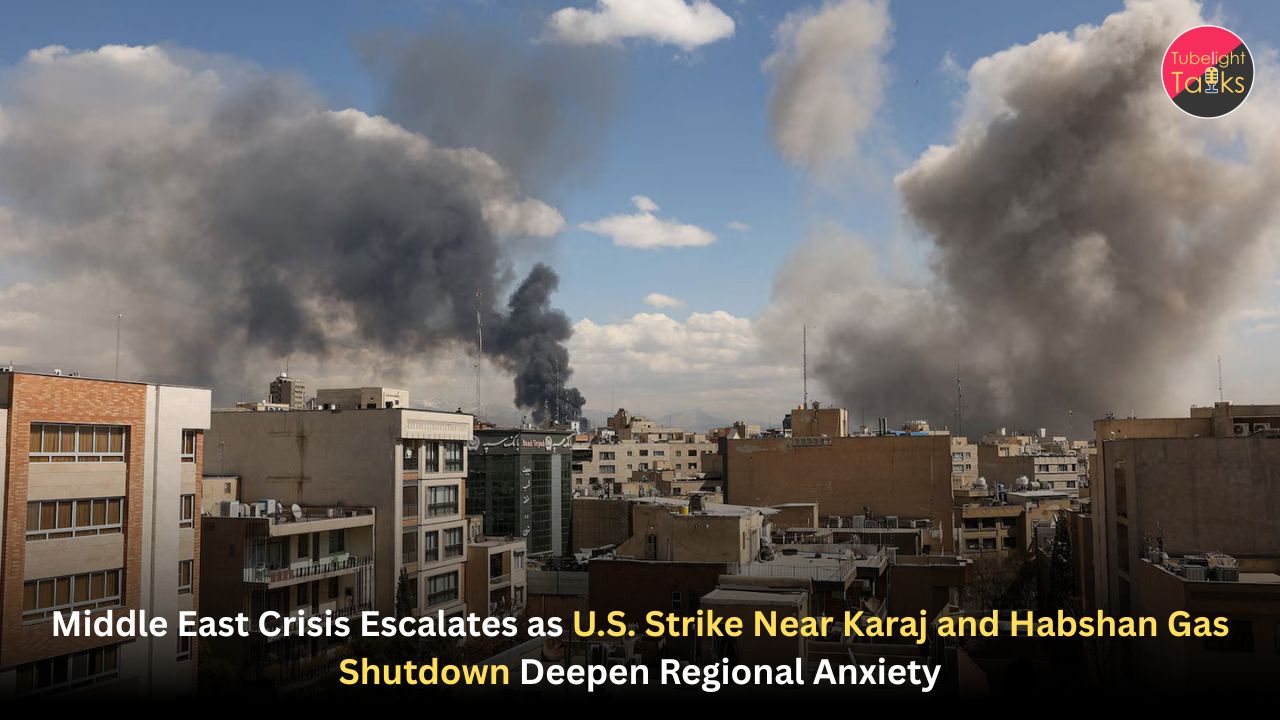
The Middle East war widened again after a U.S. strike hit the B1 bridge between Tehran and Karaj and the UAE suspended operations at the Habshan gas facility following intercepted aerial threats. One detail needs precision: the broader war began as a joint U.S.-Israeli offensive against Iran, but the Karaj bridge strike itself was specifically reported by Reuters as a U.S. attack, not a jointly attributed strike. At the same time, the Habshan shutdown shows how the conflict is now touching critical energy infrastructure outside Iran as well.
The Karaj strike marks a sharper turn toward infrastructure targets
Reuters reported that the B1 bridge linking Tehran and Karaj was struck in a U.S. bombing, with Iranian state media saying eight people were killed and 95 wounded. Trump then escalated the message publicly, warning that bridges and electric power plants could be next and saying attacks on Iran’s energy and oil infrastructure were possible. That combination matters because it pushes the conflict further toward infrastructure linked to civilian life and economic continuity, not only military assets.
Iran reacted with unusually hard language. Reuters reported that Iranian military spokesperson Ebrahim Zolfaqari warned of “more crushing, broader and more destructive” attacks in response to Trump’s remarks and the latest escalation. That signals Tehran is treating the Karaj strike not as an isolated battlefield incident, but as part of a new and more dangerous phase of the war.
Also Read: West Asia Crisis Escalates as U.S. Hits Karaj Bridge and Threatens Wider Iranian Infrastructure
The wider U.S.-Israeli war is now affecting infrastructure across the Gulf
Reuters says the conflict began on February 28 with a joint U.S.-Israeli offensive on Iran, and it has since triggered retaliatory missile and drone attacks across the region. In that context, the Habshan development is highly significant. Abu Dhabi halted operations at its largest natural gas processing facility after an attack triggered a fire, according to the city’s media office as reported by The Wall Street Journal. Other reporting citing the Abu Dhabi Media Office said the shutdown followed debris falling at the site after air-defence interception of an incoming threat.
This means the economic geography of the war is broadening. Habshan is one of the UAE’s most important gas facilities, and its disruption points to a wider regional vulnerability: even where an incoming strike is intercepted, debris or secondary effects can still force shutdowns at critical energy sites. That is one reason markets remain highly sensitive to every new development. This is an inference, but it is strongly supported by the confirmed suspension of Habshan operations and the continuing oil-market stress reported by Reuters.
Oil, shipping and market stability are now central to the crisis
Reuters reported that the conflict has already disrupted navigation around the Strait of Hormuz, through which roughly one-fifth of the world’s oil trade normally passes. The same reporting said Brent crude climbed again as hopes of a quick end to the war faded. When a bridge near Karaj is struck and a key UAE gas facility is taken offline after intercepted threats, the global concern is no longer only military escalation. It is also about whether energy flows, freight costs and supply chains can remain stable.
That is why the Karaj and Habshan developments matter together. One shows the war pushing more openly into Iranian infrastructure. The other shows the fallout spreading into Gulf energy systems. Even if the direct physical damage remains limited in some places, the strategic message is clear: the conflict is becoming more entangled with regional energy security.
Why this phase looks more dangerous than earlier rounds
Wars become harder to contain when core infrastructure enters the target map. Reuters noted that legal experts have raised concerns about attacks on civilian objects, while Trump’s public threats against bridges and power plants suggest the threshold is shifting. Once transport links, utility systems and gas facilities become part of escalation logic, the risk to civilians, markets and neighboring states rises sharply.
The UAE development adds another layer of concern because it shows neighboring states cannot assume they will remain insulated from the conflict’s direct operational effects. Even interceptions can create shutdowns, fires and industrial risk.
For governments across the Gulf, that makes defence, emergency response and energy continuity part of the same crisis-management problem. This is an inference supported by the Habshan shutdown after interception-related debris and the wider regional strike pattern described in current reporting.
When destruction spreads, restraint becomes urgent
When conflict begins reaching bridges, power systems and gas facilities, the first victims are often ordinary people who have no role in war planning. This is a reminder that real strength does not lie in expanding destruction but in wisdom, restraint and justice. A lasting peace can never be built by pushing civilian life deeper into the line of fire.
Call to Action
The most important thing to watch now is whether this pattern deepens: more attacks on Iranian infrastructure, more retaliatory pressure across the Gulf, and more disruption to energy facilities and shipping routes. Readers should track verified updates on three fronts: Iranian retaliation, Gulf energy-site security, and the condition of Hormuz-linked flows. Those will shape the next stage of the crisis more than rhetoric alone.
FAQs: Middle East Crisis Escalates as U.S. Strike Near Karaj and Habshan Gas Shutdown Deepen Regional Anxiety
1. Did Israel and the U.S. jointly strike Karaj?
The broader war began as a joint U.S.-Israeli offensive on Iran, but Reuters specifically reported the B1 bridge strike near Karaj as a U.S. bombing.
2. What was hit near Karaj?
Reuters reported that the B1 bridge between Tehran and Karaj was struck. Iranian state media said eight people were killed and 95 wounded.
3. Did Trump threaten more Iranian infrastructure?
Yes. Reuters reported that Trump warned bridges and electric power plants could be targeted next and said Iran’s energy and oil infrastructure could also be hit.
4. What did Iran say in response?
Reuters reported that Iran warned of “more crushing, broader and more destructive” attacks in retaliation.
5. What happened at the Habshan gas facility?
Abu Dhabi suspended operations at the Habshan gas facility after an attack-related incident triggered a fire, with reporting saying debris fell there after air-defence interception of an incoming threat.
6. Why is Habshan important?
Habshan is one of the UAE’s largest and most important natural gas processing facilities, so any shutdown there raises broader energy-security concerns.
Related Stories








Discussion (0)