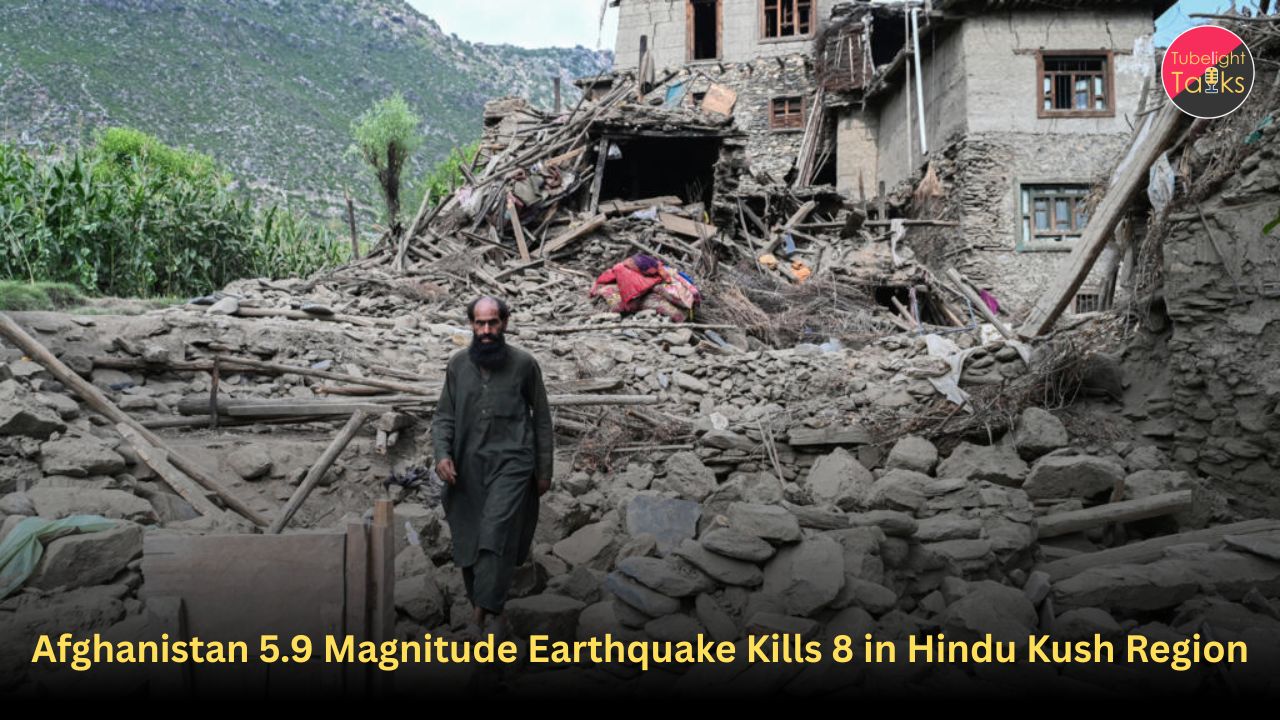
Afghanistan 5.9 Magnitude Earthquake Kills 8, Damages Homes Across Multiple Provinces
Afghanistan 5.9 Magnitude Earthquake struck on April 3, with Reuters reporting a magnitude of 5.9 from the German Research Centre for Geosciences, while AP cited a 5.8 reading from the U.S. Geological Survey. The tremor hit the Hindu Kush region at a depth of roughly 177–180 km, and at least 8 people were killed after a house collapsed near Kabul. A child was also injured, and reports of structural damage emerged from multiple provinces.
The quake was powerful enough to be felt far beyond the epicentre
Reuters said the earthquake struck Afghanistan’s Hindu Kush region at a depth of 177 km, while AP placed the epicentre about 150 km east of Kunduz and more than 180 km deep. Because of that depth, the shaking was felt across a wide area, including Kabul, Islamabad and parts of northern India.
This matters because deep Hindu Kush earthquakes often spread their impact across borders even when the heaviest destruction is not concentrated directly above the epicentre. The wide felt area is one reason such quakes quickly create regional alarm in Afghanistan, Pakistan and beyond.
The confirmed deaths were caused by a house collapse near Kabul
Reuters reported that 8 people were killed and one child injured when a house collapsed in Kabul after the quake. AP gave similar details, saying all confirmed fatalities occurred on the outskirts of Kabul when a home collapsed on a family.
AP added that the dead included eight members of one refugee family that had recently returned from Iran and were living in a tent near the village of Ittefaq on the outskirts of Kabul, where a wall collapse proved fatal. That detail shows how displacement and weak shelter conditions continue to magnify disaster risk in Afghanistan.
Structural damage was reported in more than one province
The user’s headline says the quake caused significant structural damage across the mountainous region. The strongest current reporting supports damage across several areas, though the most verified casualty count remains concentrated near Kabul. AP reported that five homes were destroyed and at least 33 others were damaged, affecting around 40 families in Kabul, Panjshir, Logar, Nangarhar, Laghman and Nuristan.
That means the quake’s impact was broader than one collapsed house, even if early fatality reporting remained limited. The damage pattern also reflects a familiar Afghan vulnerability: when housing is weak and terrain is difficult, even moderate-to-strong quakes can create serious local destruction. This is an inference grounded in the damage spread described by AP and the long-term seismic risk context noted by Reuters.
Afghanistan remains one of the world’s most earthquake-vulnerable countries
Reuters noted that Afghanistan, with its rugged mountains and fragile built environment, is highly prone to deadly natural disasters, especially earthquakes. It said the country loses about 560 people on average each year to earthquakes. AP likewise pointed to Afghanistan’s repeated seismic disasters, including major quakes in 2025 that killed large numbers of people.
This is why even a quake in the 5.8–5.9 range can become deadly. The danger comes not only from the tremor itself, but from weak structures, poverty, remoteness, and the difficulty of delivering emergency response quickly.
A regional tremor with local tragedy
Although the quake was felt across Pakistan and India, the confirmed deaths so far were in Afghanistan. AP reported no deaths in Pakistan from this event, even though the shaking was felt in cities including Islamabad and Peshawar. That contrast is important: the same earthquake can be a frightening tremor in one country and a deadly collapse in another, depending on local vulnerability.
When nature strikes, human fragility becomes clear
An earthquake reminds people how little control they really have over material life. In moments like this, compassion, humility and mutual help matter more than pride or status. The deepest response to disaster is not fear alone, but care for those who have lost safety, shelter and loved ones.
Call to Action
Relief agencies and authorities need to keep damage assessments moving quickly, especially in harder-to-reach provinces where reports often arrive late. Readers should follow official disaster updates carefully, avoid spreading unverified casualty claims, and support credible humanitarian relief for affected Afghan families where possible.
FAQs: Afghanistan 5.9 Magnitude Earthquake
1. How strong was the Afghanistan earthquake?
Reuters reported it at magnitude 5.9 based on GFZ data, while AP cited a 5.8 estimate from the U.S. Geological Survey.
2. Where did the earthquake strike?
It struck Afghanistan’s Hindu Kush region, with AP placing the epicentre about 150 km east of Kunduz.
3. How many people were killed?
At least 8 people were confirmed dead in current reporting.
4. Where did the deaths occur?
The confirmed deaths occurred after a house collapsed near Kabul.
5. Was there wider damage beyond Kabul?
Yes. AP reported destroyed and damaged homes across several provinces, including Kabul, Panjshir, Logar, Nangarhar, Laghman and Nuristan.
6. Was the quake felt outside Afghanistan?
Yes. Reuters and AP said tremors were felt in Pakistan, including Islamabad, and Reuters also noted they were felt in New Delhi.
Related Stories









Discussion (0)