Anchor of the Indo-Pacific: India–US Strategic Ties Expand Across Defence and Critical Minerals
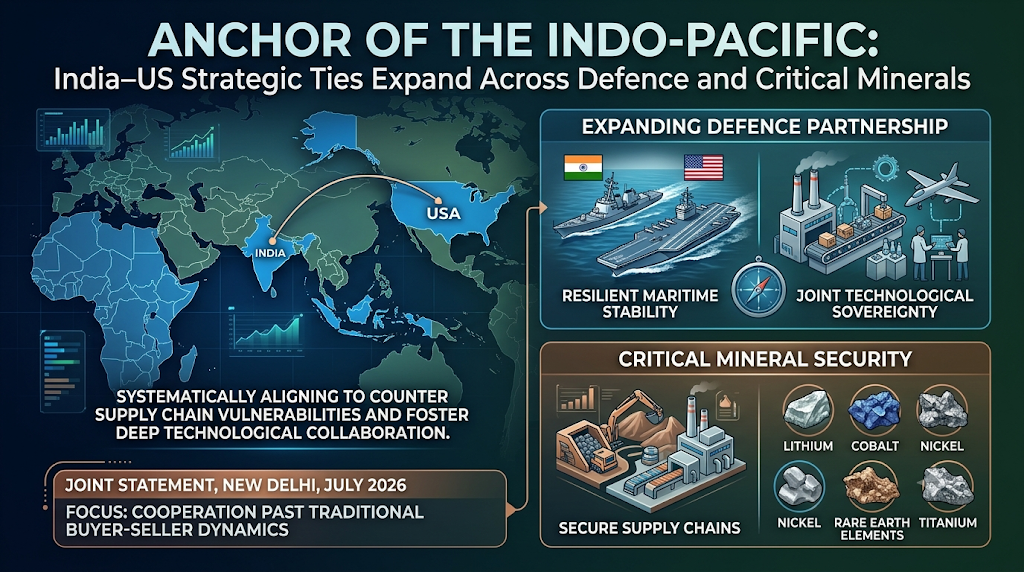
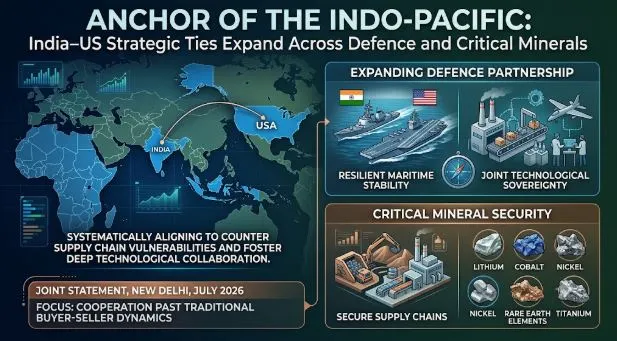
Anchor of the Indo-Pacific: The bilateral relationship between India and the United States remains one of the most consequential strategic partnerships in the modern geopolitical era. In July 2026, the partnership continues to evolve past traditional buyer-seller dynamics into an expansive framework focused on joint technological sovereignty, critical mineral security, and maritime stability across the broader Indo-Pacific. Anchored by shared strategic interests in keeping sea lines of communication open and resilient, New Delhi and Washington are systematically aligning their industrial and policy machinery to counter supply chain vulnerabilities and foster deep technological collaboration.
Anchor of the Indo-Pacific: High-Tech and Critical Mineral Security
Operationalizing iCET and the Critical Minerals Pact
Anchor of the Indo-Pacific, At the core of this expanding technological cooperation is the Initiative on Critical and Emerging Technologies (iCET), along with the newly signed Strategic Critical Minerals Cooperation Framework. Recognizing that raw mineral dependencies pose structural risks to defense, semiconductor, and clean energy sectors, both nations have established institutional channels to co-finance processing facilities, support circular economy recycling, and coordinate joint research.
The bilateral arrangement aligns US capital mechanisms with India’s growing domestic industrial capacity, ensuring that essential inputs for artificial intelligence, advanced computing, and green energy infrastructure remain secure from external market manipulation or single-source monopolies.
Concurrently, private sector engagement driven by platforms like INDUS-X continues to bridge the gap between defense innovation startups, venture capital funds, and research institutions in both countries. These mechanisms facilitate joint development in artificial intelligence algorithms, autonomous systems, and quantum communications, creating a dual-use technological architecture that complements hardware manufacturing initiatives.
Anchor of the Indo-Pacific: India–US Strategic & Defense Technology Matrix (July 2026)
| Cooperation Vector | Institutional Framework | Operational Focus & Strategic Objective |
| Critical Minerals | Strategic Critical Minerals Framework | Processing facilities, midstream refining & recycling. |
| Emerging Technology | iCET & TRUST Initiatives | Semiconductor supply chains, AI & quantum computing. |
| Defense Innovation | INDUS-X & Defense Accel Ecosystem | Startup integration, autonomous systems & joint R&D. |
| Maritime Defense | Reciprocal Logistics & Exercises | Indian Ocean security & joint operational interoperability. |
Navigating Defense as Anchor of the Indo-Pacific
Bridging the Industrial and Export Control Gap:Anchor of the Indo-Pacific
While political and strategic alignment remains at an all-time high, the industrial dimension of the defense relationship is undergoing pragmatic recalibration. High-profile joint production agreements—such as the licensed manufacturing of General Electric’s GE F414 fighter engines for India’s indigenous aircraft programs—continue through complex discussions over pricing, intellectual property (IP) sharing, and technology transfer (ToT) protocols. Indian defense planners remain committed to building localized manufacturing capabilities under Aatmanirbhar Bharat, while US agencies balance these goals against stringent International Traffic in Arms Regulations (ITAR) and export control laws.
To resolve these structural differences, both governments are examining the proposed Reciprocal Defense Procurement Agreement (RDPA). If finalized, the RDPA aims to grant reciprocal market access to defense firms in both nations, facilitating seamless co-development while creating safeguards for India’s growing domestic manufacturing ecosystem.
Meanwhile, high-level military exercises, strategic logistics sharing, and maritime domain awareness initiatives across the Indian Ocean continue to serve as the unshakeable foundation of bilateral security cooperation.
Global Impact on the Anchor of the Indo-Pacific Architecture
The deepening India–US partnership also serves as the anchor for broader regional security frameworks, including the Quadrilateral Security Dialogue (Quad). By coordinating defense diplomacy and maritime surveillance with regional partners like Japan and Australia, New Delhi and Washington ensure that the Indo-Pacific maintains a transparent, rules-based operational order. This multifaceted approach demonstrates that despite periodic economic or trade friction, the core strategic alignment between the world’s oldest and largest democracies remains durable.
Service, Humility and Public Duty
The extensive diplomatic negotiations, military co-production pacts, and high-tech alliances between world powers reflect humanity’s constant search for worldly stability, material security, and technological advantage. However, Sant Rampal Ji Maharaj’s spiritual guidance reveals that true protection and lasting peace cannot be manufactured through military hardware or political treaties alone. SatGyan teaches that international friction and insecurity stem from human arrogance, material greed, and national ego. According to the eternal laws of Supreme God Kabir, genuine security and global harmony are established when leaders act with absolute humility, recognizing that all human life is sacred and interconnected. Real progress occurs when global knowledge and technology are used selflessly for the collective welfare of humanity rather than geopolitical dominance.
Also Read White House Revises India-US Trade Deal Factsheet After Indian Objection on Pulses
FAQs on India–US Strategic Partnership
What is the significance of the Strategic Critical Minerals Cooperation Framework signed in 2026?
It creates a bilateral framework to secure critical mineral supply chains through joint mining, midstream processing, recycling, and investment, reducing reliance on single-country monopolies.
What role does iCET play in India–US relations?
The Initiative on Critical and Emerging Technologies (iCET) drives cooperation across artificial intelligence, semiconductors, quantum computing, space, and advanced defense technologies.
Why are defense technology transfer negotiations like the GE F414 engine complex?
Negotiations involve balancing India’s demand for high-tier manufacturing know-how under Aatmanirbhar Bharat against US export-control laws (ITAR), pricing, and intellectual property rights.
What is the proposed Reciprocal Defense Procurement Agreement (RDPA)?
The RDPA is a proposed framework intended to grant defense industries in both nations reciprocal access to each other’s procurement markets, promoting genuine co-development.
How does maritime cooperation anchor the India–US relationship?
Shared dependencies on open, secure Sea Lines of Communication in the Indian Ocean and the broader Indo-Pacific form the enduring bedrock of bilateral security cooperation.
Related Stories



Discussion (0)