NASA PRAXIS Mission: Critical Leap to Touch Saturn Rings
Humanity has observed the magnificent, shimmering rings of our solar system for centuries through ground-based telescopes and fast-flying space probes. However, directly touching or grabbing a physical sample from these dense ice-and-rock debris fields was historically considered a suicide run for multi-billion-dollar spacecraft. High-velocity collisions with tiny orbital particles could instantly destroy sensitive scientific instrumentation.
In a groundbreaking leap forward for planetary science, space engineers have officially unveiled a solution. The NASA PRAXIS Mission represents an ambitious robotic concept designed to break through this longstanding technical barrier. Short for Planetary Rings Autonomous EXploration with In-situ Sampling, this project leverages cutting-edge bio-inspired robotics and edge-computing Artificial Intelligence to safely navigate, touch, and sample pristine ring particles from Saturn, Uranus, and Neptune in real time.
What is the NASA PRAXIS Mission?
Conceived and developed under the NASA Innovative Advanced Concepts (NIAC) 2026 Phase I program at the Jet Propulsion Laboratory (JPL) under lead researcher Dr. B. Marco Quadrelli, this mission redefines outer planet exploration. Unlike previous orbital missions such as Cassini—which revolutionized planetary science from a safe distance without making physical contact—the NASA PRAXIS Mission aims to physically touch millimeter- to centimeter-scale ring particles directly inside hazardous debris planes.
Key Mission Objectives:
- Direct In-Situ Sampling: Collect and catalog free-floating ice, dust, and silicate particles from Saturn’s dense rings as well as the tenuous, dust-heavy ring systems of Uranus and Neptune.
- Unlocking Origin & Evolution: Address primary Decadal Survey high-priority questions regarding how planetary ring systems form, how long they persist, and how they evolve over billions of years.
- Decoding Early Solar System History: Provide structural insight into protoplanetary disks, offering a pristine window into the environmental conditions that formed early planets and stars.
- Expanding Technological Scope: Adapt the core autonomous robotics framework to explore the elusive, distant ring systems surrounding Centaur asteroids like Chariklo and Chiron.
Also Read: NASA Heart-Shaped Lake Argentina: A Pink Wonder Seen from Space
How the NASA PRAXIS Mission Works: AI and Bio-Inspired Robotics
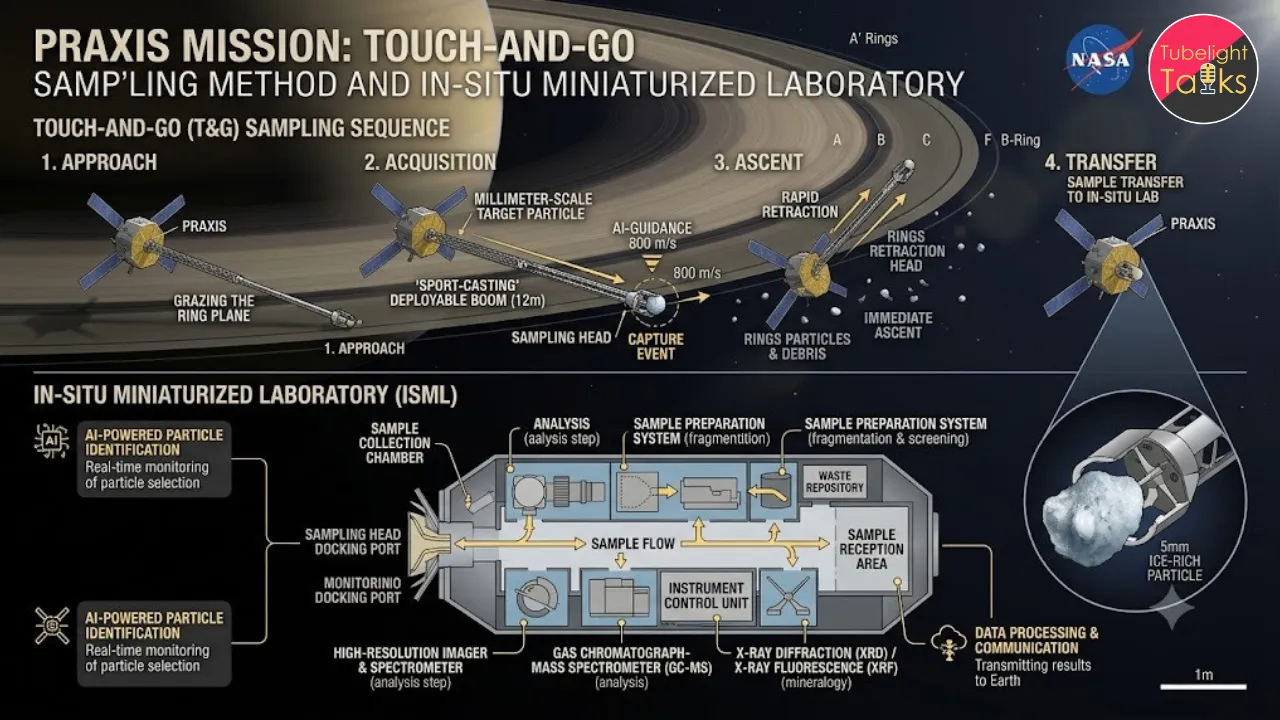
Flying directly into a planetary ring system at speeds exceeding tens of thousands of kilometers per hour presents extreme risk. To overcome catastrophic debris hazards, the spacecraft incorporates a novel “grazing” flight trajectory combined with real-time autonomous collision avoidance algorithms.
| Mission Feature | Legacy Missions (e.g., Cassini) | NASA PRAXIS Mission |
| Primary Method | Remote sensing and orbital imaging | In-situ sampling and direct particle touch |
| Navigation System | Ground-control commands from Earth | Onboard real-time AI autonomy & collision avoidance |
| Sampling Mechanism | None (No physical ring particle collection) | Sport-casting-inspired deployable boom & grabber |
| Target Objects | Broad planetary and atmospheric observation | Millimeter to centimeter ring particles of Saturn, Uranus, & Neptune |
| Data Analysis | Transmitted light and radiation spectra | Onboard real-time size, porosity, & chemical testing |
The Four-Step “Touch and Go” Mechanism
- Grazing the Target Orbit: The primary spacecraft stays outside the high-risk ring plane, avoiding dense particle clouds while maintaining an optimal parallel trajectory.
- AI Target Identification: Real-time computer vision models track safe, millimeter-to-centimeter scale target particles moving at rapid relative velocities.
- Deployable Boom Sampling: A bio-inspired robotic arm (utilizing a mechanism inspired by sport-casting whip movements) extends rapidly to capture the target particle without disturbing the surrounding ring field.
- Immediate In-Situ Analysis: Miniaturized onboard instruments analyze the physical sample’s porosity, elemental makeup, and water-ice purity instantly deep in space.
Scientific Significance: Decoding the Debris of Creation
Understanding why Saturn boasts prominent, brilliant ice rings while Uranus and Neptune possess faint, dark rings remains one of planetary science’s biggest riddles. Studying these ring particles in their unadulterated state will unlock fundamental secrets of gravity, dust aggregation, and cosmic evolution.
Also Read: Artemis II Lunar Flyby Success: NASA’s Historic Crewed Mission Opens a New Moon Era
By capturing pristine particles before they degrade or fall into host planets, the NASA PRAXIS Mission will provide unprecedented data on the physical building blocks of our solar system. The advanced autonomous framework pioneered by this mission will also serve as a blueprint for future robotic exploration across hazardous regions of deep space.
Beyond Human Reach: The Spiritual Quest for Universal Truth
While science strives endlessly to decipher the physical mechanics of dust, ice, and cosmic matter, humanity’s fascination with space highlights an inherent urge to seek truth beyond our immediate world. We build billion-dollar probes like the NASA PRAXIS Mission to touch the fragile rings of distant planets, yet our physical existence on Earth remains bound to time, decay, and mortality.
In his enlightening spiritual discourses, Sant Rampal Ji Maharaj explains that the physical universes—including stars, planets, and galaxies—are part of a temporary, perishable creation (Kshar Purush’s realm). No matter how far technology advances, material exploration alone cannot bring eternal peace or resolve the ultimate mysteries of human suffering, birth, and death. True knowledge (Satgyan) reveals that beyond this temporal universe lies the immortal realm (Satlok), created by the Supreme Almighty (Supreme God Kabir). By practicing authentic spiritual worship according to holy scriptures, human beings can transcend the cycles of creation and destruction, attaining ultimate liberation and eternal happiness.
Click this link to order your completely free copy of the sacred book ‘Gyan Ganga’ by Sant Rampal Ji Maharaj.
Frequently Asked Questions (FAQs)
1. What does PRAXIS stand for in the NASA PRAXIS Mission?
PRAXIS stands for Planetary Rings Autonomous EXploration with In-situ Sampling. It is an advanced robotic exploration concept engineered to touch and capture particles within planetary ring systems.
2. Which outer planet ring systems will the NASA PRAXIS Mission explore?
The concept is designed primarily to study the complex rings of Saturn, Uranus, and Neptune, with potential adaptability to explore Centaur asteroids like Chariklo and Chiron.
3. Why is real-time Artificial Intelligence vital for the NASA PRAXIS Mission?
Due to multi-hour communications delays between Earth and the outer solar system, manual control is impossible. Onboard AI enables real-time collision avoidance, target identification, and sampling inside hazardous ring environments.
4. How does the NASA PRAXIS Mission differ from past outer planet probes like Cassini?
While Cassini studied Saturn through remote imaging from safe orbital distances, this new initiative uses a deployable robotic boom to directly touch, capture, and analyze physical ring particles in real time.
5. Has a formal launch date been set for the NASA PRAXIS Mission?
No official launch date has been set. The project was selected for Phase I feasibility funding under the NASA Innovative Advanced Concepts (NIAC) 2026 program and is undergoing early design and system-validation studies.
Related Stories









Discussion (0)