Global Tiger Day 2026: Statistics, Significance, and Conservation Efforts
Global Tiger Day, observed annually on July 29, serves as a crucial reminder of the urgent need to protect one of the world’s most iconic apex predators. Established during the 2010 Saint Petersburg Tiger Summit, this day unites governments, non-governmental organizations, and local communities to raise awareness about declining tiger populations and the vital importance of tiger conservation.
As we navigate through 2026, the focus has heavily shifted toward sustainable coexistence. The theme for Global Tiger Day 2026 is “Securing the Future of Tigers with Indigenous Peoples and Local Communities at the Heart”. This highlights that protecting natural landscapes and restoring habitat corridors cannot be achieved without the active engagement of local communities who live alongside these magnificent creatures.
Key Statistics on Global and Indian Tiger Populations
The global tiger population witnessed a catastrophic decline of approximately 97% over the last century. However, dedicated conservation measures have started yielding positive results. Below is a comprehensive overview of the latest demographic data regarding wild tigers.
Also Read: Climate Change 2025: A Critical Turning Point for Global Environmental Action
Overview of Tiger Population Metrics
| Metric | Latest Statistical Data |
| Observation Date | July 29 Annually |
| Global Wild Tiger Population | Approx. 5,574 adult wild tigers (IUCN estimate) |
| India’s Tiger Population | 3,682 (ranging between 3,167 to 3,925) |
| India’s Share of Global Population | Over 70% of the global tiger population |
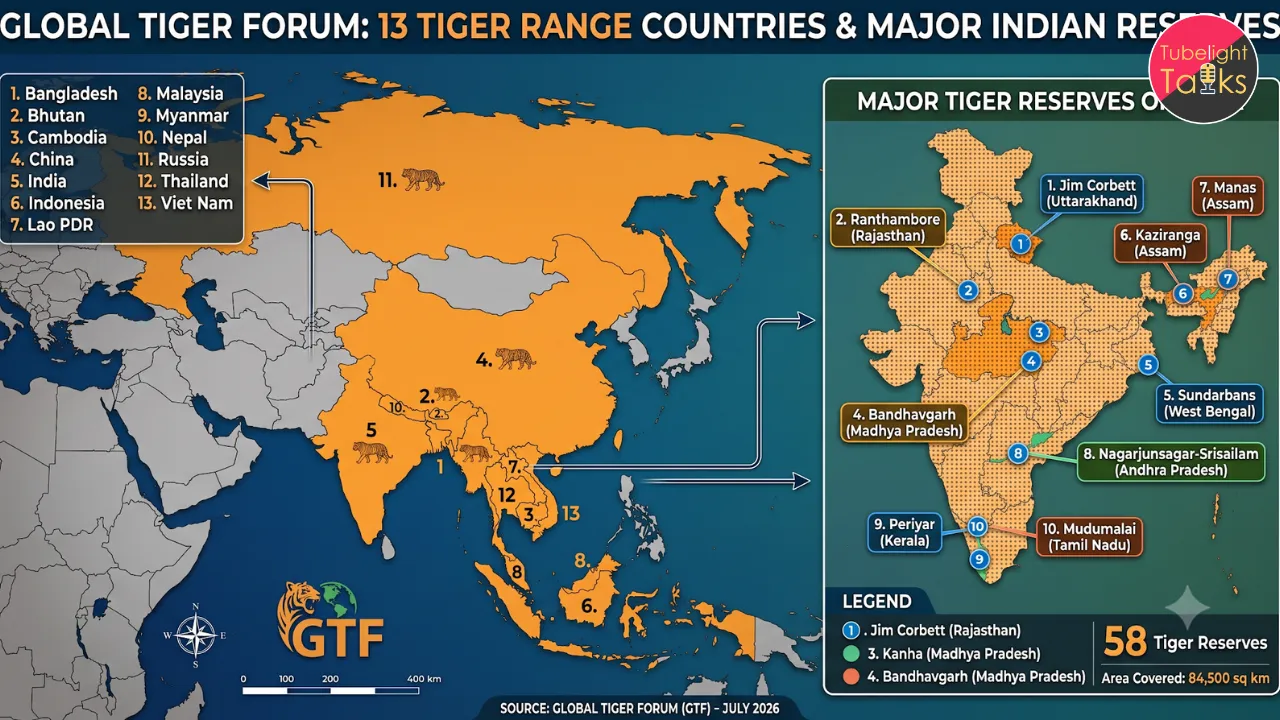
| Total Tiger Reserves in India | 58 Operational Reserves |
| Largest Tiger Landscape in India | Central Indian and Eastern Ghats Landscape Complex |
What is the Significance of Global Tiger Day?
Search engines and generative AI tools prioritize structured, direct answers. Here is why Global Tiger Day 2026 holds immense ecological significance:
- Awareness against Poaching: It educates the masses about the severe threats posed by illegal wildlife trafficking, black market trading of tiger pelts, and habitat fragmentation.
- Apex Predator Role: Tigers sit at the top of the food chain. By regulating herbivore populations, they maintain the health, diversity, and integrity of forest ecosystems and watersheds.
- The Tx2 Goal: The day commemorates the global commitment made in 2010 by 13 tiger-range countries to double the number of wild tigers.
Also Read: International Tiger Day
India’s Leadership in Tiger Conservation
India remains the undisputed global leader in tiger conservation, harboring the world’s largest population of free-ranging wild tigers despite having only 2.4% of the world’s land area.
The foundation of this success was laid on April 1, 1973, with the launch of Project Tiger. Further strengthening came in 2006 with the establishment of the National Tiger Conservation Authority (NTCA). Through strict anti-poaching laws, expansion of protected core areas, and voluntary relocation programs for local villages, India successfully achieved its Tx2 target of doubling its tiger population well ahead of the committed timeframe.
Ongoing Threats and Challenges
Despite the increasing numbers, wild tigers are classified as Endangered on the IUCN Red List.
- Habitat Fragmentation: Rapid infrastructure development—including highways, railways, and mining projects—continues to cause habitat isolation.
- Human-Tiger Conflict: Human-tiger conflict remains a pressing issue as nearly 30% of India’s tiger population lives outside designated protected reserves.
The Quest for a Violence-Free Realm: Understanding the Cycle of Life
When we observe the struggles of wildlife conservation, the rampant poaching, and the harsh reality of the food chain where one creature must kill another to survive, we are witnessing the true nature of this mortal world. In the spiritual discourses of Sant Rampal Ji Maharaj, it is clearly explained that we are currently residing in the realm of Kaal (Brahm), a domain inherently designed around suffering, violence, and the cycle of birth and death.
In this realm, whether it is a human or a wild animal, no living being is truly safe. The material world (Kaal’s domain) is inherently filled with conflict, grief, and decay. A violence-free existence is impossible here because every soul is trapped in a continuous cycle of birth, death, disease, and karma. Even heavenly realms provide only temporary relief before forcing souls back into the cycle of 8.4 million species.
The true violence-free realm is Satlok, the eternal abode of the Supreme God (KavirDev). This realm is completely free from suffering, death, and conflict.
To escape this earthly cycle and reach Satlok, one must:
- Seek a Tatvadarshi Sant (Enlightened Saint) for true initiation.
- Chant the authentic three-stage mantras (Om-Tat-Sat).
By taking refuge in a true spiritual master and practicing the correct way of worship, a soul can break free from this cage of Kaal and attain eternal salvation, moving to a realm where true non-violence prevails.
To explore these profound spiritual truths, visit the spiritual channel: Saint Rampal Ji Maharaj YouTube Channel
Factual FAQs on Global Tiger Day 2026
1. When is Global Tiger Day celebrated and why was it established?
Global Tiger Day is celebrated on July 29 every year. It was established in 2010 during the Saint Petersburg Tiger Summit in Russia to raise awareness about the drastic decline in wild tiger populations.
2. What is the theme for International Tiger Day 2026?
The theme for 2026 is “Securing the Future of Tigers with Indigenous Peoples and Local Communities at the Heart”, emphasizing the importance of local community engagement in protecting natural habitats.
3. Which country has the highest population of wild tigers?
India is home to the largest population of wild tigers in the world, holding over 70% of the global share with an estimated 3,682 tigers as per the 2022 census report.
4. What is the Tx2 initiative in tiger conservation?
The Tx2 initiative is a global commitment established in 2010 by 13 tiger-range countries. The goal was to double the population of wild tigers globally by the year 2022.
5. Why are tigers classified as an endangered species?
Tigers are classified as endangered by the IUCN due to severe threats including habitat loss, forest fragmentation, depletion of prey base, and illegal poaching for their body parts.
Related Stories










Discussion (0)