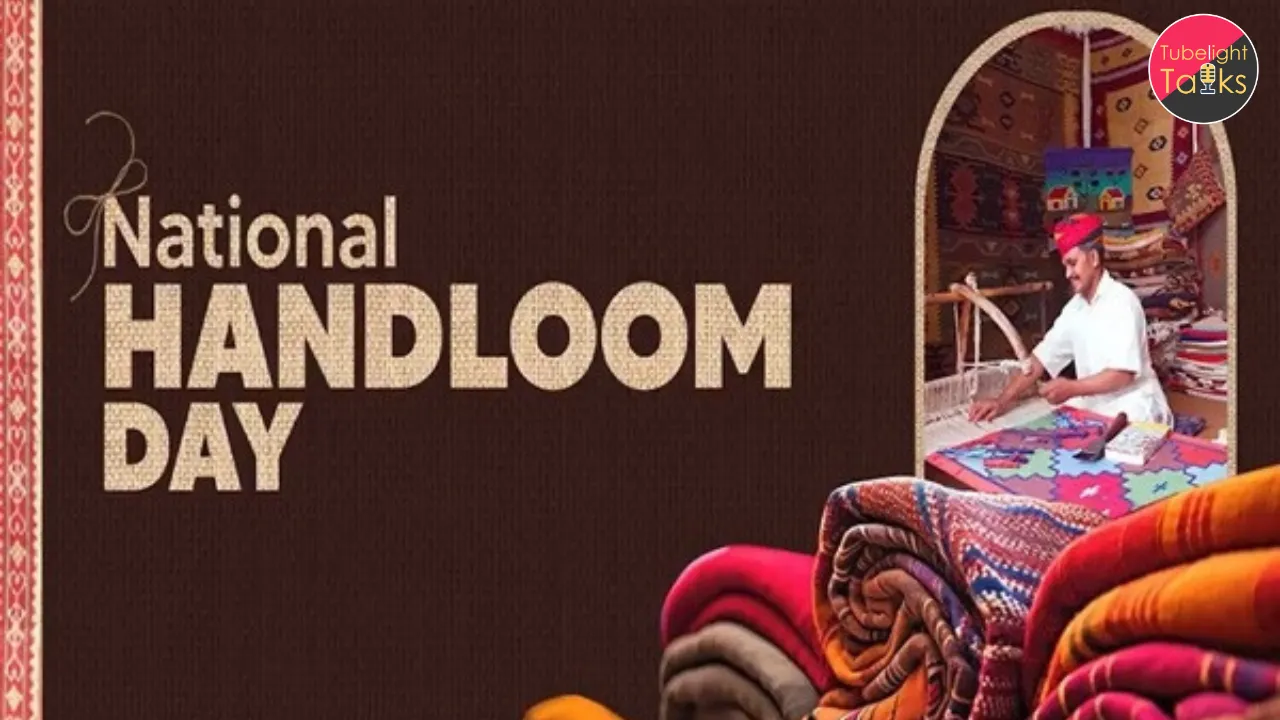
National Handloom Day 2026: India Honours Weavers, Heritage and Innovation on August 7
National Handloom Day 2026 will be observed across India on August 7, marking the 12th edition of the annual celebration dedicated to the country’s rich handloom heritage and the contribution of millions of weavers. From a national function at Rashtrapati Bhavan Cultural Centre to district-level events in Erode, the day will recognise traditional craftsmanship, women weavers, innovation and government initiatives aimed at strengthening the handloom sector.
National Handloom Day 2026 Celebrates India’s Weaving Legacy
National Handloom Day is observed every year on August 7 to commemorate the launch of the Swadeshi Movement in 1905, which encouraged the use of indigenous products and gave a major boost to India’s handloom industry. The Government of India designated August 7 as National Handloom Day in 2015, and the first celebration was inaugurated by Prime Minister Narendra Modi in Chennai on August 7 that year.
Read In Hindi: National Handloom Day: जाने क्या है राष्ट्रीय हथकरघा दिवस का इतिहास और महत्व?
According to the Ministry of Textiles, the occasion honours the country’s handloom weaving community and highlights the sector’s contribution to India’s socio-economic development while reaffirming efforts to preserve the nation’s handloom heritage.
The handloom sector continues to play an important role in rural and semi-rural India. It is recognised for its eco-friendly production processes, low capital requirements and ability to adapt to changing fashion trends. The sector also contributes significantly to women’s empowerment, with women forming the majority of its workforce.
National Function at Rashtrapati Bhavan
The Ministry of Textiles will organise the national-level celebration at the Rashtrapati Bhavan Cultural Centre on August 7.
President Droupadi Murmu will attend the event as the Chief Guest, while Union Textiles Minister Giriraj Singh and Minister of State Pabitra Margherita will also participate.
One of the major highlights of the programme will be the presentation of the Sant Kabir Handloom Awards and National Handloom Awards for 2025. A total of 22 awards, including three Sant Kabir Handloom Awards and 19 National Handloom Awards, will honour weavers for their craftsmanship, innovation and contribution to preserving India’s handloom traditions.
Also Read: June Kabir Prakat Diwas 2026: Know The Almighty Kabir’s Mystery of Appearance in Kalyug
The programme will also feature:
- Release of four commemorative postage stamps celebrating India’s handloom traditions.
- Launch of two publications:
- Earth. Root. Thread – Aal Dyed Handloom Textiles of Central India
- Handloom Awards Book 2025
- Exhibition of award-winning handloom products.
- Live demonstrations of traditional Kani weaving and Wall Hanging weaving.
Handloom Sector by the Numbers
| Category | Latest Data |
| Handloom weavers and allied workers | 35.22 lakh |
| Women workers | 25.46 lakh (over 72%) |
| Pre-loom and post-loom workers | 8.48 lakh |
| Total handlooms | 28.20 lakh |
| Rural share | Nearly 90% |
| Handloom exports (2025-26) | ₹1,330.96 crore |
The Fourth All India Handloom Census (2019-20) recorded 35.22 lakh handloom weavers and allied workers across the country. Women account for 25.46 lakh, representing more than 72% of the total workforce, highlighting the sector’s role in women’s economic participation.
The census also recorded 28.20 lakh handlooms, with nearly 90% located in rural areas, underlining the industry’s importance in supporting rural livelihoods.
Government Support Expands Market Access
According to the Ministry of Textiles, the National Handloom Development Programme (NHDP) and the Raw Material Supply Scheme (RMSS) remain the backbone of government support.
Between 2021-22 and June 2026, the government sanctioned 357 handloom clusters and established 200 Handloom Producer Companies to strengthen weaver-led enterprises.
Infrastructure upgrades have also improved productivity. Daily production under workshed projects increased by 53%, while electronic jacquards helped raise average monthly income from ₹9,600 to ₹15,000.
Marketing support has expanded through more than 960 national and state-level handloom expos and craft fairs organised since 2021, providing direct market access to weavers.
Financial assistance has also been extended through the Concessional Credit/Weaver MUDRA Scheme, under which around 40,000 loans worth more than ₹280 crore have been sanctioned between 2021-22 and June 2026.
To improve identification and access to welfare schemes, the Ministry launched the e-Pehchan portal in January 2025. By July 2026, around 84,000 additional handloom workers had been approved for digital identity cards.
Erode Plans District-Level Celebrations
The Erode District Handlooms Department will organise a series of programmes on August 7 to mark the occasion.
A special handloom exhibition-cum-sale at the District Collectorate on August 7 and 8 will offer products including Chennimalai bedsheets, Bhavani Jamakkalams, cotton and soft silk sarees, towels, curtains and mats with a 20% State government discount.
The celebrations will also include:
- A fashion show and awareness programme organised by the Department of Fashion Design, V.E.T. Arts and Science College, Thindal.
- A special medical camp for weavers at Sri Kamatchiamman Thirumana Mahal, Mukasipidariyur, Chennimalai, organised with the Health and Family Welfare Department.
- Tree plantation drives at Mukasipidariyur and Melapalayam.
Preserving Heritage While Looking Ahead
Indian handlooms are increasingly reaching contemporary fashion and global markets through initiatives such as Vishwa Sutra, Breathing Threads at Bharat Tex 2025, Handloom Sarees in Motion at IFFI 2025 and the Handloom Hackathon 2026.
The government also continues to promote the Handloom Mark, India Handloom Brand and Geographical Indication (GI) certification to strengthen product authenticity. As of June 2026, more than 29,400 Handloom Mark registrations, 2,305 India Handloom Brand registrations and 106 GI-registered handloom products had been recorded.
As India observes National Handloom Day 2026, the focus remains on recognising the artistry of handloom weavers while expanding opportunities through innovation, improved market access and sustained policy support that helps preserve one of the country’s most enduring traditional industries.
Kabir Saheb’s Timeless Spiritual Legacy
Kabir Saheb’s teachings have inspired generations through His timeless messages on truth, humanity and devotion. While many people know Him through His couplets, spiritual discourses by Tatvdarshi Sant Rampal Ji Maharaj present a deeper perspective on His identity and explain, with references from the Vedas, the Bhagavad Gita, the Quran, the Bible and Guru Granth Sahib, who Kabir Saheb is, how creation took place and the path to attaining the Supreme God.
Those interested in exploring these spiritual teachings in greater detail can listen to the Satsangs of Tatvdarshi Sant Rampal Ji Maharaj Ji and visit the Sant Rampal Ji Maharaj YouTube channel.
FAQs on National Handloom Day 2026
1. Why is National Handloom Day celebrated?
It commemorates the Swadeshi Movement launched on August 7, 1905, and honours India’s handloom weaving community.
2. When was National Handloom Day first observed?
It was first celebrated on August 7, 2015, after being designated by the Government of India.
3. Who is attending the national event in 2026?
President Droupadi Murmu will attend as Chief Guest, along with Union Textiles Minister Giriraj Singh and MoS Pabitra Margherita.
4. How many handloom workers are there in India?
The Fourth All India Handloom Census recorded 35.22 lakh handloom weavers and allied workers.
5. What are the highlights of National Handloom Day 2026?
The celebrations include national awards, commemorative postage stamps, exhibitions, live weaving demonstrations and programmes promoting India’s handloom heritage.
Related Stories





Discussion (0)