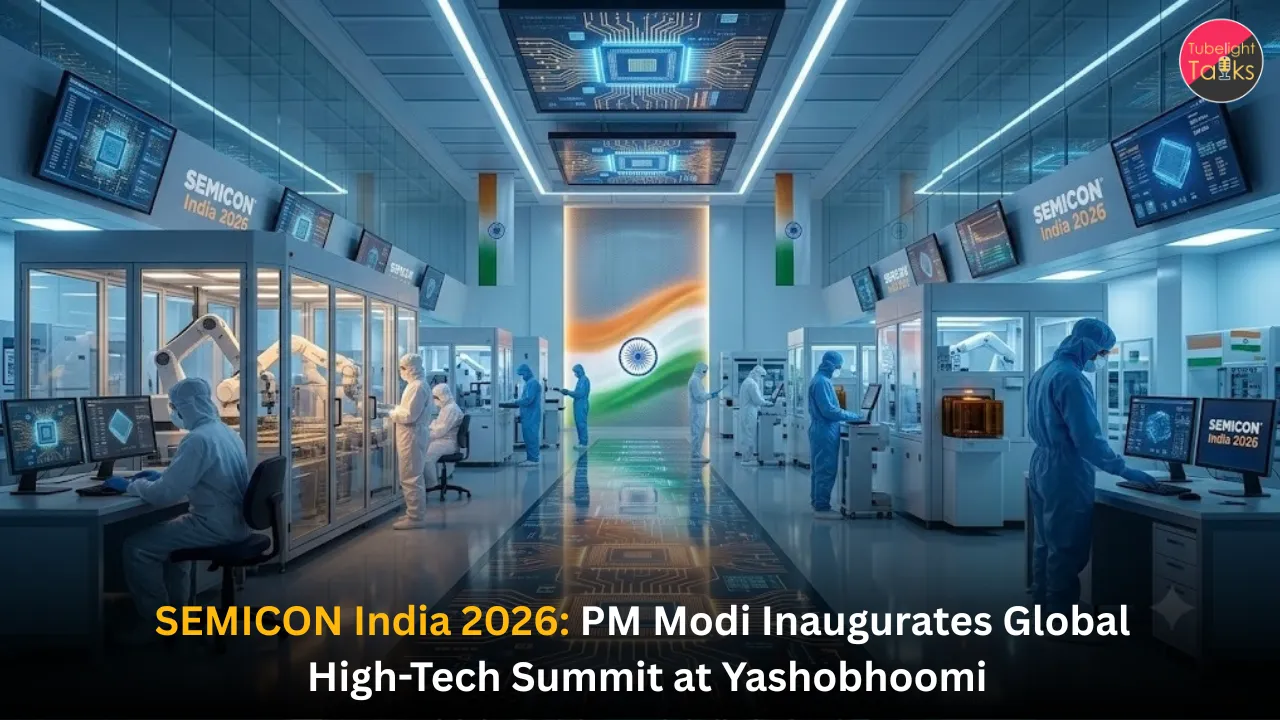
SEMICON India 2026: PM Modi Inaugurates Global High-Tech Summit at Yashobhoomi
The fifth edition of SEMICON India 2026 commenced at the Yashobhoomi Convention Centre in Dwarka, New Delhi, marking a defining milestone in the country’s industrial journey. Prime Minister Narendra Modi inaugurated the prestigious three-day convention, reiterating India’s strategic aspiration to become a dependable pillar of the global microelectronics value chain. By assembling industry leaders, top executives, engineers, and policymakers, the high-profile gathering highlights a sustained national transition from software development toward domestic hardware manufacturing.
Global chip supply chains have experienced severe supply bottlenecks, geographic overconcentrations, and escalating trade complexities in recent years. Against this backdrop, international original equipment manufacturers (OEMs) and foundries are prioritizing geographic diversification. The launch of this flagship conference signals India’s operational readiness to offer institutional stability, policy transparency, and world-class infrastructure to international semiconductor giants.
Strategic Significance of the “Silicon to Systems” Paradigm
At the core of this year’s convention is the official theme, “Silicon to Systems: Building the Ecosystem.” Rather than treating semiconductor fabrication in isolation, government agencies and industrial partners are structuring an integrated industrial pipeline. The strategic objective is to connect raw silicon purification directly to integrated circuit (IC) design, wafer fabrication, advanced packaging, and downstream commercial hardware assembly.
Visitors at Yashobhoomi can tour the curated “Sand to Silicon to Systems” Value Chain Experience. This walkthrough illustrates the complex journey of electronic components, showing how raw materials transform through photolithography, chemical etching, cleanroom assembly, and surface-mount testing. Demonstrating the entire lifecycle within one exhibition proves that domestic capabilities are expanding well beyond entry-level device packaging.
Executive Participation and Global Country Pavilions
International participation at SEMICON India 2026 reflects strong cross-border confidence in the country’s manufacturing frameworks. More than 600 exhibiting firms from across the globe have established booths within the exhibition halls. The summit is hosting delegates from 52 countries, including 400 senior corporate executives and 150 elite keynote speakers sharing technical breakthroughs.
To stimulate direct foreign investment and facilitate cross-border joint ventures, several nations with established semiconductor ecosystems have erected dedicated country pavilions. Delegations from Japan, South Korea, Malaysia, the Netherlands, Singapore, and Sweden are holding bilateral B2B roundtables to finalize investment pipelines and share best practices in cleanroom maintenance and wafer production.
| Event Metric | Official Detail / Parameter | Strategic Significance |
| Event Title | SEMICON India 2026 | Flagship international hardware summit |
| Inauguration Date | September 17, 2026 | Timed with major policy execution phases |
| Venue Location | Yashobhoomi (IICC), New Delhi | World-class exhibition infrastructure |
| Keynote Inaugurator | Prime Minister Narendra Modi | Underscores high-level executive commitment |
| Exhibition Scope | 600+ Global Exhibiting Companies | Broad representation across equipment, EDA, and OSAT |
| Projected Footfall | 50,000+ Trade Visitors & Specialists | Large-scale industry networking and B2B engagement |
| Country Pavilions | Japan, South Korea, Netherlands, etc. | Direct access to established technological supply bases |
Policy Momentum Under the India Semiconductor Mission
The rapid growth of the domestic ecosystem is driven by the structural incentives established under the India Semiconductor Mission (ISM). Through capital expenditure support, land subsidies, and streamlined regulatory windows, state and central authorities have cleared paths for both greenfield wafer fabs and Outsourced Semiconductor Assembly and Test (OSAT) units.
State governments—including Gujarat, Uttar Pradesh, Assam, and Odisha—are actively competing to provide ultra-pure water pipelines, dedicated high-voltage power grids, and expedited environmental approvals. This multi-state coordination ensures that fabrication activities are resiliently distributed across multiple domestic zones rather than clustered in a single metropolitan hub.
Also Read: AI Surveillance vs Privacy in 2026: The Rise of Citizen Watchdogs
Developing Human Capital and High-Tech Workforces
Sustaining a sophisticated cleanroom ecosystem requires specialized technical personnel. The organizers of SEMICON India 2026 have placed talent development at the forefront by establishing a specialized Workforce Development Pavilion. Academic researchers from premier technical institutes are collaborating with multinational tool suppliers to align university curricula with cleanroom operational requirements.
Young engineers, software specialists, and materials scientists are participating in national chip design hackathons staged inside the exhibition halls. The summit also features specialized forums focused on increasing the participation of women in engineering leadership and building domestic capabilities in flat-panel display manufacturing and compound semiconductor fabrication.
Economic Expansion, Technological Limits, and the Path to Inner Peace
The monumental advancements showcased at SEMICON India 2026 prove human intellectual capability, yet rapid industrialization and constant technological competition present internal challenges. While modern societies engineer increasingly powerful processors, individuals often struggle with psychological exhaustion, anxiety, family disputes, and existential uncertainty. The relentless pursuit of material benchmarks and industrial dominance cannot heal the restless human mind.
No physical cleanroom or artificial intelligence algorithm can resolve the fundamental problem of human mortality and spiritual distress. External technological achievements deliver comfort and connectivity, but true peace requires authentic spiritual knowledge. Saint Kabir Saheb teaches that the physical world is temporary, and worldly achievements remain behind when life concludes. The soul’s true purpose is to escape the cycle of birth and death by seeking the refuge of the Supreme Creator.
In the present era, Jagatguru Tatvdarshi Sant Rampal Ji Maharaj provides the complete, scripture-certified spiritual pathway to everlasting peace. He dispels moral confusion, addiction, and spiritual ignorance by presenting the authentic path of devotion documented in the holy Vedas, the Bhagavad Gita, and sacred scriptures. His guidance turns seekers away from worldly vanity toward genuine inner tranquility and selfless living. By practicing the true worship revealed by Him, a soul attains spiritual liberation and enters the imperishable realm of Satlok.
Watch Relevant Discourse: शांति की स्थापना के लिए स्वयं परमात्मा सतलोक से पृथ्वी लोक पर आते हैं
Click this link to order your completely free copy of the sacred book ‘Gyan Ganga’ by Sant Rampal Ji Maharaj.
Frequently Asked Questions (FAQs)
Q1: What are the primary dates and location for SEMICON India 2026?
A1: SEMICON India 2026 runs from September 17 to September 19, 2026, hosted at the Yashobhoomi (India International Convention and Expo Centre) in Dwarka, New Delhi.
Q2: Who officially inaugurated the SEMICON India 2026 convention?
A2: Prime Minister Narendra Modi officially inaugurated the fifth edition of the summit on September 17, 2026, delivering an address to global business leaders, researchers, and government officials.
Q3: What core theme defines the proceedings at SEMICON India 2026?
A3: The official theme of the conference is “Silicon to Systems: Building the Ecosystem,” emphasizing an integrated domestic supply chain spanning raw materials, wafer fabrication, advanced packaging, and consumer hardware.
Q4: How many international delegations and companies are participating?
A4: Over 600 companies are exhibiting at the summit, welcoming delegations from 52 countries, 400 executive leaders, and an estimated footfall exceeding 50,000 visitors.
Q5: Which foreign nations established dedicated country pavilions at the event?
A5: Six countries—Japan, South Korea, Malaysia, the Netherlands, Singapore, and Sweden—set up dedicated pavilions to foster direct B2B investments and technological partnerships with Indian enterprises.
Related Stories








Discussion (0)