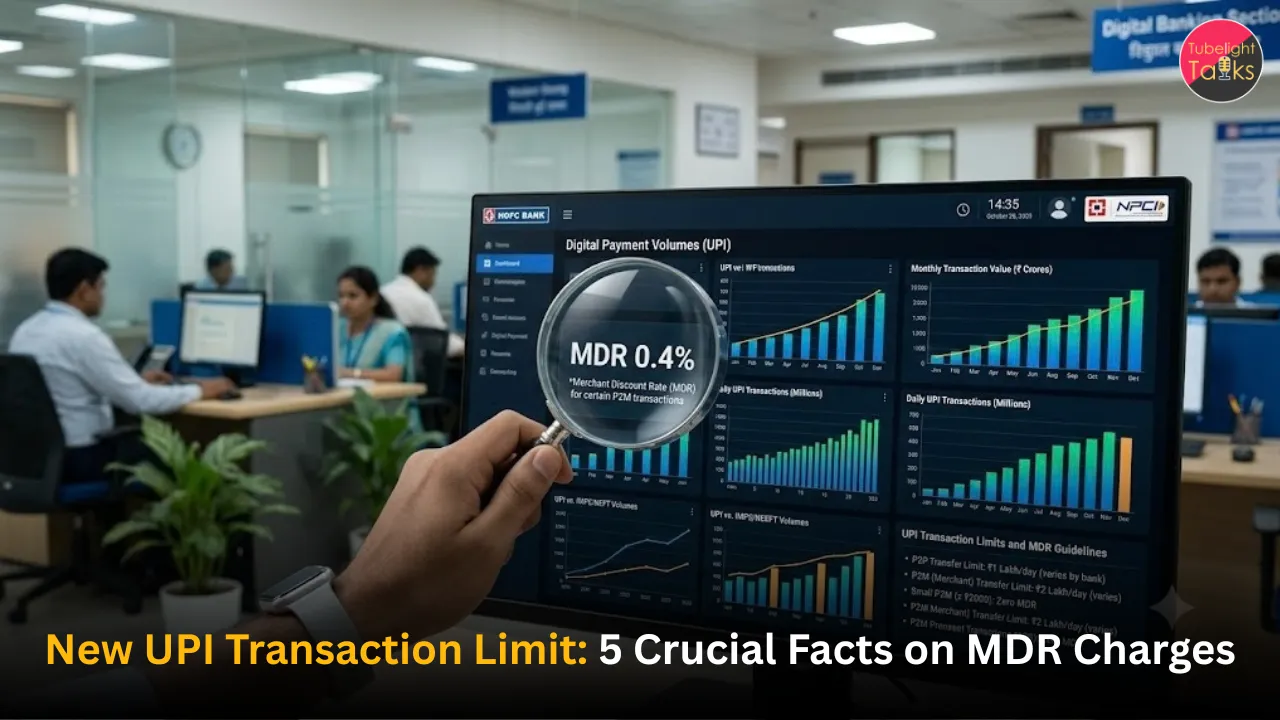
New UPI Transaction Limit: 5 Crucial Facts on MDR Charges
The digital payments landscape in India is navigating a decisive transformation as regulators move to build a durable financial foundation. The National Payments Corporation of India (NPCI) has formally implemented an updated UPI transaction limit framework regarding fee-free commercial settlements across the country. While widespread rumors have circulated across various social media forums suggesting that ordinary citizens will face extra levies, the practical regulatory mechanics present an entirely different reality.
Starting immediately, the revised regulatory standard applies a targeted 0.4% Merchant Discount Rate (MDR) on Person-to-Merchant (P2M) payments exceeding an established payment threshold. Consumers, merchants, and digital enterprises must grasp the operational parameters of this UPI transaction limit to properly evaluate their everyday payment routines, online shopping practices, and checkout dynamics.
Understanding the New UPI Transaction Limit and MDR Mechanics
The NPCI established this specific threshold to sustain the rapidly expanding digital banking architecture without overburdening state finances. Under the official directive, the fee-free threshold under the UPI transaction limit for merchant collections is fixed at Rs 2,000. When a customer executes a purchase exceeding Rs 2,000 to an authorized commercial enterprise, an MDR of 0.4% comes into effect. To safeguard commercial stability, the regulatory authority has strictly capped the maximum permissible fee at Rs 5 per transaction.
This MDR is not a penalty or punitive levy; it represents an industry-standard interchange fee structured to support payment aggregators, sponsor banks, and platform providers who manage high-capacity processing nodes. For years, public subsidies absorbed these massive operational outlays to accelerate widespread adoption. As monthly clearing volumes scale into tens of billions of individual records, creating a self-sufficient operational revenue stream has become an inescapable technical requirement.
Consumer Protection Rules Under the UPI Transaction Limit
The most important takeaway for regular consumers is straightforward: everyday retail users pay nothing extra. The restructured UPI transaction limit applies exclusively to commercial entities and acquiring platforms. Whenever you pay for electronics, restaurant dining, or monthly retail supplies exceeding Rs 2,000, your personal account reflects only the actual transaction sum. The receiving bank deducts the fractional MDR directly from the merchant’s gross intake prior to final settlement.
For example, if you complete a transaction of Rs 4,500 at a registered home appliance center, your linked bank account registers a precise debit of Rs 4,500. You will never encounter arbitrary checkout markups, payment handling levies, or terminal surcharge lines added onto your final invoice. The NPCI mandates that merchant entities cannot transfer this processing overhead onto the paying buyer under any circumstances.
Grassroots Safeguards and Exemption Policies
To shelter small enterprises and family units from unnecessary financial friction, regulatory authorities designed sharp exemptions surrounding the operational UPI transaction limit. Retaining the operational divide between personal peer transfers and registered commercial settlements remains central to this architecture:
- Person-to-Person (P2P) Settlements: Transferring money between family members, reimbursing colleagues, or settling shared personal expenses remains 100% free of charge, regardless of the transaction volume.
- Small Vendors and Micro-Merchants: Neighborhood produce stalls, independent tea vendors, and unorganized village shops receiving collections below Rs 2,000 are fully exempt from MDR processing deductions.
- Essential Utility Billing Slabs: Standard government bill payments and educational institutions operate under designated relief brackets to avoid disturbing public services.
By implementing this calibrated UPI transaction limit, regulators guarantee that large commercial conglomerates support payment processing maintenance, while informal vendors retain full access to zero-cost digital finance.
| Transaction Type | Amount Category | MDR Applicable | Maximum Charge | Fee Bearer |
| Person-to-Person (P2P) | Any Amount | No (0%) | Rs 0 | Nobody (Free) |
| Person-to-Merchant (P2M) | Up to Rs 2,000 | No (0%) | Rs 0 | Nobody (Free) |
| Person-to-Merchant (P2M) | Above Rs 2,000 | Yes (0.4%) | Rs 5 | Merchant Entity |
| Prepaid Payment Instruments (Wallets) | Above Rs 2,000 | Yes (Up to 1.1%) | Interchange Cap | Merchant / Issuer |
Also Read: UPI Rules 2026: ₹2000 तक डिजिटल पेमेंट पूरी तरह मुफ्त, जानिए ₹2000 से ऊपर के ट्रांजेक्शन का पूरा सच
Why Regulators Restructured the Payment Architecture
For nearly a decade, zero-fee mandates propelled real-time digital payments across the country. Yet running real-time clearance grids demands extensive capital investments in physical hardware and data integrity. Leading banking institutions and payment interfaces manage colossal server demands every second, requiring round-the-clock defensive measures against digital threats.
Financial system analysts have repeatedly noted that an entirely fee-free operational model restricts continuous technological investment. By applying an MDR above the specified UPI transaction limit, payment processors obtain steady cash flows to upgrade infrastructure resilience. These reserves fund enhanced fraud detection, multi-region server redundancy, and near-instant dispute resolutions across modern banking systems.
Commercial Adaptations and Market Realities
Will modern businesses abandon digital checkouts because of these updated rules? Industry data suggests merchant resistance will remain negligible across commercial sectors. Because the maximum service charge is strictly capped at Rs 5, a business selling an item for Rs 40,000 absorbs only an imperceptible reduction in its gross operating margin.
Retail chains understand that declining modern digital payments risks alienating shoppers who rarely carry physical cash. The efficiency of real-time account reconciliation, reduced cash pilferage, and elevated daily store traffic easily outweigh the minor administrative costs established under the modern payment guidelines.
Achieving Lasting Stability Amidst Shifting Economic Policies
Modern headlines frequently highlight the unstable nature of commercial structures and monetary conventions. Today, an institutional adjustment like an MDR deduction recalculates operating revenues; tomorrow, systemic inflation or unexpected currency realignments can diminish lifetime savings. While people dedicate their lives to navigating regulatory changes and monetary goals, material reserves deliver only temporary reassurance. The relentless pursuit of material accumulation often blinds human beings to the fundamental purpose of existence.
True security is never found in fluctuating bank ledgers or digital wallets, but in developing eternal spiritual devotion. Sacred texts show that the Supreme Creator, God Kabir, is the ultimate caretaker of all life. When an individual undertakes true worship under a realized mentor, the Supreme Lord alleviates worldly anxieties and grants genuine spiritual sanctuary.
Jagatguru Tatvdarshi Sant Rampal Ji Maharaj delivers this authentic spiritual knowledge to humanity, validating His teachings through primary scriptures, including the Holy Vedas, Shrimad Bhagavad Gita, Holy Quran, and the Bible. He explains that permanent salvation and inner tranquility are achieved only by taking refuge in the Supreme God and following authentic devotion. He Himself emphasizes that material wealth remains here when we leave, whereas true devotion secures the soul’s eternal journey. By walking the path of spiritual practice shown by Him, an individual gains relief from the stresses of worldly existence and attains lasting liberation in the eternal abode (Satlok).
Watch Relevant Discourse: परमात्मा चारों युगों में आते हैं | संत रामपाल जी महाराज सत्संग
Click this link to order your completely free copy of the sacred book ‘Gyan Ganga’ by Sant Rampal Ji Maharaj.
Frequently Asked Questions
What is the new UPI transaction limit for fee-free commercial transactions?
The regulatory framework sets the fee-free threshold under the UPI transaction limit at Rs 2,000 for Person-to-Merchant (P2M) purchases. Any transfer made to a registered commercial vendor below or equal to this sum is processed entirely free of charges for both the consumer and the store owner.
Will personal transfers between relatives or friends face additional deductions?
No. Standard Person-to-Person (P2P) transfers remain completely unaffected by these fees. You can move funds freely between personal bank accounts, family members, or acquaintances without paying any administrative levies.
Who covers the 0.4% charge when crossing the UPI transaction limit?
The receiving merchant covers the 0.4% fee whenever a shopper pays an amount exceeding Rs 2,000. Consumers pay only the exact purchase cost, as payment aggregators deduct the processing charge directly from the merchant’s gross deposit.
Is there a regulatory cap on MDR deductions for high-value purchases?
Yes, the NPCI has enforced a strict upper ceiling of Rs 5 per transaction. Even on high-value settlements of Rs 50,000 or more, the total fee absorbed by the merchant cannot exceed Rs 5.
Are neighborhood grocery stores and small street vendors subject to these charges?
Most independent street stalls and local neighborhood shops conduct transactions well below the Rs 2,000 threshold, remaining entirely exempt. Furthermore, banks maintain separate exempt classifications for micro-merchants, protecting small businesses from routine payment processing charges.
Yes, the NPCI has enforced a strict upper ceiling of Rs 5 per transaction. Even on high-value settlements of Rs 50,000 or more, the total fee absorbed by the merchant cannot exceed Rs 5.
Are neighborhood grocery stores and small street vendors subject to these charges?
Most independent street stalls and local neighborhood shops conduct transactions well below the Rs 2,000 threshold, remaining entirely exempt. Furthermore, banks maintain separate exempt classifications for micro-merchants, protecting small businesses from routine payment processing charges.
Related Stories





Discussion (0)