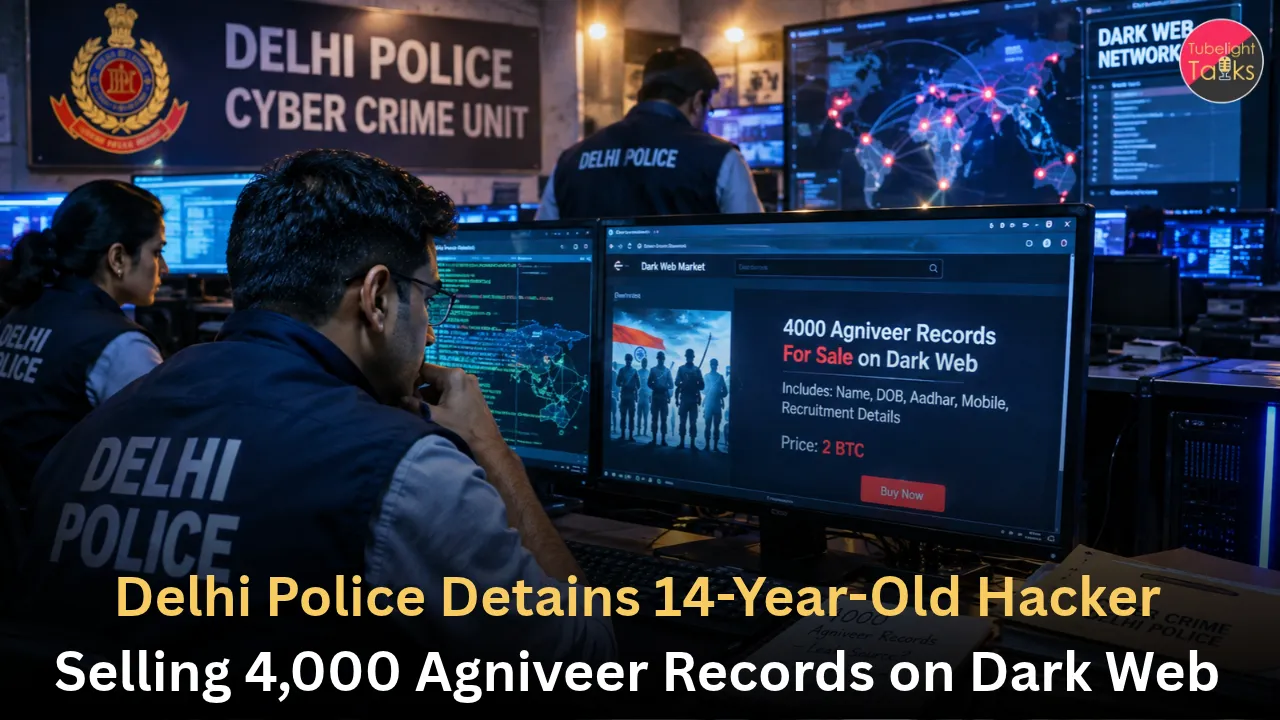
14-Year-Old Hacker Trying to Sell Private 4000 Agniveer Records on Dark Web Detained by Delhi Police
Law enforcement officials in the national capital apprehended a 14-year-old hacker trying to sell private 4,000 Agniveer records on the dark web for $500. The Intelligence Fusion and Strategic Operations (IFSO) unit of the Delhi Police tracked down the juvenile from Ballabgarh in Haryana after detecting an online advertisement offering unauthorized access to sensitive recruitment files.
Investigators confirmed that the minor used artificial intelligence tools to exploit coding vulnerabilities on a test portal designed for former Agniveers. While authorities seized the digital devices containing the alleged database before any transaction occurred, forensic teams are currently verifying the authenticity of the recovered files with the Union Ministry of Home Affairs (MHA).
How Delhi Police Tracked the Hacker Trying to Sell Private 4000 Records?
The investigation began in October 2026 after cyber monitoring teams spotted a dark web listing advertising personal details and administrator credentials linked to an MHA recruitment website. The seller listed a Telegram handle to negotiate payments with prospective buyers, demanding $500 for the entire dataset.
Specialists from the Delhi Police Special Cell and IFSO unit traced the digital footprint of the Telegram account directly to a private school student residing in Ballabgarh, Haryana. Officers detained the teenager, questioned him for two hours in the presence of legal guardians, and confiscated his electronic devices for forensic analysis.
Case Timeline and Investigation Summary
| Parameter | Official Case Details |
|---|---|
| Accused Profile | 14-year-old private school student from Ballabgarh, Haryana |
| Investigating Agency | Delhi Police Intelligence Fusion and Strategic Operations (IFSO) |
| Alleged Claim | Personal data of 2,500 to 4,000 Agniveers & portal admin credentials |
| Asking Price | $500 (approx. ₹42,000) via dark web listing and Telegram |
| Method Used | Automated AI bots exploiting landing page coding gaps |
| Current Legal Status | FIR registered under IT Act; minor handed over to family after questioning |
Role of AI Tools in the Alleged Agniveer Portal Breach
According to senior police officials, the case highlights a troubling shift in juvenile cybercrime: the use of generative artificial intelligence to automate vulnerability scanning. The teenager did not possess advanced manual coding expertise; instead, he deployed an AI bot to scan the landing page of a test website for structural flaws.
Once the AI tool identified gaps in the website’s architecture, the juvenile bypassed authentication protocols and extracted saved job application data. Police noted that the boy’s primary motive was quick financial gain rather than espionage or ideological disruption.
Also Read: India-Japan Defense Tech Partnership 2026
What Is the MHA Agniveer Portal?
The Union Ministry of Home Affairs conceptualized this digital platform to assist former Agniveers after they complete their four-year military tenure under the Agnipath scheme. Its primary functions include:
- Post-Service Transition: Connecting outgoing Agniveers with vacancies in the Central Armed Police Forces (CAPFs), Assam Rifles, and state police departments.
- Application Management: Storing candidate registration details, educational records, and service history for streamlined government recruitment.
- Administrative Controls: Allowing authorized agencies to manage job postings, process grievances, and export applicant reports.
Forensic Verification: Was the Data Genuine ?
Despite the alarming headline of a hacker trying to sell private 4,000 personnel records, investigators have urged caution until forensic cross-checking concludes. While some dark web advertisements boasted access to 4,000 profiles—and even claimed broader access across 47 government departments—preliminary device inspections recovered records linked to roughly 2,500 applicants.
The Delhi Police have formally written to the Ministry of Home Affairs (MHA) requesting the official Agniveer database to match against the seized files. Investigators are working to answer three critical questions:
- Whether the compromised platform was a live government server or an isolated staging/test environment.
- Whether the recovered personal details belong to actual Agniveer personnel or represent fabricated test entries.
- Whether any third party downloaded or purchased the dataset before police intervened.
Officials confirmed that no financial transaction was completed on the dark web prior to the boy’s detention. An FIR has been registered under relevant sections of the Information Technology Act, 2000, and the juvenile is being dealt with strictly under the provisions of the Juvenile Justice Act.
Protecting Young Minds from Digital Temptations Through True Spiritual Wisdom
When a 14-year-old breaches government servers using AI for just $500, it highlights more than a technical flaw; it shows a deep moral void in today’s youth. Firewalls and laws alone cannot stop greed and instant gratification without true ethical direction.
Real change comes from understanding life’s true purpose. Through the spiritual discourses of Sant Rampal Ji Maharaj, millions including students and professionals are learning righteousness, honesty, and devotion to Supreme God Kabir Ji. His teachings show that wealth gained through harm leads to suffering, while a virtuous life brings lasting peace.To learn how true spiritual knowledge transforms character, watch the discourses on the Sant Rampal Ji Maharaj YouTube channel.
FAQs
1. Who was detained by the Delhi Police in the Agniveer data leak case?
The Delhi Police’s IFSO unit detained a 14-year-old private school student from Ballabgarh, Haryana. Investigators found that the minor was the hacker trying to sell private 4,000 Agniveer records on the dark web.
2. How much money did the teenager demand for the Agniveer data?
The juvenile advertised the database and administrator credentials on a dark web forum for $500. He shared a Telegram ID in the listing to communicate with potential buyers, which allowed cybercrime investigators to trace his location.
3. How did the 14-year-old gain access to the Agniveer website?
According to Delhi Police investigators, the boy used automated artificial intelligence (AI) tools to scan for coding gaps on the landing page of a test website. Exploiting those vulnerabilities allowed him to access saved application data.
4. Was the Agniveer data successfully sold on the dark web?
No, Delhi Police officials confirmed that they apprehended the minor and seized his digital devices before any sale or financial transaction could be completed.
5. Is the recovered Agniveer data confirmed to be authentic?
Not yet; the Delhi Police have written to the Union Ministry of Home Affairs (MHA) to obtain official records and cross-check whether the seized files contain genuine personnel data or test entries.
Related Stories





Discussion (0)