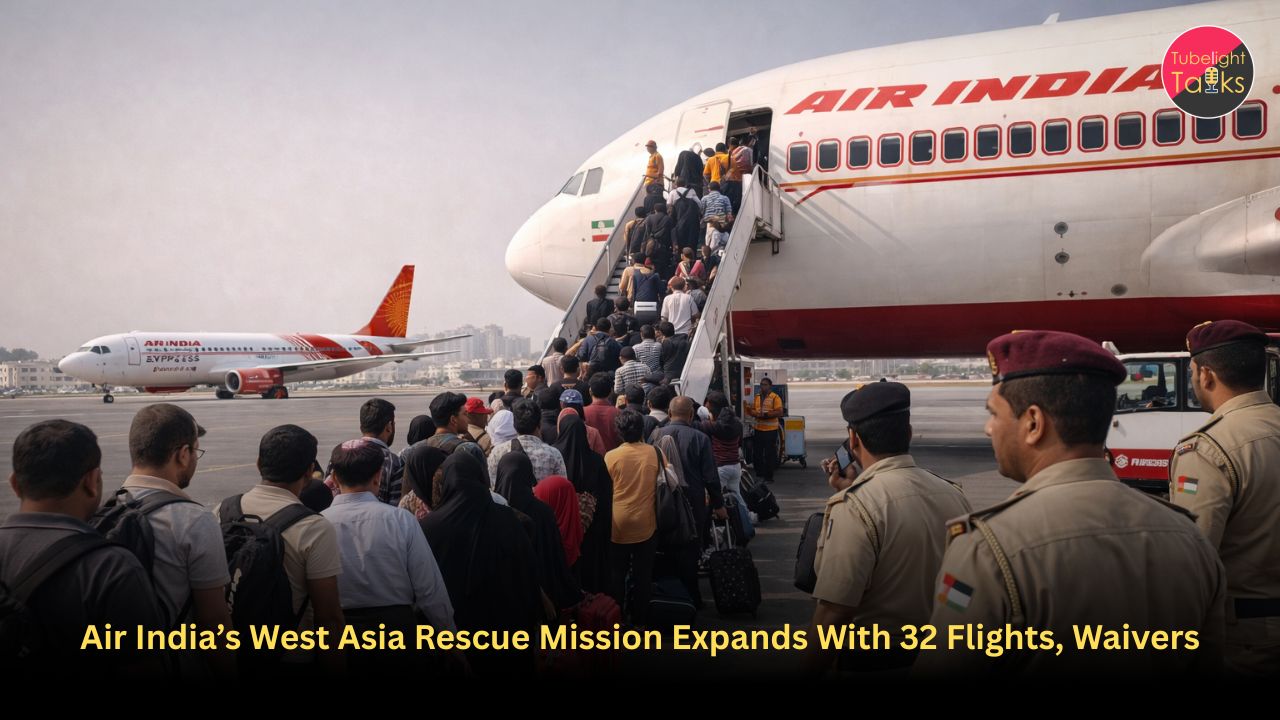
Air India’s West Asia Rescue Mission Shows Civil Aviation as Crisis Lifeline
Air India and Air India Express have stepped up their West Asia operation again on Wednesday, March 26, 2026, announcing a combined 32 scheduled and non-scheduled flights to and from the region under Air India’s West Asia rescue mission. The official update matters because it clarifies the current position precisely: the group is not operating “32 special flights” alone, but 32 total West Asia services today, including 12 ad-hoc UAE flights alongside scheduled connectivity to Jeddah, Muscat, and Riyadh.
That distinction is important in a fast-moving crisis, because route availability is changing day by day and the airlines are trying to keep stranded passengers moving through the corridors that remain workable.
This aviation push sits inside a much wider national effort. In an official inter-ministerial briefing on March 24, the Government of India said the flight situation from West Asia was improving, that around 4,02,000 passengers had returned to India from the region since February 28, and that limited non-scheduled services from the UAE continued even while Kuwait and Bahrain airspaces remained closed.
That means Air India’s operation is not an isolated airline response. It is part of a broader Indian strategy to preserve mobility, assist nationals, and use whatever viable air routes remain open.
What Air India is operating today
The official March 26 update from the Air India group lays out the plan clearly. The group said it would operate 32 scheduled and non-scheduled flights to and from West Asia today. Of these, the biggest flexible support element is the 12 non-scheduled flights to and from the UAE, subject to slot availability and prevailing conditions. Alongside those ad-hoc UAE services, the group is continuing scheduled links to Jeddah, Muscat, and Riyadh, which are among the most important remaining gateways for Indian travelers in the region right now.
The route structure also shows how carefully the airline is working around disruptions. The March 26 table says there are no operating services today to Kuwait, Bahrain, Doha, or Tel Aviv under the Air India group plan, while UAE ad-hoc services continue from airports such as Dubai, Abu Dhabi, and Sharjah. Muscat, Jeddah, and Riyadh remain active scheduled corridors. In practice, this means the rescue mission is relying on partially functional regional hubs rather than pretending the whole Gulf network has normalized.
Why this operation matters so much
The importance of these flights is not only logistical. It is human. The government’s March 24 briefing said transit of Indian nationals was being facilitated via Saudi Arabia for people in Kuwait, Bahrain, and Iraq, while Indian nationals in Iran were also being assisted through Armenia and Azerbaijan. That context makes airline operations to places such as Jeddah, Muscat, and Riyadh far more than ordinary commercial sectors. They are functioning as parts of an emergency mobility network.
This also explains why every operational corridor matters. When some airspaces are closed and others are only partially functioning, a route to Muscat or Riyadh can effectively become a bridge home for people who cannot travel directly from their original location. That is why the Air India group’s March 26 schedule should be read as a rescue-support framework, not just a flight roster. This is an inference based on the official route pattern and the government’s description of alternate transit arrangements.
Free rebooking and passenger outreach are central to the mission
A major part of the operation is customer handling, not just aircraft movement. Air India said passengers booked on routes where its scheduled services remain temporarily suspended can rebook to a future date at no additional charge or opt for a full refund. Air India Express separately said passengers booked from any UAE station can rebook without extra charges onto its additional commercial flights operating from any UAE station to destinations in India.
The airline group also said it is proactively reaching out to impacted guests using the mobile numbers registered in their bookings. That detail matters because crisis aviation is often decided as much by communication as by capacity. A stranded passenger who cannot interpret rapidly changing schedules is still stranded even if a seat eventually exists. By directly contacting affected travelers and pushing rebooking options, the airline is trying to reduce confusion and speed decision-making.
Also Read: Global Relief as Trump Iran Strike Pause Eases Economic Pressure
The AI layer is real, but it is specific
The user’s summary mentioned AI-powered digital assistants, and the current official wording makes that more precise. Air India Express says passengers with active bookings can rebook through Tia, its AI-powered digital assistant on WhatsApp. That is an important and practical use of AI in a crisis: not as a vague marketing label, but as a tool for rebooking travelers faster when call centers and websites may be under pressure. The official statement does not say that all rescue outreach itself is being done by AI; it says the airline is proactively reaching out to passengers and that Air India Express customers can use Tia to rebook.
That distinction is worth keeping clear. In crisis operations, accuracy matters. The AI-enabled part is the Air India Express rebooking interface, while the broader passenger-contact effort is described as proactive outreach using registered mobile numbers. Together, though, they show a more digitally coordinated rescue response than Indian passengers might have seen in older aviation disruptions. This is an inference grounded in the exact wording of the airline’s March 26 update.
This is part of a larger Indian return effort
The wider numbers show why aviation has become so important. The March 24 government briefing said more than 4.02 lakh passengers had returned from the region to India since February 28, with around 85 flights expected from the UAE to India that day across carriers. It also said Gulf Air and Jazeera Airways were helping facilitate travel from closed-airspace countries through alternate airports in Saudi Arabia. That broader context makes Air India’s March 26 schedule look like one visible part of a much larger movement system being improvised under pressure.
There is also a recency point here. As of March 25, official day-by-day flight numbers had been varying. The Air India group’s March 25 update mentioned 26 total West Asia flights, while the March 26 update raised that to 32. That means capacity is being actively adjusted rather than fixed. The rescue mission is therefore best understood as dynamic and demand-responsive, not static.
Why this is one of the day’s biggest governance stories
At first glance, this may look like an airline operations update. It is bigger than that. When airspace is restricted, sea lanes are under stress, and hundreds of thousands of people are trying to return or reroute, airlines become instruments of national resilience.
Air India’s operation today shows how a commercial carrier and its low-cost arm can be pushed into a quasi-relief role: keeping open corridors alive, absorbing disrupted demand, waiving charges, and helping citizens get home with a mix of scheduled, ad-hoc, and digitally managed services. That is an inference based on the official schedule, waiver policy, and the government’s return figures.
Service in Difficult Times
Teachings associated with Sant Rampal Ji Maharaj emphasize compassion, responsibility, and helping people in moments of distress rather than thinking only in narrow self-interest. In that spirit, a rescue-oriented air operation has value not merely as transport management, but as service. When systems are designed to reduce suffering, remove confusion, and help ordinary people return safely to their families, governance and technology both become more humane. This is a spiritual reflection, not a factual claim.
Call to Action
Follow official flight updates, not rumor chains
In volatile situations, passengers and families should rely on airline advisories, official government briefings, and verified booking channels. The March 26 Air India update itself makes clear that flights remain subject to slot availability, prevailing local conditions, and route-specific suspensions. That means old screenshots and rumor-based messages can quickly become misleading.
Keep booking details updated
One of the simplest but most important steps passengers can take is to ensure that the mobile number on the booking is current. Air India says it is proactively contacting impacted travelers through registered numbers, and Air India Express is offering WhatsApp-based rebooking through Tia. In a fast-moving evacuation or disruption environment, accurate contact information can make the difference between confusion and a usable travel option.
FAQs: Air India’s West Asia Rescue Mission Push Expands on March 26
1. Is Air India operating 32 “special” flights today?
The current official update for March 26, 2026 says Air India and Air India Express are operating 32 scheduled and non-scheduled West Asia flights in total, not 32 ad-hoc flights alone. Of these, 12 are non-scheduled UAE flights.
2. Which West Asia destinations are being served today?
The Air India group says it is operating services involving UAE airports, Jeddah, Muscat, and Riyadh on March 26, while some other destinations such as Kuwait, Bahrain, Doha, and Tel Aviv remain unavailable in its current schedule.
3. Are rebooking charges being waived?
Yes. Air India says passengers on temporarily suspended routes can rebook without additional charge or take a full refund, and Air India Express says UAE-booked passengers can rebook onto its additional commercial flights to India without extra charges.
4. What is Tia?
Tia is the AI-powered digital assistant of Air India Express on WhatsApp, which active-booking passengers can use for rebooking.
5. How big is India’s broader return effort from West Asia right now?
In its March 24 inter-ministerial briefing, the Government of India said around 4,02,000 passengers had returned from the region to India since February 28.
6. Why are flights through places like Muscat and Riyadh so important?
Because the government says some airspaces, including Kuwait and Bahrain, remain closed, and Indian nationals are being facilitated through alternate routes, including transit via Saudi Arabia. That makes still-open corridors especially valuable.
Related Stories










Discussion (0)