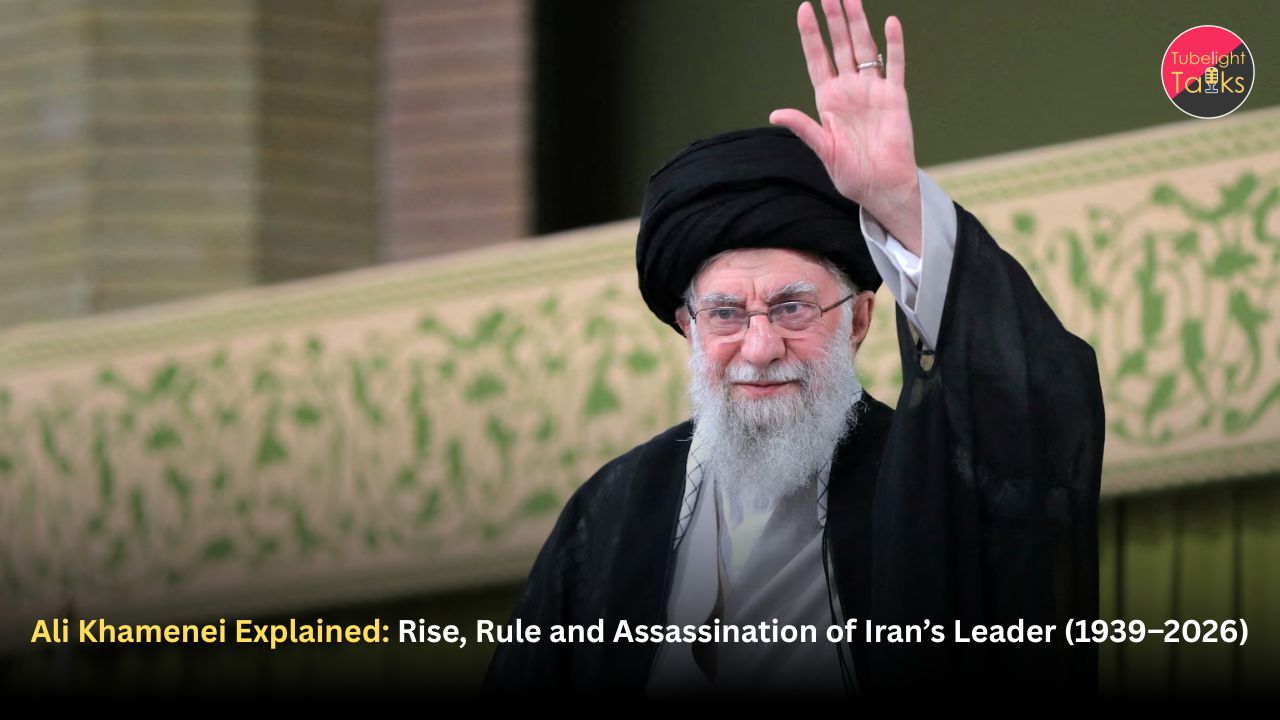
Ali Khamenei Explained: Rise, Rule and Assassination of Iran’s Leader
For more than three decades, Ayatollah Ali Hosseini Khamenei was the most powerful figure in the Islamic Republic of Iran. As Supreme Leader from 1989 until his death in 2026, he oversaw the military, judiciary, state broadcasting system and strategic national decisions. His tenure spanned wars, sanctions, nuclear negotiations, proxy conflicts and repeated domestic unrest.
On 28 February 2026, joint Israeli–United States airstrikes killed Khamenei, bringing an abrupt end to 36 years of centralized leadership and opening a new phase of uncertainty for Iran and the broader Middle East.
Key Takeaways on Ali Khamenei’s Rise, Leadership and Assassination
- Born in Mashhad in 1939 into a clerical family
- Arrested six times during opposition to Shah Mohammad Reza Pahlavi
- Survived a 1981 bombing that permanently paralyzed his right arm
- Served as President of Iran (1981–1989) during the Iran–Iraq War
- Became Supreme Leader in 1989 after Ayatollah Ruhollah Khomeini’s death
- Strengthened the Islamic Revolutionary Guard Corps (IRGC) militarily and economically
- Oversaw crackdowns during protests in 1999, 2009, 2019, 2022 and 2025–2026
- Backed regional groups including Hezbollah and Hamas
- Supported civilian nuclear development while banning weapons of mass destruction
- Killed in 2026 US–Israel strikes targeting Iranian leadership
Early Life and Revolutionary Roots
Ali Hosseini Khamenei was born on 19 April 1939 in Mashhad. His father was a religious scholar of Azerbaijani heritage, and his upbringing was centered on Islamic scholarship. He began religious education at a young age and later moved to Qom, where he studied under Ayatollah Ruhollah Khomeini.
During the 1960s and 1970s, Khamenei became politically active against Shah Mohammad Reza Pahlavi. He was detained multiple times and spent years under surveillance and exile before the 1979 Islamic Revolution reshaped Iran’s political structure.
The 1979 Revolution and Hostage Crisis
After the Shah’s fall, Khamenei quickly entered the new ruling establishment. He became Tehran’s Friday Prayer leader and assumed key state responsibilities.
In 1979, militants seized the US Embassy in Tehran, holding American diplomats hostage for 444 days. Revolutionary leaders, including Khamenei, supported the takeover. The crisis fundamentally altered Iran’s relations with the United States.
Surviving an Assassination Attempt in 1981
On 27 June 1981, a bomb concealed inside a tape recorder exploded during one of his public speeches. He survived but permanently lost the use of his right arm. The attack elevated his standing among hardline factions within the Islamic Republic.
Later that year, after President Mohammad-Ali Rajai was assassinated, Khamenei was elected president with overwhelming support.
Presidency During the Iran–Iraq War
As president from 1981 to 1989, Khamenei governed during the Iran–Iraq War. Iraqi forces used chemical weapons and launched missile strikes on Iranian cities, including Tehran.
Iran mobilized volunteers in human wave tactics, suffering heavy casualties. During this period, Khamenei developed strong ties with the Islamic Revolutionary Guard Corps, which expanded its influence significantly.
Also Read: Israel-Iran Conflict: Mossad Operation Sparks Fears of Regional War and Global Fallout
Becoming Supreme Leader in 1989
Following Khomeini’s death, the Assembly of Experts appointed Khamenei Supreme Leader. Though he did not initially hold the highest clerical rank, constitutional changes allowed his elevation.
Over 36 years, he centralized power and strengthened the IRGC’s role not only in security but also in economic sectors such as construction, energy and telecommunications.
The Mykonos Case and European Fallout
In 1997, a German court linked Iranian officials to the Mykonos restaurant assassinations in Berlin and stated the killings occurred with knowledge of senior leadership. Iran denied involvement, and the case triggered diplomatic tensions with European nations.
Protest Waves and Internal Dissent
Iran experienced major protest movements during Khamenei’s leadership:
1999 – Student protests
2009 – Election protests
2019 – Fuel price protests
2022 – Mahsa Amini protests
Late 2025 – Economic uprising
January 2026 – Nationwide protests
Reports indicated more than 7,000 killed in late 2025 unrest and 6,488 killed with 53,700 detained in January 2026 demonstrations.
Authorities used arrests, internet blackouts and lethal force to contain unrest.
Nuclear Policy and Sanctions Disputes
Khamenei supported civilian nuclear advancement while issuing a religious decree prohibiting weapons of mass destruction. Iran signed the 2015 nuclear agreement, limiting enrichment in exchange for sanctions relief.
After the United States withdrew in 2018, Iran resumed enrichment, reaching 60 percent purity. Negotiations later stalled amid disputes over ballistic missile development and regional activities.
Regional Strategy and Escalation
Iran backed Hezbollah, Hamas, Syrian leadership under Bashar al-Assad and Houthi forces in Yemen. After Hamas’ October 7, 2023 attack on Israel, tensions escalated. Hezbollah’s leadership, including Hassan Nasrallah, was targeted. Assad’s government fell in December 2024.
Direct exchanges between Iran and Israel occurred in 2024 for the first time.
The 2026 Strikes and Khamenei’s Death
In June 2025, Israeli forces struck Iranian nuclear facilities. The United States later bombed three enrichment sites. Retaliatory missile exchanges followed.
On 28 February 2026:
- Strikes targeted 24 provinces
- At least 201 people were reported killed
- 108 girls died in a school strike in Minab
- Senior IRGC commanders, including Mohammad Pakpour, were reported killed
- Ali Shamkhani was reported killed
- Satellite imagery showed heavy destruction at Khamenei’s compound
Iranian state media confirmed Khamenei was killed in his office. A 40-day mourning period was declared. His daughter, son-in-law, granddaughter and daughter-in-law were also reported killed.
A Spiritual Reflection on Power and Impermanence
The life of Ali Khamenei demonstrates how political authority, military strength and global influence are temporary. Leadership shapes history, but no ruler remains indefinitely.
According to the teachings of Saint Rampal Ji Maharaj, lasting peace cannot be achieved through conflict or domination. His spiritual knowledge emphasizes understanding the Supreme God through authentic scriptures and living with righteousness and compassion.
In times of global tension and instability, spiritual wisdom offers a path toward harmony that transcends political power.
International Reaction and Succession
At the UN Security Council, calls for de-escalation were made. The United States defended the strikes as lawful. China expressed concern, and Russia condemned the operation.
Iran’s Assembly of Experts is constitutionally responsible for appointing a successor. Intelligence assessments suggested hardline IRGC figures could influence the transition.
FAQs on Ali Khamenei Explained
1. Who was Ali Khamenei?
Ali Khamenei was Iran’s Supreme Leader from 1989 to 2026 and previously served as president during the Iran–Iraq War.
2. How did Ali Khamenei die?
He was killed on 28 February 2026 during joint Israeli–US airstrikes targeting Iranian leadership sites.
3. How long did he rule Iran?
Khamenei served as Supreme Leader for 36 years and six months.
4. What was his role in Iran’s nuclear program?
He supported civilian nuclear development and oversaw enrichment expansion after US withdrawal from the 2015 deal.
5. What protests occurred under his leadership?
Major protests occurred in 1999, 2009, 2019, 2022 and 2025–2026.
6. Who will replace him?
Iran’s Assembly of Experts is responsible for selecting the next Supreme Leader.
Related Stories








Discussion (1)