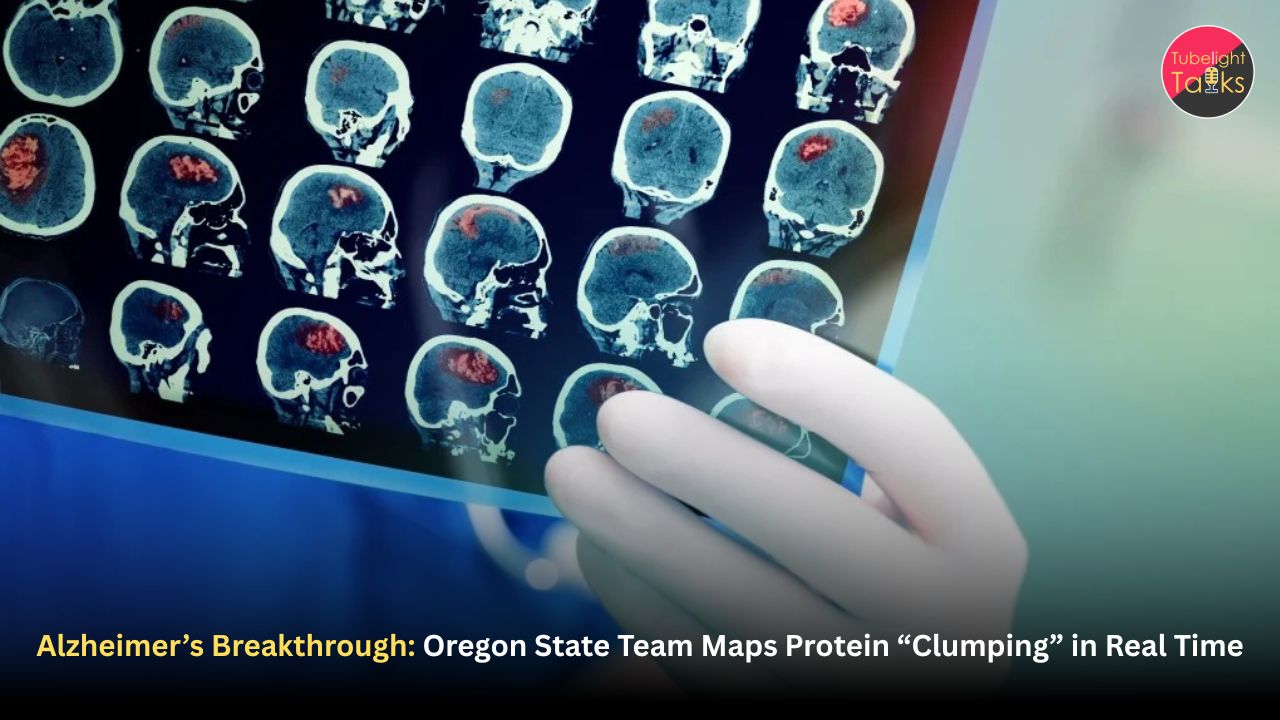
Alzheimer’s Breakthrough: Reversing the “Clumping” Process
Alzheimer’s disease remains one of the most devastating neurological disorders worldwide, gradually stealing memory, reasoning, and independence. For years, treatments have focused mainly on managing symptoms rather than stopping the disease itself. Now, in a major Alzheimer’s Breakthrough, researchers at Oregon State University have captured detailed real-time insights into how harmful protein clumps form in the brain—one of the defining hallmarks of the condition.
This Alzheimer’s Breakthrough could represent a crucial advance in understanding the disease’s progression and may open new pathways for developing treatments aimed at slowing or preventing its impact.
Understanding Alzheimer’s at the Molecular Level
What is protein “clumping”?
One hallmark of Alzheimer’s disease is the accumulation of misfolded proteins—especially beta-amyloid and tau—that aggregate into plaques and tangles inside the brain. These clumps interfere with neuron-to-neuron communication and trigger inflammation, leading to progressive cognitive decline.
While scientists have long known that these clumps exist, observing exactly how they form at a molecular level has been extremely challenging.
Why metals matter
The Oregon State team identified that certain metal ions—such as copper and iron—play a catalytic role in accelerating protein aggregation. These metals interact chemically with amyloid proteins, altering their structure and encouraging clump formation.
By tracking these interactions in real time, researchers gained unprecedented clarity into the chemical chain reaction that leads to plaque buildup.
Why This Discovery Is So Important
From symptom control to disease interruption
Most current Alzheimer’s treatments focus on slowing memory decline or managing behavioral symptoms. Few directly address the underlying molecular triggers of plaque formation.
By identifying how metal ions promote aggregation, scientists now have a tangible target. Future therapies could:
- Block harmful metal-protein interactions
- Neutralize metal-induced oxidative stress
- “Unclump” aggregated proteins before they cause widespread damage
This represents a fundamental shift—from symptom management to root-cause intervention.
The possibility of reversal
The most exciting implication is the concept of reversibility. If aggregation is driven by specific chemical triggers, interrupting that trigger could potentially halt—and perhaps even reverse—damage progression, especially in early stages.
Although full reversal in humans remains theoretical, understanding the clumping pathway opens the door to next-generation drug design.
Also Read: The Holy Grail Vaccine: Stanford’s Universal Nasal Spray Breakthrough
The Broader Impact on Neurodegenerative Research
A new framework for drug development
Pharmaceutical research has struggled with Alzheimer’s because of its complexity. By isolating a precise chemical mechanism, drug developers can design molecules tailored to interfere with the aggregation process.
Insights beyond Alzheimer’s
Protein misfolding and aggregation also occur in Parkinson’s and other neurodegenerative disorders. This discovery could influence broader neurological research, potentially accelerating cross-disease therapies.
Why This Story Is Trending Today
The public conversation around Alzheimer’s often feels heavy—centered on caregiving stress and limited treatment options. A discovery that hints at true disease interruption naturally sparks global interest.
Families living with dementia are searching for hope. Scientific breakthroughs that move beyond symptom control toward addressing root causes are deeply meaningful.
In a world often dominated by political and economic headlines, this medical advancement stands out as a reminder of humanity’s relentless pursuit of healing.
Caution and Next Steps
While the findings are promising, several steps remain before clinical application:
- Extensive laboratory validation
- Animal model testing
- Safety trials in humans
- Large-scale clinical efficacy studies
Alzheimer’s disease is complex, and no single mechanism explains all cases. However, pinpointing one major contributor is a critical milestone.
The Deeper Reflection: Clarity in Complexity
Just as tangled proteins disrupt communication within the brain, confusion and imbalance disrupt harmony in life. In spiritual teachings shared by Sant Rampal Ji Maharaj, clarity, discipline, and inner balance are emphasized as essential for well-being. When harmful elements are identified and removed—whether in the body or the mind—restoration becomes possible.
This scientific breakthrough reflects a similar principle: understanding the root cause is the first step toward healing.
FAQs: Alzheimer’s Breakthrough
1. What causes the “clumping” in Alzheimer’s?
Misfolded proteins like beta-amyloid aggregate in the brain, forming plaques that disrupt neural communication.
2. What did the Oregon State team discover?
They identified how certain metal ions accelerate protein aggregation in real time.
3. Does this mean Alzheimer’s can now be cured?
No. It is an early-stage discovery, but it opens new possibilities for targeted therapies.
4. Why are metal ions significant in this process?
They chemically interact with proteins, altering their structure and promoting clumping.
5. What happens next in research?
Further lab studies, followed by animal and human trials, are needed before treatment becomes available.
Related Stories










Discussion (0)