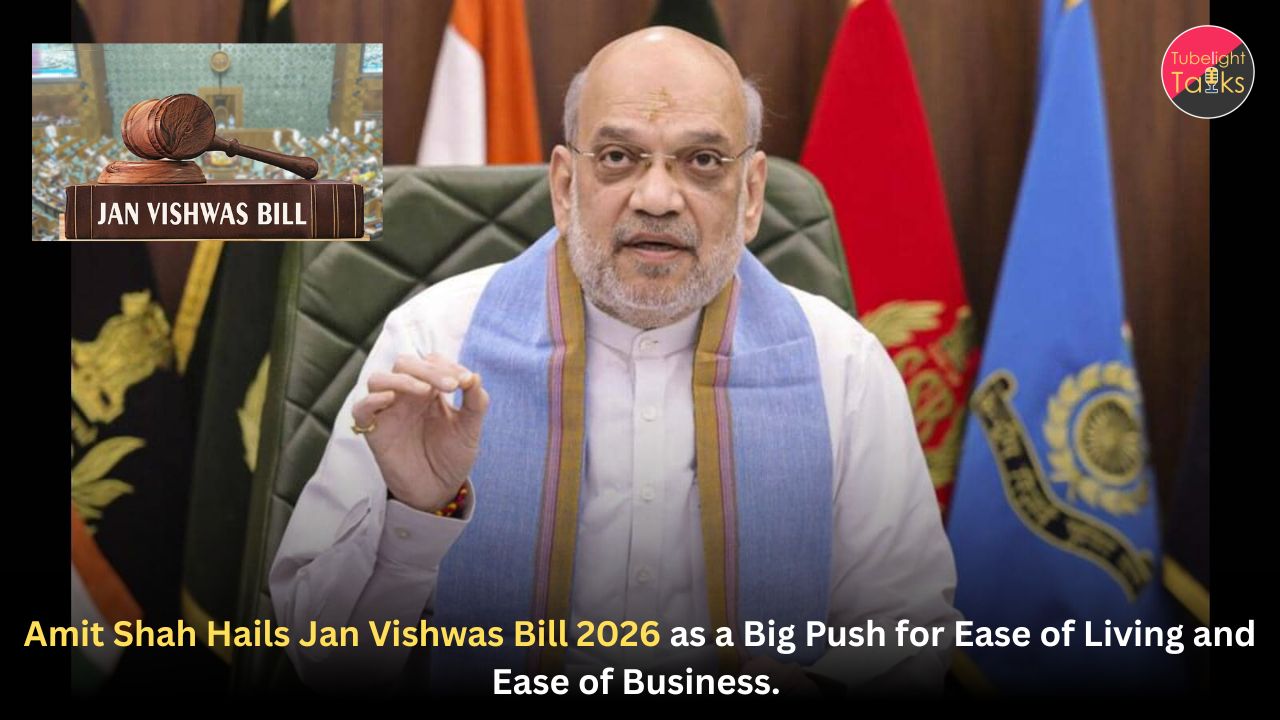
Amit Shah Hails Jan Vishwas Bill 2026 After Parliament Passes Broad Decriminalisation Reform
Union Home Minister and Minister of Cooperation Amit Shah has publicly welcomed the passage of the Jan Vishwas Bill, 2026 in Parliament. According to an official PIB release issued on April 3, Shah said the Bill is India’s “giant step” toward accelerating ease of living and ease of business, and that by cutting down several legal provisions it will make life easier and business simpler for all.
Amit Shah’s response puts the reform in a political frame
The Ministry of Home Affairs release says Amit Shah hailed the Bill after it cleared Parliament and described it as an important part of the vision of a “New India.” The official text reproduces his X post, where he said the law cuts down several legal provisions and turns governance in a more practical direction. That means Shah is presenting the Bill not only as a technical amendment, but as a larger reform in how the state deals with minor violations.
What the Jan Vishwas Bill 2026 does
According to the government’s official account, the Jan Vishwas (Amendment of Provisions) Bill, 2026 amends 784 provisions across 79 Central Acts administered by 23 Ministries. The PIB summary says 717 provisions are being decriminalised to promote ease of doing business, while 67 provisions are being amended to facilitate ease of living. The government also says the overall exercise rationalises more than 1,000 offences by removing minor criminal provisions and reducing compliance burden.
That scale is what makes the Bill significant. This is not a single-sector legal change. It is a cross-ministerial effort to reduce criminal penalties for low-severity or technical defaults and replace fear-heavy compliance with proportionate regulation. The official government framing is that this will strengthen a trust-based governance framework and improve the regulatory environment for both businesses and citizens.
Why the government is pitching it as a major reform
The official PIB note on the Bill says Parliament’s passage marks a significant step toward further improving both ease of doing business and ease of living. Amit Shah’s own statement, as carried by PIB, matches that language closely. That alignment shows the government wants the Bill to be seen as more than legal housekeeping. It is being sold as a structural shift away from criminalising minor offences and toward simpler, more proportionate rules.
The Bill became much larger after committee review
The government’s official summary says the Bill was first introduced in August 2025 in a narrower form, then expanded substantially after examination by a Lok Sabha Select Committee. PIB says the committee held 49 sittings and its work helped increase the Bill’s scope from 355 provisions across 16 Acts to the final 784 provisions across 79 Acts. That expansion suggests the reform was reshaped significantly before final passage.
Why the “judicial reform” label needs some care
The user’s headline calls this “judicial reform,” but the strongest official descriptions frame it more as legal and regulatory reform than as a court-system overhaul. Amit Shah’s statement focuses on ease of living and ease of business, while the PIB summary focuses on decriminalisation, compliance reduction and trust-based governance. So the safest wording is that the Bill may ease pressure caused by minor criminal provisions, but its primary official identity is as a decriminalisation and governance reform measure.
A broader shift toward proportionate law
The deeper importance of the Bill lies in the message behind it. A legal system works better when it distinguishes between serious wrongdoing and minor non-compliance. By welcoming the Bill, Amit Shah is effectively endorsing a less punitive approach to small violations across multiple sectors. The government’s stated aim is to make business simpler, reduce harassment potential and create a more predictable regulatory climate.
Fairness makes reform meaningful
A legal system should protect order without becoming unnecessarily harsh. That broader idea fits naturally with the principle that governance should act with balance, justice and responsibility. When minor mistakes are not treated like major crimes, public trust can grow and the relationship between citizen and state becomes healthier.
Call to Action
The passage of the Jan Vishwas Bill 2026 is important, but its real test will come in implementation. Citizens, businesses and legal professionals should now watch how quickly ministries update their rules, compliance systems and enforcement practices to reflect the new law. A reform of this scale matters most when its benefits become visible in everyday life.
FAQs: Amit Shah Hails Jan Vishwas Bill 2026 as a Big Push for Ease of Living and Ease of Business.
1. Did Amit Shah officially welcome the Jan Vishwas Bill 2026?
Yes. A PIB release from the Ministry of Home Affairs says Amit Shah welcomed the passage of the Bill in Parliament.
2. What did Amit Shah say about the Bill?
PIB quoted him as saying the passage of the Jan Vishwas Bill 2026 is India’s “giant step” toward accelerating ease of living and ease of business.
3. What is the main aim of the Jan Vishwas Bill 2026?
The government says it aims to decriminalise minor offences, reduce compliance burden and improve ease of doing business and ease of living.
4. How many legal provisions does the Bill amend?
According to the official government summary, it amends 784 provisions across 79 Central Acts administered by 23 Ministries.
5. How many provisions are being decriminalised?
The government says 717 provisions are being decriminalised to promote ease of doing business.
6. Is this mainly a judicial reform or a regulatory reform?
The strongest official framing is regulatory and legal reform focused on decriminalisation, compliance reduction and trust-based governance, rather than a direct restructuring of the judiciary.
Related Stories










Discussion (0)