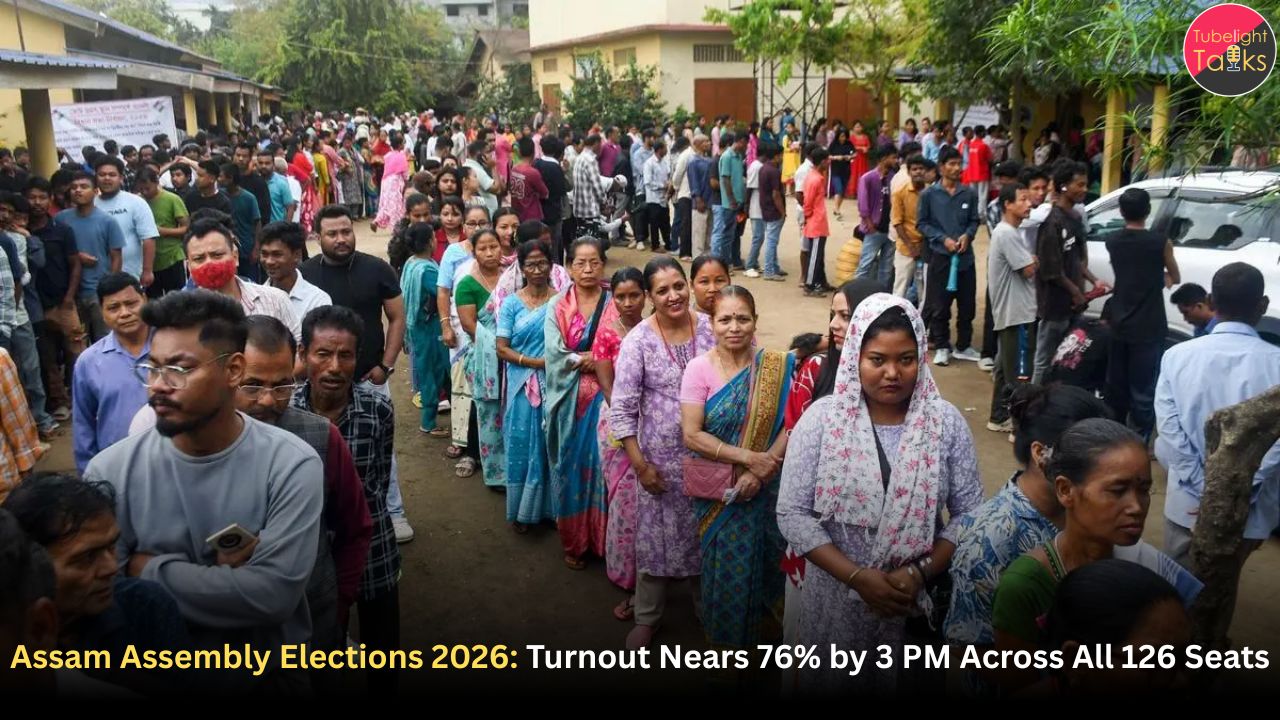
Assam Assembly Elections 2026: Nearly 76% Turnout by 3 PM in High-Stakes Statewide Poll
Assam Assembly Elections 2026 has recorded a strong 75.91% voter turnout by 3 PM, according to election-linked reporting, as citizens voted across all 126 constituencies in a single-phase contest. Polling began at 7 AM under tight security and extensive logistical arrangements, with more than 2.5 crore eligible voters set to decide the shape of the next state government.
The election is being treated as a major political test, not only for the ruling BJP-led alliance seeking another term, but also for the Congress-led opposition trying to turn public sentiment into a statewide breakthrough.
A high-participation election day in Assam
The biggest headline of the day has been the turnout itself. A 75.91% figure by 3 PM points to unusually strong engagement well before polls closed, and that matters because turnout in Assam often reflects both political intensity and organisational reach on the ground.
DD News reported that polling gathered pace steadily through the day, while Times of India’s live election coverage said the figure came amid a high-stakes battle across the state. Reuters also placed the Assam poll within a larger national sequence of state elections being watched as a barometer of political mood.
This level of participation also suggests that local issues remain powerful mobilisers in Assam. Voters are not responding only to national rhetoric; they are making choices shaped by welfare delivery, identity politics, flood management, jobs, infrastructure, citizenship anxieties, and regional power equations.
High turnout in such a context can benefit either incumbents with strong booth machinery or challengers who have successfully converted discontent into votes. That is why raw turnout numbers matter, but their geographic spread matters even more.
Also Read: Elections 2026: Voting Underway in Kerala, Assam and Puducherry
Rural participation appears especially important
Field reporting suggests rural participation played a strong role in the day’s voting pattern. Times of India described a rural surge as a key driver behind the high percentage by mid-afternoon. In Assam, that is politically significant because rural constituencies often decide the broader electoral outcome, especially when contests tighten in urban and semi-urban pockets. Mobilisation in riverine districts, tea-growing regions, and border-adjacent areas can reshape the final map in ways that headline seat predictions often miss.
Assam’s electoral sociology is also unusually layered. Communities do not vote as a single bloc across the state, and issues differ sharply between Upper Assam, Lower Assam, the Barak Valley, central districts, and tribal belts. A strong statewide turnout, therefore, does not mean a uniform trend. It means the electorate across very different political landscapes has shown up in large numbers. That is one reason the Assam result will be read carefully even outside the state.
Scale, logistics and the meaning of this contest
The 2026 Assam Assembly election is not a routine state vote. More than 2,50,54,463 eligible voters and 722 candidates are involved, making it one of the largest political exercises in the Northeast. Polling has taken place with heavy deployment, close monitoring, and an administrative apparatus designed to manage remote terrain, weather uncertainty, and transport pressure. Reports also noted disruptions in public transport because vehicles were diverted for election duty, which underlined the scale of the operation.
That logistical complexity matters because Assam is not an easy state to conduct elections in uniformly. Terrain, river systems, long travel times, scattered settlements, and security sensitivity in some areas make polling day planning especially demanding. When turnout still remains high despite such friction, it reflects not only party mobilisation but also voter determination. In several parts of India, inconvenience depresses participation; in Assam, high turnout in spite of difficulty often becomes part of the political story itself.
A bigger political test than seat arithmetic alone
For the BJP-led alliance, this election is a test of governance credibility and coalition durability. For the opposition, it is a chance to prove that the ruling camp’s dominance can be challenged through coordinated mobilisation. AP noted that Assam is one of the places where Prime Minister Narendra Modi’s party is trying to consolidate and extend its reach, while Reuters described the wider round of state polls as a key political indicator even if they do not directly affect national government formation.
Assam also matters because it sits at the crossroads of identity, migration, development and security debates that have national resonance. Issues such as documentation, border management, religious polarisation, indigenous concerns, welfare access, and youth aspiration do not operate in isolation here. They merge into a powerful electoral language that parties are forced to speak differently in different districts. This makes Assam one of the most complex state contests in the country.
What a near-76% turnout could indicate
Turnout does not predict victory by itself, but it does indicate mobilisation strength, emotional investment and the seriousness with which voters are treating the election. A high figure by 3 PM may mean that the final turnout could end up being very substantial, depending on late-evening participation and weather conditions.
More importantly, it indicates that the contest has not suffered from voter apathy. Whether that energy helps incumbents or opponents will depend on constituency-level patterns, candidate strength and how effectively each alliance converted support into booth-day execution.
High turnout also tends to sharpen scrutiny of post-poll narratives. Every camp will attempt to interpret the number in its favour: incumbents may call it an endorsement of stability, while challengers may say it signals hunger for change. Both claims can sound plausible on polling day. The only reliable answer comes later, when turnout data is read alongside district-wise performance and seat conversion.
Why national observers are watching closely
Assam is not voting in isolation. The state is part of a larger election cycle that also includes Kerala, Puducherry, West Bengal and Tamil Nadu in close sequence. That gives the Assam result broader importance. A win, loss, or even reduced margin here will be interpreted as a signal about the BJP’s organisational grip, the opposition’s recovery capacity, and the regionalisation of national politics. State elections often become narrative-building exercises, and Assam is one of the first major tests in that chain.
Democracy, duty and Sat Gyaan
A voting day of this scale reminds us that public life depends on individual responsibility. In the light of Sat Gyaan, participation should not come from anger, caste pride, propaganda or fear, but from conscience and clarity. Sant Rampal Ji Maharaj teaches that truthfulness, moral conduct and awareness are essential in every field of life. Elections also become healthier when citizens act with wisdom rather than impulse. A ballot is not merely a political tool; it reflects character, duty and the values a society chooses to uphold.
Call to Action
Use official election information, avoid spreading rumours, and respect the democratic process even when opinions differ. Strong participation matters most when it is guided by awareness, calm judgment and ethical conduct.
FAQs: Assam Assembly Elections 2026: Turnout Nears 76% by 3 PM Across All 126 Seats
Q1. What was Assam’s voter turnout by 3 PM?
Assam recorded 75.91% turnout by 3 PM.
Q2. How many Assembly seats are being contested in Assam?
All 126 Assembly constituencies are voting in this election.
Q3. How many eligible voters are there in Assam?
There are more than 2.5 crore eligible voters, with Times of India reporting 2,50,54,463 electors.
Q4. Why is this election politically significant?
It is being seen as a major test for the ruling BJP-led alliance and the Congress-led opposition, with implications for wider political narratives.
Q5. When will the results be declared?
Reuters reported that results for this phase of state elections are due on May 4, 2026.
Related Stories









Discussion (0)