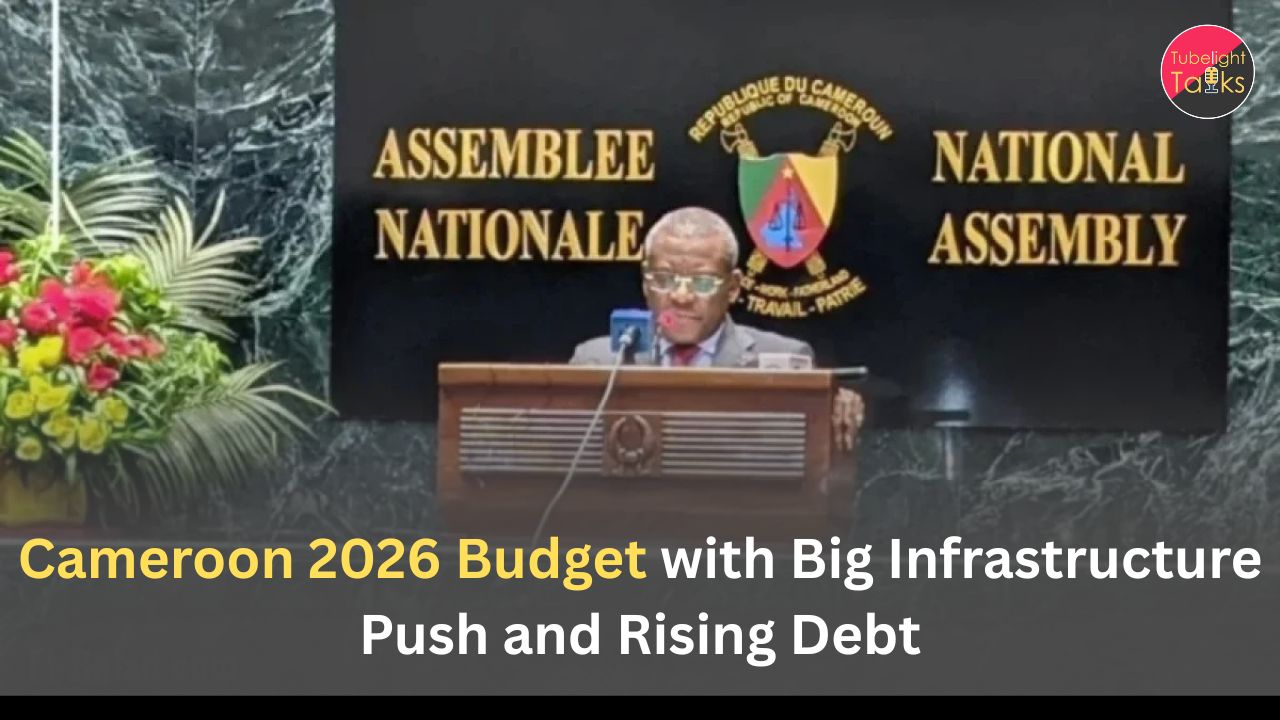
Cameroon 2026 Budget with Big Infrastructure Push and Rising Debt
Cameroon 2026 Budget: Cameroon has unveiled a sharply expanded 2026 state budget of CFA 8,816.4 billion, signalling one of its most ambitious fiscal programmes in recent years. Rising 14% from 2025, the budget places heavy focus on accelerating national infrastructure, widening opportunities for youth and women, and managing public finances amid mounting borrowing pressures.
Prime Minister Joseph Dion Ngute, presenting the plan before Parliament, framed it as a decisive step aligned with President Paul Biya’s national vision—one that aims to deliver stability, economic revival and inclusive development in 2026.
Key Takeaways: Cameroon’s 2026 Budget Prioritises
- Total Budget: CFA 8,816.4 billion (+14%)
- General Budget: CFA 8,683.9 billion (+13%)
- Special Accounts: CFA 132.5 billion (nearly doubled due to new Women & Youth Fund)
- Deficit Projection: CFA 631 billion—more than double 2025
- Financing Needs: CFA 3,104.2 billion
- Growth Forecast: 4.3% GDP growth in 2026
- Major Works: 335 km of road rehabilitation, 1,500+ meters of engineering structures
- Debt Warnings: Classified “high risk of debt distress” by IMF and AfDB
- Flagship Social Measure: CFA 50 billion fund for women’s empowerment and youth employment
- Strategic Alignment: Consistent with SND30 and CEMAC convergence rules
A 14% Budget Surge Signals Cameroon’s Biggest Fiscal Ambition in Years
The government’s draft 2026 finance bill, submitted to Parliament, sets revenues and expenditures at CFA 8,816.4 billion, up by more than CFA 1,000 billion from 2025. The general budget amounts to CFA 8,683.9 billion, while Special Accounts nearly double to CFA 132.5 billion, driven largely by a new women-and-youth empowerment fund.
This expansion comes amid projections of 4.3% GDP growth for 2026, supported by non-oil sectors despite sustained global economic pressure. Inflation is expected to ease slightly from 3.2% to 3.0%.
A Deficit That More Than Doubles and Borrowing Needs Above CFA 3 Trillion
A central pillar of the 2026 budget is its widening deficit. Cameroon projects a CFA 631 billion shortfall—more than twice the 2025 level. Including other financing costs, total funding needs rise to CFA 3,104.2 billion.
To meet this requirement, the government plans to mobilise multiple borrowing streams:
| Financing Source | Amount (CFA billion) |
| External Borrowing | 1,000 |
| Project Loan Disbursements | 826.7 |
| Domestic Bank Financing | 589.7 |
| Treasury Securities | 400 |
| Budget Support | 120 |
| Exceptional Financing | 167.8 |
This equals approximately $5.5 billion in new borrowing for 2026.
Debt risks continue to loom large. By late 2025, domestic debt stood at CFA 4,246 billion, while external debt reached CFA 8,568.2 billion. With IMF repayments beginning in 2026, Finance Minister Louis Paul Motazé warned lawmakers that domestic liquidity pressures may intensify as external obligations take priority.
Infrastructure Domination: Roads, Bridges and Energy Projects Take Centre Stage
Prime Minister Dion Ngute underscored that 2026 marks a renewed push for high-priority infrastructure. Planned works include:
National Road and Bridge Works
- 335 km of asphalt road rehabilitation
- Over 1,500 meters of engineering structures
- Ebolowa–Kribi Road (179 km)
- Bina–Mokranz–Andi Road (143 km)
- Fedak–Babji–Beka–Butu–Lewa–Bikop Road (145 km)
- Ndola–Kampo Express Road (39 km)
- Gaou–Edéa–Kribi Road (110 km)
- Nkambe–Garoua Road (242 km)
- Continued development of the Garoua bypass, including a second Benue bridge and the Ntem River bridge
Recent approvals of nearly USD 298 million in loans—from the Islamic Development Bank, Deutsche Bank Spain and Standard Chartered Bank—reflect Cameroon’s debt-driven infrastructure strategy. These projects are viewed as critical to trade corridors serving cocoa, timber, cotton and other sectors.
A Social Focus: Transforming Youth and Women’s Prospects
The 2026 programme carries a significant social emphasis, responding to national expectations and post-election pressures.
Key Reforms
- Reopening of PhD programmes in state universities
- Reintroduction of competitive entrance exams for teacher training colleges
- Establishment of a national spatial plan to boost youth employment
- Expansion of labour-intensive public works to generate immediate jobs
CFA 50 Billion Women & Youth Fund
This new fund under Special Accounts stands out as a flagship measure aimed at economic empowerment, entrepreneurship and employment creation.
Governance Changes: A Modernised Budget Architecture
The 2026 finance bill also introduces structural reforms designed to strengthen public financial management:
- Removal of “chapitres communs”, replaced with targeted emergency “dotations”
- Operating contingencies now under MINFI, investment contingencies under MINEPAT
- Reconstruction fund split for North, Far North, North-West and South-West regions
- Adoption of the revised state budget nomenclature for better transparency
These adjustments bring Cameroon closer to international budgetary standards and CEMAC requirements.
Diplomatic Ambition Rises Ahead of WTO 2026 Ministerial Conference
Cameroon is preparing to host the 14th WTO Ministerial Conference from 26–29 March 2026, a major geopolitical opportunity. The government has pledged intensified diplomatic engagement, stronger global partnerships and modernised diplomatic tools.
Domestically, reforms will target political party oversight and the regulatory environment for associations and civil society groups—aimed at reinforcing national stability.
A Crucial Year for Cameroon’s Economic Direction
Cameroon’s 2026 budget is both ambitious and high-risk. With a surge in infrastructure spending, expanded social programmes and sweeping governance reforms, the government aims to set a transformative course. Yet success will hinge on its ability to raise CFA 3.1 trillion sustainably, manage rising debt pressures and translate planned investments particularly in youth and women into visible, measurable progress.
Also Read: Cameroon Internet Blackout Raises Questions Over Election Transparency
As global conditions tighten and repayment obligations rise, 2026 stands as a defining test of Cameroon’s fiscal discipline, administrative capability and long-term development strategy.
FAQs on Cameroon 2026 Budget and Infrastructure Push
1. What is the total size of Cameroon’s 2026 budget?
Cameroon’s 2026 budget totals CFA 8,816.4 billion, a 14% increase from 2025, focused on infrastructure, social programmes, and youth and women empowerment.
2. Why is Cameroon’s 2026 budget deficit doubling?
The deficit rises to CFA 631 billion due to expanded spending on infrastructure, social reforms and debt obligations, pushing total financing needs to CFA 3,104.2 billion.
3. What major infrastructure projects are planned in 2026?
Key projects include 335 km of road rehabilitation, new bridges, and major routes like Ebolowa–Kribi, Bina–Mokranz–Andi, Gaou–Edéa–Kribi and Nkambe–Garoua.
4. Why is Cameroon considered at high risk of debt distress?
Rising borrowing, large external obligations, and IMF repayments beginning in 2026 place Cameroon in the high-risk debt category, according to AfDB and IMF assessments.
5. What social reforms are included in the 2026 budget?
Reforms include reopening PhD programmes, reviving teacher-training exams, expanding labour-intensive jobs, and launching a CFA 50 billion fund for women and youth empowerment.
Related Stories









Discussion (0)