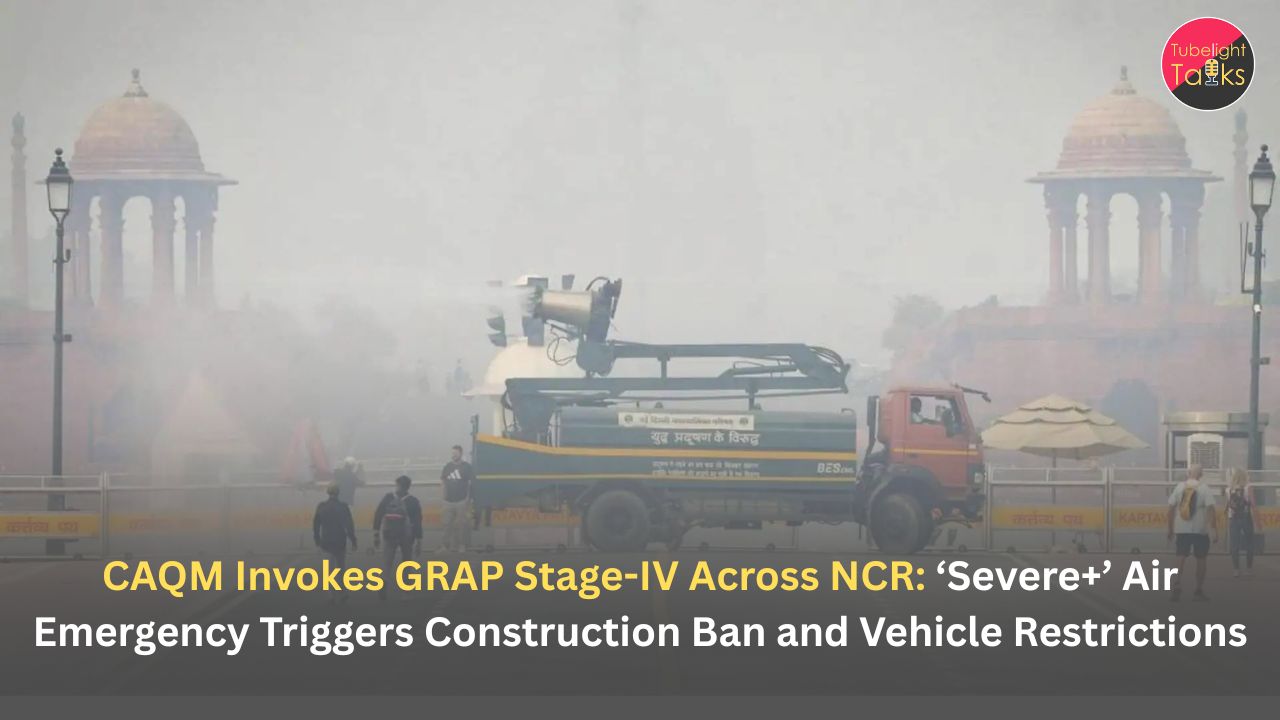
CAQM Invokes GRAP Stage-IV Across NCR: ‘Severe+’ Air Emergency Triggers Construction Ban and Vehicle Restrictions
CAQM Invokes GRAP Stage-IV: Has the National Capital Region (NCR) once again failed the annual test of air quality management, forcing a crippling emergency lockdown? The Commission for Air Quality Management (CAQM) Sub-Committee on the Graded Response Action Plan (GRAP) has taken the drastic step of invoking Stage-IV (Severe+) restrictions across the entire NCR with immediate effect. This emergency activation—triggered after the Air Quality Index (AQI) surged past the critical 450 mark—signals the most stringent level of anti-pollution curbs, underscoring a severe public health crisis in India 2026.
This sudden, disruptive measure is a brutal reminder that despite high-level commitments to clean environment, the region continues to rely on last-minute, economically devastating lockdowns instead of permanent, year-round solutions, putting the rapid urbanization goals of Viksit Bharat 2047 at risk.
AQI Breaches Critical Threshold
The invocation of GRAP Stage-IV, classified as ‘Severe+’ (AQI typically above 450), comes as a direct response to a rapid and alarming deterioration in air quality over the last 24 hours. The primary factors cited by CAQM include extremely slow wind speeds, stagnant atmospheric conditions, and the lack of pollutant dispersal, which traps emissions from vehicle traffic, construction dust, and industrial sources.
GRAP is a scientific framework, approved by the Supreme Court, that implements pre-defined actions at four stages to prevent air quality from worsening. Stage-IV is the apex of this plan, designed to bring about an immediate and steep reduction in emissions during an environmental emergency. This is only the second time in the last two years that the CAQM has been compelled to invoke the ‘Severe+’ category, highlighting the persistence and intensity of the pollution sources plaguing the NCR.
The Economic Cost of Emergency Lockdowns
The immediate implementation of Stage-IV measures places an immense economic burden on the core of North India’s economy, leading to a Shocking Report 2026 on financial losses.
Construction Halt: The blanket ban on all non-essential Construction and Demolition (C&D) activities—including earthwork, excavation, and structural work—shuts down the single largest employment and investment sector in the region. Industry estimates suggest each week of a prolonged GRAP Stage-IV lockdown costs the NCR economy an estimated ₹2,500 Crores in lost wages, project delays, and raw material spoilage.
Also Read: Cold Wave & Fog Alerts Across India: What It Means & How to Stay Safe
Logistics Disruption: The ban on the entry of all non-essential diesel-powered Medium and Heavy Goods Vehicles (MHGVs) into Delhi, along with restrictions on older BS-IV diesel and BS-III petrol four-wheelers, paralyses regional logistics. Only clean-fuel vehicles (LNG, CNG, Electric, or BS-VI diesel) and vehicles carrying essential goods are permitted, creating massive bottlenecks and price inflation across the supply chain, directly impacting the vision of Viksit Bharat 2047’s efficient logistics network.
Work-From-Home Mandates: State governments across the NCR (Delhi, Haryana, UP) are directed to implement work-from-home policies for 50% of staff in government and private offices, crippling administrative efficiency and disrupting the daily economic function of New India’s capital region.
Health Mandate and Institutional Enforcement
Despite the economic cost, the decisive action by the CAQM demonstrates that institutional integrity and public health remain non-negotiable priorities.
Public Health First: The invocation of Stage-IV prioritizes the health mandate, protecting vulnerable populations—children, the elderly, and those with respiratory ailments—who face serious risks when the AQI is above 450. The mandatory shift to hybrid schooling (online and physical) for classes up to IX and XI in Delhi also protects students from prolonged exposure to the toxic air.
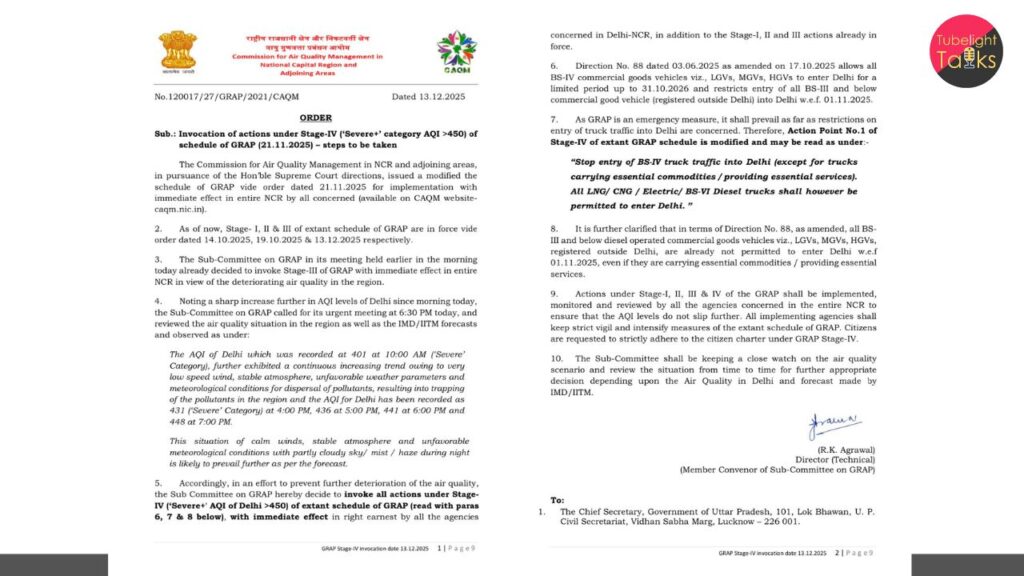
Targeting Polluters: The restrictions are precisely aimed at the biggest controllable sources of emissions: construction dust, vehicular traffic, and industrial fuels. The permanent ban on industrial operations using coal, furnace oil, or other unapproved fuels ensures long-term compliance and incentivizes the shift to cleaner alternatives like CNG and PNG. This strict enforcement is the core of the CAQM’s mandate and vital for the ultimate success of the clean air mission.
The Need for Year-Round Compliance
The Ground Reality across the NCR is one of exasperation—both among citizens breathing toxic air and businesses suffering shutdowns.
Dr. Sunil Sharma, Environmental Scientist, IIT Delhi: “The fact that we are repeatedly hitting Stage-IV indicates a failure of year-round compliance, not just weather. The construction ban is necessary but temporary. The permanent solution lies in 100% enforcement of dust control norms, a complete and permanent transition to BS-VI vehicles nationwide, and most importantly, a decisive, economically viable solution to stubble burning that doesn’t rely on last-minute bans. We need continuous action, not seasonal panic.”
Rakesh Kumar, Construction Site Manager (Gurugram): “Another GRAP-IV shutdown means thousands of daily-wage laborers lose their income overnight. This is the fourth major stop-work order this year. The government must provide financial relief or subsidies for dust control equipment to ensure we can meet norms without these complete shutdowns. We are supporting Viksit Bharat 2047 infrastructure, but we are being penalized for a systemic failure.”
Stewardship of the Environment (Prakriti Parirakshan)
The recurring air crisis highlights a profound failure of environmental stewardship, a core tenet of the Satgyan taught by Sant Rampal Ji Maharaj. The continuous pollution is a form of adharma (unrighteousness) against the natural world, impacting the health and well-being of millions.
Sant Rampal Ji Maharaj stresses the principle of Prakriti Parirakshan (environmental protection) and ethical living. Pollution is a collective consequence of human actions—from burning stubble for short-term economic gain to driving polluting vehicles and ignoring dust control norms. The true solution for New India lies not just in emergency measures but in a shift toward a moral consciousness where humans view themselves as stewards, not destroyers, of the environment.
Adopting a righteous, ethical lifestyle, prioritizing clean technologies, and ensuring environmental laws are obeyed with moral conviction, not just fear of penalties, is the only path to clean air and a healthy Viksit Bharat 2047.
Key Facts: GRAP Stage-IV Invocation (December 2025)
Invoked By: CAQM Sub-Committee on GRAP.
Area: Entire National Capital Region (NCR) with immediate effect.
Trigger Threshold: AQI > 450 (Classified as ‘Severe+’).
Key Restriction (Construction): Total ban on all non-essential C&D activities, including excavation and structural work.
Key Restriction (Transport): Ban on entry of non-essential diesel MHGVs into Delhi; Ban on BS-III Petrol and BS-IV Diesel four-wheelers in Delhi.
Economic Impact: Estimated loss of ₹2,500 Crores per week to the NCR economy.
FAQs: CAQM Invokes GRAP Stage-IV
Q1: Which vehicles are banned under GRAP Stage-IV?
BS-III petrol and BS-IV diesel four-wheelers are banned from plying in Delhi, as is the entry of non-essential diesel Medium and Heavy Goods Vehicles (MHGVs) into the city.
Q2: Are any construction activities still allowed?
Yes, only construction related to essential services and public projects like metro rail, railways, airports, defense, healthcare, and sanitation are exempt, subject to strict dust control norms.
Q3: Is Work From Home (WFH) mandatory for all offices?
State Governments are mandated to conduct classes up to IX and XI in hybrid mode. Government and private offices are directed to work at 50% physical capacity, with the remainder working from home.
Q4: What is the primary pollutant driving the AQI to ‘Severe+’?
The predominant pollutant during this severe phase is typically PM 2.5, fine particulate matter that penetrates deep into the lungs.
Q5: When will the GRAP Stage-IV restrictions be lifted?
The restrictions will be reviewed and lifted by the CAQM Sub-Committee when the AQI is consistently forecast to remain below the ‘Severe+’ threshold for a reasonable period.
Comment Your Experience Below Share If This Is Your Reality Too
How is the GRAP Stage-IV lockdown affecting your daily commute, work, or construction projects in the NCR? What is the single biggest pollution source in your area?
Drop your state/city name in comments | Tag a friend who needs to know the exact emergency restrictions!
Related Stories






Discussion (0)