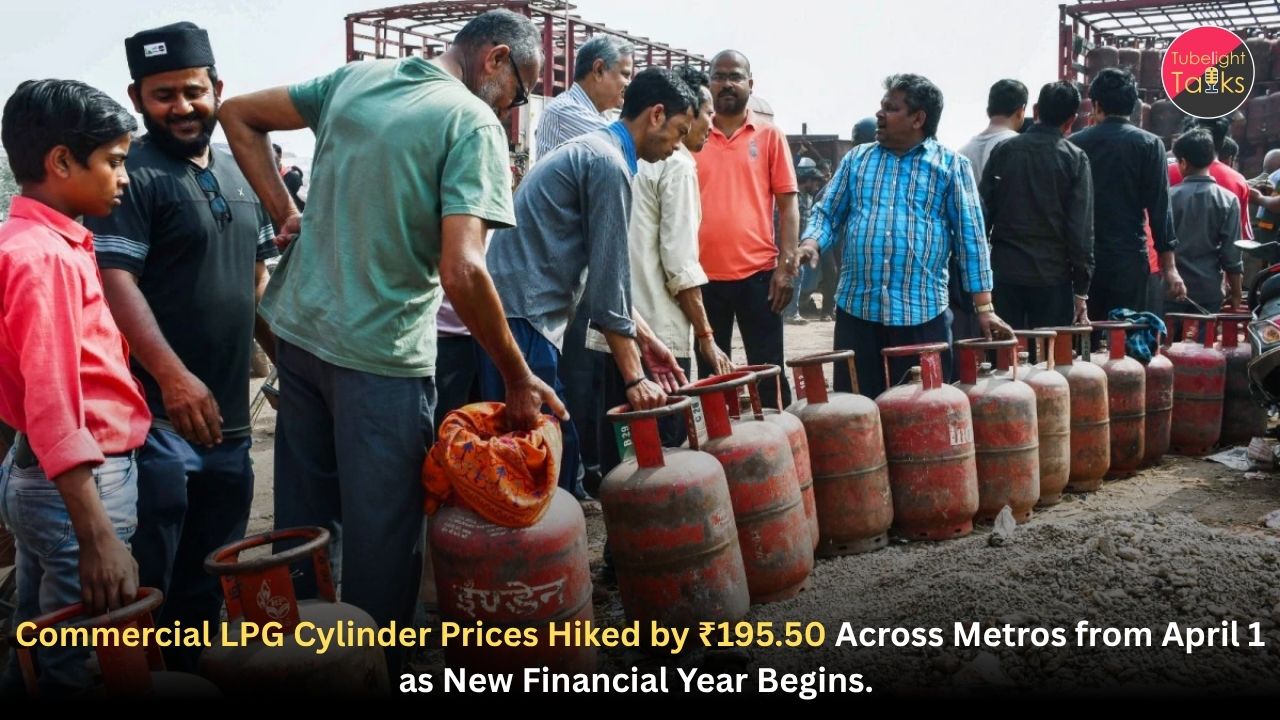
LPG Cylinder Prices Hiked by ₹195.50 Across Metropolitan Cities Effective April 1 as New Financial Year Begins.
The new financial year 2026-27 has begun with a significant increase in commercial cooking gas prices. From April 1, oil marketing companies raised the retail price of 19-kg commercial LPG cylinders by ₹195.50 across metropolitan cities. The revised rates now stand at ₹2,078.50 in Delhi, ₹2,031 in Mumbai, ₹2,208 in Kolkata and ₹2,246.50 in Chennai.
The move comes at a time of heightened global energy stress, with reports linking the increase to volatility caused by the ongoing West Asia conflict and the wider strain on fuel markets.
Commercial LPG Prices Have Risen Sharply from the First Day of April
The increase is uniform in amount, but not in final city price
Official and government-linked reporting on April 1 said commercial LPG cylinder prices were increased by ₹195.50 across metro cities. Even though the hike amount is the same, the final retail prices differ by city. According to News on Air, Delhi’s 19-kg cylinder now costs ₹2,078.50, Kolkata’s ₹2,208, Mumbai’s ₹2,031 and Chennai’s ₹2,246.50. That makes Chennai the costliest among the four metros in the current revision cycle.
Reuters separately confirmed the Delhi revision and reported that the capital’s commercial LPG rate rose 10.38% to ₹2,078.50 per 19-kg cylinder. This helps place the April 1 revision in perspective: it is not a token adjustment but a double-digit percentage increase in one of the most widely used commercial fuel categories for urban businesses.
The hike has immediate business consequences
Commercial LPG is widely used by restaurants, hotels, roadside food stalls, bakeries, caterers and other small business establishments. Economic Times noted that the latest revision is expected to hit hotels, restaurants and small enterprises that depend heavily on commercial gas supplies. For businesses operating on thin margins, a sharp one-day increase in input costs can quickly affect pricing, profitability and daily cash flow.
That is what makes this change particularly important. Unlike many economic indicators that feel distant to ordinary citizens, commercial LPG revisions can show up almost immediately in the prices of tea, snacks, meals and food services in urban markets. The burden first falls on small operators, but it often travels quickly to consumers.
The Hike Comes Against the Backdrop of a Wider Energy Shock
West Asia conflict and global fuel volatility are central triggers
The April 1 increase did not happen in isolation. Reuters reported that Indian fuel retailers raised jet fuel and commercial LPG prices following a sharp spike in global prices driven by the Iran war. The same report said India is facing one of its worst gas crises in decades and that the government has already cut supplies for industries to protect household cooking gas availability.
Economic Times also connected the LPG hike to the widening West Asia conflict, saying global oil prices had surged because of disrupted energy supply chains. When international energy prices rise sharply, monthly domestic commercial fuel revisions tend to reflect those pressures, especially for products whose prices are linked to global benchmarks and exchange-rate movements.
Also Read: Markets Reel as Rupee Breaches 95-Mark, but the Bigger Story Is India’s Oil Shock Exposure
This is part of a broader fuel-price adjustment cycle
The same April 1 reporting showed that the increase was not limited to commercial LPG. Reuters said aviation turbine fuel was also raised the same day, highlighting that the pressure is spreading across energy products rather than remaining confined to one category. Economic Times added that state-owned Indian Oil, Bharat Petroleum and Hindustan Petroleum revise LPG and ATF prices on the first day of each month based on international benchmarks and exchange rates.
That monthly revision system matters because it means price changes often arrive in clusters when global energy conditions deteriorate. Businesses using commercial LPG therefore have to monitor not just domestic policy, but also geopolitical developments and international commodity trends.
Domestic LPG Has Not Been Increased This Time
Household consumers get temporary relief
One of the most important distinctions in this price revision is that the hike applies to commercial LPG, not household LPG. News on Air reported that domestic LPG cylinder prices remained unchanged despite uncertainty in fuel prices due to the West Asia conflict. Economic Times said the 14.2-kg domestic cooking gas cylinder continues to cost ₹913 in Delhi and that there was no fresh change in household rates on April 1.
That distinction is politically and economically significant. Household cooking gas prices affect millions of families directly, so keeping domestic LPG unchanged while raising commercial rates suggests an attempt to shield homes while shifting the immediate burden toward the commercial sector. Reuters also pointed to government efforts to protect household availability amid the ongoing gas strain.
But commercial users may still pass on the cost
Even if domestic users do not feel the impact at the refill counter right away, they may still encounter the consequences indirectly. Food outlets, caterers, small eateries and urban vendors often adjust menu prices when commercial fuel costs jump. That makes commercial LPG an important inflation-sensitive input even when domestic LPG remains unchanged.
In cities already facing supply strain, this cost pressure can become even sharper. Recent Chennai reporting described severe LPG shortages affecting small eateries, with some vendors reporting very high black-market rates and forced changes in food pricing. The April 1 official hike therefore lands on top of an already stressed business environment in some markets.
Also Read: Fuel Excise Duty Cut India as Government Expands LPG Supply Amid Oil Shock
April 1 Has Opened FY 2026-27 with Fresh Cost Pressure on Urban Businesses
The timing matters as much as the amount
The fact that the revision takes effect on April 1 gives it extra significance. This is the first day of the new financial year, when businesses reset books, reassess pricing and estimate costs for the months ahead. A ₹195.50 jump in commercial LPG on day one immediately alters the cost structure for many small and medium operators.
It also follows another recent upward move. Economic Times reported that rates had already been increased by ₹114.50 per 19-kg cylinder on March 1. So for many businesses, this is not a one-off shock but part of a sequence of increases over a short period. That compounds pressure, especially in food and hospitality segments where margins are already narrow.
The city-wise burden is uneven in total price terms
Although the hike amount is identical across metros, the starting point matters. At ₹2,246.50, Chennai now has the highest metro commercial LPG price among the four cited cities, followed by Kolkata at ₹2,208, Delhi at ₹2,078.50 and Mumbai at ₹2,031. This creates different local cost environments for businesses in each metro, which may influence how quickly price increases are passed to consumers.
City-specific pricing also matters because food markets, service structures and local demand conditions differ. A small vendor in Mumbai may face a lower nominal refill cost than one in Chennai, but the commercial pressure still depends on rent, competition, supply reliability and customer spending power. Fuel cost is only one part of that chain, but it is a major one.
What This Means for Businesses and Consumers
Small establishments are likely to feel the shock first
Large restaurant chains and institutional kitchens may have more room to absorb part of the increase temporarily. Small tea shops, dhabas, roadside eateries, local bakeries and canteens usually do not. Their pricing flexibility is limited, and they depend heavily on daily turnover. A steep LPG increase can therefore hit them faster and harder. Economic Times explicitly pointed to the impact on hotels, restaurants and small enterprises.
This is why commercial LPG price changes often have a street-level economic effect. They influence not just industrial accounts, but ordinary urban consumption. A higher cylinder price can eventually translate into more expensive meals, snacks, tea, tiffin services and catering bills.
Consumers may not be spared for long
Even though household LPG has not been increased this time, consumers are unlikely to remain fully insulated if commercial fuel stays elevated. Businesses facing repeated fuel hikes typically respond by reducing margins, cutting portions, changing menu pricing or raising service charges. The pass-through may be gradual, but it is often real.
That makes the April 1 revision important beyond the business community. It is also a story about urban cost of living, especially in a year already shaped by global fuel volatility and geopolitical uncertainty.
Real Relief Comes from Moderation and Wise Living
Economic shocks remind us how quickly daily life can become difficult when the cost of basic needs rises. In such times, the teachings of Sant Rampal Ji Maharaj offer a deeper social lesson. They emphasize simple living, restraint, truth and balance rather than waste, greed and excess. That connection fits naturally here.
When society learns moderation and discipline, people become better able to endure external pressures without falling into panic or exploitation. Material systems remain necessary, but inner stability and ethical living help individuals and families face uncertainty with greater strength and clarity.
Call to Action
Businesses need to track fuel costs closely from the start of the new financial year
The April 1 commercial LPG hike is not a minor monthly adjustment. It is a meaningful cost event for urban businesses, particularly in food service and hospitality. Business owners should recalculate operating costs immediately, review refill frequency, and avoid assuming domestic-price stability means the broader fuel situation is under control. Global energy shocks are clearly feeding into commercial fuel pricing.
Citizens should watch the ripple effects, not just the cylinder price
Consumers should also pay attention to what follows this hike. Even without a change in domestic LPG, commercial fuel inflation can influence everyday prices in markets, restaurants and neighborhood food outlets. Staying informed about fuel revisions helps households understand why local costs may rise and why small businesses may come under extra strain in the weeks ahead.
FAQs: Commercial LPG Cylinder Prices Hiked by ₹195.50 Across Metros from April 1 as New Financial Year Begins.
1. By how much were commercial LPG cylinder prices increased on April 1, 2026?
Oil marketing companies increased 19-kg commercial LPG cylinder prices by ₹195.50 across metropolitan cities.
2. What is the new commercial LPG price in Delhi?
The revised price in Delhi is ₹2,078.50 for a 19-kg commercial LPG cylinder.
3. What are the new metro-city commercial LPG prices?
The revised rates are ₹2,078.50 in Delhi, ₹2,031 in Mumbai, ₹2,208 in Kolkata and ₹2,246.50 in Chennai.
4. Have domestic household LPG prices also been increased?
No. Reporting on April 1 said domestic LPG prices remained unchanged even as commercial cylinder prices were raised.
5. Why were commercial LPG prices hiked?
Reuters and other current reporting linked the increase to rising global energy prices and fuel-market volatility caused by the West Asia conflict.
6. Who is likely to be affected most by this increase?
Hotels, restaurants, tea stalls, caterers and other small enterprises that depend on commercial LPG are expected to feel the impact most quickly.
Related Stories








Discussion (0)