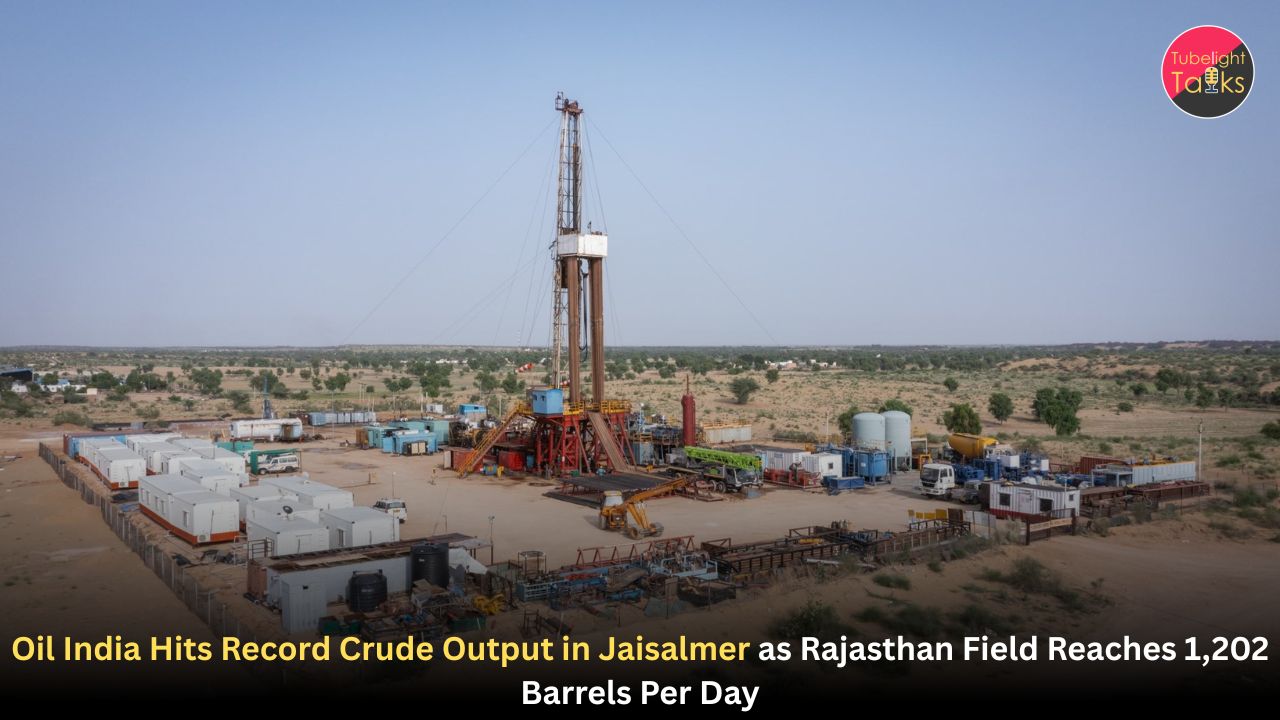
Oil India Achieves Record Crude Output in Rajasthan’s Jaisalmer Field
Oil India Ltd has achieved its highest-ever crude oil production from its Rajasthan operations, with output from the Jodhpur sandstone formation in the Baghewala field in Jaisalmer reaching 1,202 barrels per day. Current reporting says this is about 70% higher than last year’s 705 barrels per day and comes at a time when India is paying closer attention to domestic energy resilience because of global market uncertainty.
A major production jump from a difficult heavy-oil field
The Baghewala field lies in the Bikaner-Nagaur sub-basin of Rajasthan and is one of the few onshore heavy-oil fields in India. Reports say Oil India has been producing heavy crude there since 2017, and the latest jump to 1,202 barrels per day marks the strongest output yet from the area. That gives the achievement significance beyond one daily number, because it shows that a difficult reservoir is being made more productive over time.
This matters because heavy crude in desert geology is not easy to produce using ordinary methods. Current reports say the high viscosity of the crude meant conventional extraction approaches were not sufficient, pushing the company toward more specialised recovery techniques.
Thermal recovery played a central role
The biggest technical reason cited for the production rise is Cyclic Steam Stimulation, or CSS, which is a thermal enhanced oil recovery method used for extracting high-viscosity crude. Reports say Oil India deployed CSS in 19 wells, a 72% increase over the previous year, and that this was the first time the technology had been used in Rajasthan’s heavy-oil reservoirs.
That makes the achievement more important than a routine field uptick. It suggests that Oil India is not merely drilling more, but also improving how it unlocks difficult reserves. In energy terms, that is valuable because India’s domestic output challenge is not just about finding hydrocarbons, but about economically producing them from geologically tougher basins. This is an inference, but it is strongly supported by the emphasis current reporting places on CSS and other specialised recovery methods.
Also Read: Government Waives Duty on Petrochemical Imports, Raises LPG Allocation to 70%
New drilling and production methods also boosted output
The production gain was not attributed to CSS alone. Reports also say Oil India used techniques such as fishbone drilling, barefoot completion, electric downhole heaters, hydraulic sucker rod pumps and high-temperature thermal wellheads. Some of these were described as first-time applications in Indian heavy-oil reserves.
Those details matter because they show a broader field-modernisation effort. A reservoir like Baghewala typically responds best when recovery, drilling and completion technologies all improve together. That appears to be what happened here, with a mix of thermal enhancement and production-efficiency changes helping push output to a new record. This is an inference drawn from the range of techniques cited in current reporting.
Annual production figures also show a wider trend
The field’s daily production milestone is supported by the wider annual data. Current reports say Oil India’s Rajasthan operations produced 43,773 metric tonnes of crude in FY 2025-26, up from 32,787 metric tonnes in the previous year. That suggests the record daily output was part of a broader rise rather than an isolated one-day spike.
When annual output climbs this strongly, it points to sustained operational gains rather than only good short-term conditions. For India’s energy planners, that is more meaningful because it reflects repeatable improvement. Again, this is an inference, but it fits the annual and daily numbers reported across multiple current sources.
Why the Jaisalmer milestone matters for India
The production increase comes at a time when energy security has become even more sensitive because of volatility in West Asia and shipping disruption concerns. Current reporting explicitly connects the Rajasthan milestone to India’s efforts to strengthen domestic output and reduce vulnerability to global uncertainty.
It would be an overstatement to call 1,202 barrels per day “energy independence” by itself. India’s oil demand is vastly larger than what one field can supply. But it is fair to say that milestones like this strengthen domestic resilience, show that unconventional and heavy-oil resources can contribute more meaningfully, and reduce some pressure at the margin. That distinction matters.
The field’s logistics chain shows how regional output feeds the national system
Current reports say crude from the Baghewala field is transported by tankers to ONGC facilities in Mehsana, Gujarat, and then sent via pipeline to Indian Oil’s Koyali refinery. That means this is not an isolated desert operation with symbolic value alone. It is plugged into a working downstream chain that converts regional output into usable refining feedstock.
This logistical linkage is important because energy milestones only matter nationally when the system can actually move and process the output efficiently. In that sense, Jaisalmer’s production rise is part of a broader energy ecosystem rather than a stand-alone extraction story.
Technology-led production growth is becoming the bigger story
The Rajasthan result suggests that future domestic hydrocarbon gains may increasingly come from technology-led improvement in difficult reservoirs rather than easy new discoveries alone. When a company can raise output significantly in a heavy-oil field through better recovery and well design, it changes how policymakers and operators think about older or less attractive assets. This is an inference, but it is well supported by the fact that the reported breakthrough is tied directly to enhanced recovery and innovative completions.
That is why the Baghewala milestone may carry importance beyond Rajasthan. It provides a working example of how India can extract more value from technically challenging domestic reserves if the right field methods are applied consistently.
Strength grows when effort is disciplined
This achievement also carries a simple human lesson. Difficult results usually come not from one sudden act, but from patient improvement, better methods and disciplined execution. Teachings associated with Sant Rampal Ji Maharaj also emphasize living with sincerity, discipline, humility and constructive effort rather than wasteful confusion or ego. That principle fits naturally here: real progress comes when work is done thoughtfully and persistently, even in hard conditions.
Call to Action
The bigger question now is whether Oil India can sustain and scale this Rajasthan performance. Readers should watch for three things in the coming months: whether production remains near current levels, whether CSS and related methods are expanded further, and whether similar recovery approaches are applied to other difficult domestic reservoirs. If that happens, Baghewala may become a model for how India strengthens oil resilience from within.
FAQs: Oil India Hits Record Crude Output in Jaisalmer as Rajasthan Field Reaches 1,202 Barrels Per Day
1. What production milestone has Oil India achieved in Rajasthan?
Oil India has reached a record crude output of 1,202 barrels per day from the Jodhpur sandstone formation in Rajasthan.
2. Where is this field located?
The production comes from the Baghewala field in the Jaisalmer region of Rajasthan, within the Bikaner-Nagaur sub-basin.
3. How much higher is this than last year?
Current reports say the new output is around 70% higher than last year’s 705 barrels per day.
4. What technology helped raise output?
Reports say Cyclic Steam Stimulation, a thermal enhanced oil recovery technique, played a major role, along with fishbone drilling and other advanced production methods.
5. How much crude did Oil India’s Rajasthan operations produce in FY 2025-26?
Current reporting says Rajasthan operations produced 43,773 metric tonnes of crude in FY 2025-26.
6. Does this mean India has achieved oil self-sufficiency?
No. This is a meaningful domestic production gain, but not energy independence by itself. It is better understood as a boost to domestic resilience and supply security.
Related Stories









Discussion (0)