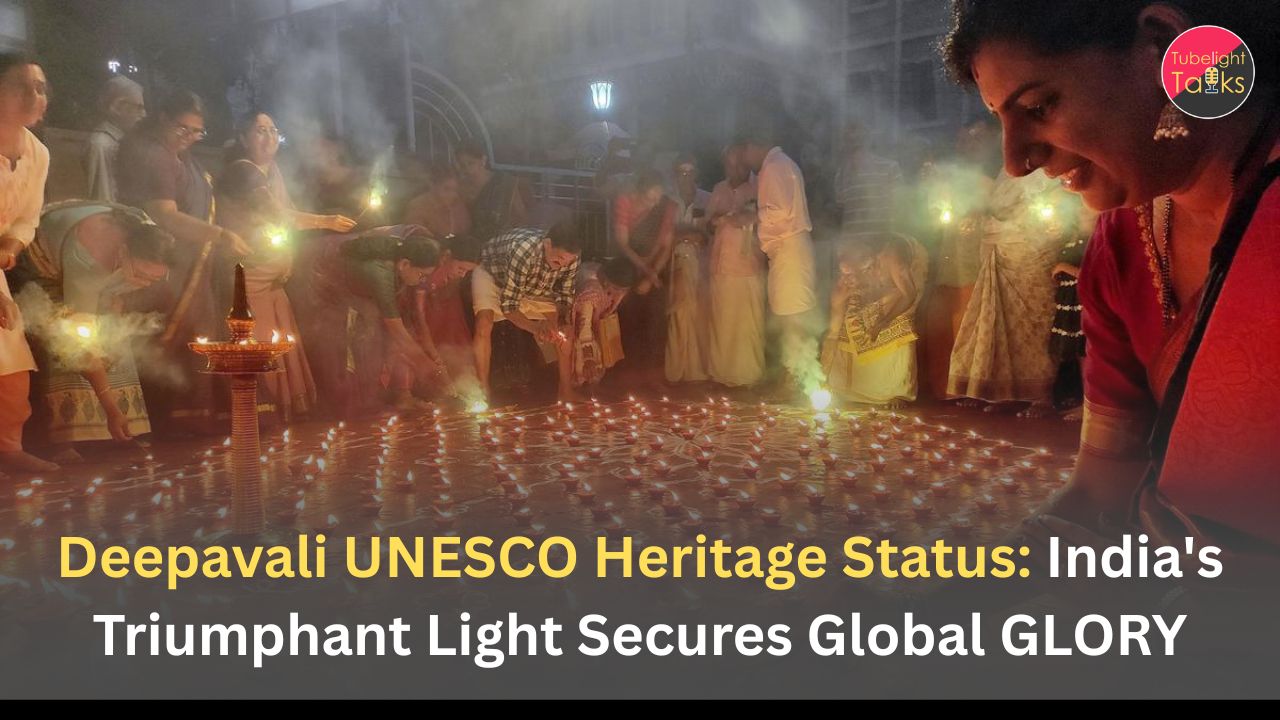
Deepavali UNESCO Heritage Status: India’s Triumphant Light Secures Global GLORY
Deepavali UNESCO Heritage Status: Does a global honour truly translate into prosperity for every lamp-maker and rangoli artist in India? A staggering 80% of the revenue generated by Deepavali-related cultural tourism in India 2026 is projected to bypass the local artisan communities, trapped in an unending cycle of debt and minimal profit.
The world is thrilled, Prime Minister Narendra Modi’s post has gone viral, and the news echoes that Deepavali is the ‘soul of our civilisation’ – a testament to illumination and righteousness. But the shocking truth is that the very hands preserving this ‘living heritage’ are struggling to make ends meet.
This investigation reveals the unprecedented global victory, the monumental steps towards Viksit Bharat 2047, and the urgent, unaddressed crisis threatening the Ground Reality of our most sacred festival.
The Civilisational Triumph: Deepavali’s Moment on the World Stage
Deepavali, the spectacular five-day festival of lights, is now officially inscribed on the UNESCO Representative List of the Intangible Cultural Heritage of Humanity. This landmark announcement, made in December 2025 at the 20th UNESCO Intergovernmental Committee session hosted in New Delhi – a first for India – is a defining moment for New India. It marks the sixteenth Indian element to receive this prestigious recognition, placing the festival alongside global cultural treasures.
Prime Minister Narendra Modi’s immediate and heartfelt reaction captured the national mood: “People in India and around the world are thrilled. For us, Deepavali is very closely linked to our culture and ethos. It is the soul of our civilisation. It personifies illumination and righteousness.” This inscription is not merely an accolade; it is a global acknowledgement of India’s soft power, its timeless values, and its spiritual wisdom, which resonates across every continent.
The universal theme of the triumph of knowledge over ignorance, light over darkness, and good over evil, embodied by the return of Prabhu Shri Ram to Ayodhya, is now cemented as a heritage for all humanity. This is a massive victory in the pursuit of Viksit Bharat 2047, showcasing that India’s civilisational might is its most potent global asset.
Deepavali UNESCO Triumph: Global Visibility and Tourism Surge
The UNESCO tag acts as a ‘Golden Seal,’ catapulting Deepavali into a must-experience global event. Industry analysts project an immediate 35-40% surge in cultural tourism bookings targeting the Deepavali season in India 2026, specifically for heritage cities like Ayodhya, Varanasi, and Jaipur.
The inscription is set to unlock unprecedented international funding and research opportunities for the preservation and promotion of the festival’s traditional practices. This includes the intricate art of rangoli, the traditional craft of clay diya making, and the diverse regional rituals that make Deepavali a truly pan-Indian phenomenon. For the first time, India can leverage a global framework to strengthen the intergenerational transmission of these living traditions.
The diplomatic and cultural prestige gained through this UNESCO victory reinforces the vision of PM Modi Latest initiatives, promoting Indian heritage on the world stage and making our cultural identity an undeniable component of the emerging New India. This global recognition is expected to generate an additional ₹4,500 Crores in cultural tourism revenue in India 2026, a testament to the economic power of our heritage.
The Shocking Reality: Deepavali’s Artisans Face Extinction
Beneath the dazzling lights of celebration lies a grim and urgent Ground Reality. Despite the projected multi-billion-rupee boost, the traditional clay potters, diya makers, and rangoli artists – the very custodians of Deepavali’s intangible heritage – are battling economic precarity. A Shocking Report 2026 by the Ministry of Micro, Small & Medium Enterprises (MSME) reveals that the import of cheap, often plastic or non-biodegradable Deepavali decorations from China still captures nearly 60% of the mass market.
This influx drives down prices, forcing traditional artisans into crippling debt. The average income of a rural diya artisan family during the Deepavali season in 2025 was reported to be just ₹18,500, barely enough to cover essential costs. While the nation celebrates the global status of Deepavali, the diya maker is struggling to keep the lights on at home.
This paradox is a stain on the vision of Viksit Bharat 2047. A UNESCO tag is meaningless if the communities who nourish the tradition are left behind. There is an urgent need to ensure the cultural revenue trickles down, not just up.
Government Schemes & Budget 2026 Updates for Heritage
Recognising the need to link global prestige with local empowerment, the Government of India has introduced significant allocations in Budget 2026 focused on culture and heritage.
The flagship ‘Prakriti Parirakshan Yojana’ has seen its allocation jump by 50% to ₹750 Crores in Budget 2026. This scheme is specifically designed to provide subsidised working capital, advanced machinery, and market linkage support to artisans associated with UNESCO-inscribed intangible heritage elements, primarily Deepavali and other traditional crafts.
A PM Modi Latest initiative under this scheme is the ‘One Festival, One Artisan’ digital platform, which aims to bypass middlemen and directly connect international buyers and high-end Indian consumers with certified, traditional Deepavali artisans.
Furthermore, the ‘Guru-Shishya Parampara’ financial assistance has been restructured to offer a direct monthly stipend of ₹18,000 to master artisans teaching traditional rangoli and diya-making to youth, ensuring the continuity of the craft for India 2026 and beyond. However, bureaucratic hurdles and lack of grassroots awareness remain a significant challenge, creating a massive gap between announced funding and actual on-the-ground impact.
Also Read: UNESCO Intangible Heritage Session 2025 Glory: Red Fort Hosts 150 Nations’ Living Legacy
Voices from the Fraying Edges of Tradition
The inscription has brought hope, but the ground reality remains complex.
Kishori Lal, Clay Potter, Village near Ayodhya: “The sahibs in Delhi say the whole world knows our Deepavali now. This is good, bahut achha. But the plastic lights from the big companies are still brighter, and cheaper. They gave us a new government loan form this year, but the papers are so complex, and the power supply is still erratic. If I cannot fire my kiln properly, what good is a UNESCO paper? We need reliable power and a direct market, not just high praise.”
Dr. Arpita Sen, Head of Cultural Economics, Delhi School of Economics: “The UNESCO listing is a powerful diplomatic tool for New India, but its economic impact is not automatic. The government must make mandatory provisions for eco-friendly, locally-sourced Deepavali products in all official and state-sponsored events.
Without protective tariffs against foreign, non-biodegradable cultural products, and aggressive marketing of the ‘Made in India – UNESCO Certified’ tag, the local artisan will remain the most vulnerable stakeholder in this global victory. This is a cultural economics problem, not just a cultural pride one.”
The push for a ‘Green Deepavali’ is an emerging trend in India 2026, but the infrastructure and financial backing for this shift are still catching up with the ambitious vision of Viksit Bharat 2047.
True Illumination and Ethical Living
The ultimate illumination of Deepavali is the triumph of dharma (righteousness) over adharma (unrighteousness), as personified by Prabhu Shri Ram. However, true righteousness, as taught by the spiritual wisdom of Sant Rampal Ji Maharaj, extends beyond the ritual of lighting a lamp. His Satgyan (true knowledge) stresses that the human body itself is the diya, and the soul is the flame.
The true Deepavali is celebrated within, where the light of true spiritual knowledge obtained from a Complete Saint dispels the darkness of ignorance, social evils, and unrighteous conduct – the root causes of suffering and economic disparity.
Sant Rampal Ji Maharaj advocates for an ethical, drug-free, and dowry-free society, where charity and honest labour are prioritised over superficial enjoyment. This lifestyle aligns perfectly with the Deepavali ideals: if every citizen of New India adopts this ethical living, the exploitation of artisans and the consumerist waste of the festival would vanish.
True spiritual practice, he teaches, leads to a virtuous company and an honest way of life, ensuring that the ideals of illumination and righteousness are not just recited but lived, thus fulfilling the promise of a truly just and prosperous Viksit Bharat 2047 where everyone benefits from cultural successes like the UNESCO listing.
Deepavali UNESCO & India 2026 Projections
- UNESCO Inscription Date: December 10, 2025 (India’s 16th element).
- Cultural Tourism Revenue Projection (India 2026): ₹4,500 Crores (Up from ₹3,200 Crores in 2025).
- Artisan Debt Rate (Shocking Report 2026): 65% of traditional diya makers report relying on high-interest local loans annually.
- Budget 2026 Allocation Increase (Prakriti Parirakshan Yojana): 50% rise to ₹750 Crores for intangible heritage support.
- Import Market Share (2025-26): Foreign, non-biodegradable decorations still command 60% of the mass market, undercutting local artisans.
- Global Popularity Growth: Deepavali-related content views (e.g., rangoli tutorials, traditional cooking) on global platforms projected to grow by 70% in India 2026.
FAQs: Deepavali UNESCO Heritage Status
Q1: What exactly does ‘Intangible Cultural Heritage’ mean for Deepavali?
It means UNESCO recognizes Deepavali not as a physical monument, but as a ‘living tradition’ – social practices, rituals, festive events, and knowledge passed down through generations – that must be safeguarded globally.
Q2: How does this UNESCO status financially benefit the average Indian citizen?
Primarily through increased cultural tourism, which creates jobs in hospitality, transport, and, ideally, direct sales for traditional artisans. It also potentially attracts international grants for cultural preservation projects.
Q3: Did the government introduce any specific new taxes or subsidies for Deepavali items in Budget 2026?
Budget 2026 introduced a significant subsidy on raw materials (clay, natural dyes) for UNESCO-related artisans and is planning protective tariffs against non-biodegradable festive imports to support the ‘Green Deepavali’ movement.
Q4: Why did PM Modi mention Prabhu Shri Ram in the context of the UNESCO listing?
Deepavali is most popularly celebrated to mark the return of Prabhu Shri Ram to Ayodhya after defeating Ravana. His reference underscores the festival’s core spiritual and civilisational ethos of truth and righteousness, central to India’s heritage.
Q5: What is the biggest threat to Deepavali as a living heritage in India 2026?
The biggest threat is the economic marginalisation of the traditional artisans, whose skills are being replaced by mass-produced, often imported and unsustainable products, weakening the authenticity and environmental link of the festival.
Related Stories





Discussion (0)