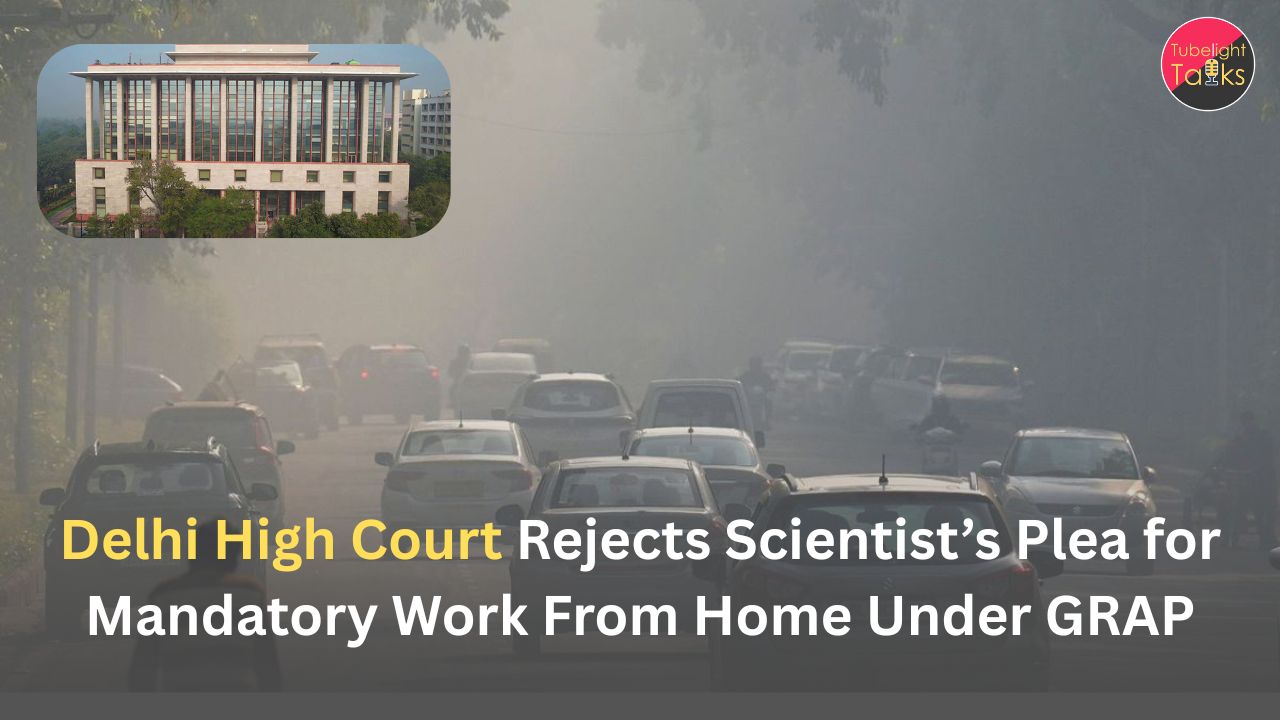
Delhi High Court Rejects Scientist’s Plea for Mandatory Work From Home Under GRAP: Pollution Norms Do Not Create Enforceable Service Rights
Delhi High Court Rejects Scientist’s Plea: Does the failure of the government to control pollution automatically grant an employee the right to alter their work conditions? The Delhi High Court has delivered a definitive ruling that clarifies the precise legal nature of the Graded Response Action Plan (GRAP), striking a blow to employees seeking mandatory work-from-home (WFH) privileges during periods of severe air pollution.
Dismissing a petition filed by a ‘Scientist-E’ employed with the Centre for Development of Telematics (C-DOT), Justice Sachin Datta ruled firmly that “pollution control norms do not create enforceable service rights.”
The verdict, delivered earlier this week, is a Shocking Report 2026 for workers in the National Capital Region (NCR): while the government is bound to implement GRAP’s pollution-mitigating measures scrupulously, the plan’s objectives “cannot be construed as to create an enforceable personal right upon individual employees” against their employers, especially if it derogates existing service conditions.
The ruling establishes a critical precedent on the separation between public health policy and individual employment law in New India.
The Medical Plea vs. Service Conditions
The petitioner, a scientist, sought permission to work from home indefinitely, citing severe respiratory distress and medical advice to “avoid dust and smoke exposure.” He alleged that his employer’s premises had ongoing construction and demolition activities that violated GRAP norms, leading to hazardous indoor air quality.
The plea requested a mandamus (a court order compelling an authority to perform a duty) directing the employer to allow WFH until the air quality within the office premises was certified to be safe. The Court, however, observed that the provisions for WFH under GRAP Stage-III (which were under consideration at the time of the filing) only vest discretionary and not a mandatory obligation upon the Central Government to grant such relief.
Furthermore, the Stage-III WFH directions had already been revoked by the Commission for Air Quality Management (CAQM) as the air quality temporarily improved, making the specific request moot.
No Individual Mandate, No WFH Right
The core legal finding of the Delhi High Court is unequivocally against the petitioner’s claim of entitlement:
GRAP is Regulatory, Not Personal: Justice Datta stressed that GRAP guidelines are essentially regulatory mechanisms intended to curb polluting activities and empower authorities like CAQM. Their objective is to support broader pollution mitigation—a societal obligation—not to create a personalized entitlement to WFH or automatically alter service conditions.
Rejection of Mandamus: The Court refused to issue a mandamus because doing so would effectively require the Judiciary to override the established terms of employment and service rules under the guise of enforcing pollution norms. “There is no occasion for issuance of a mandamus for effectively altering applicable service condition/s in the guise of compliance with GRAP orders,” the order stated.
This ruling reinforces the Ground Reality that, despite the public health emergency caused by pollution, employees cannot unilaterally invoke GRAP to dictate their workplace arrangements.
Judicial Humanity and Transfer Option
While the Court rejected the mandatory WFH plea on legal grounds, it took careful note of the scientist’s genuine medical concerns, demonstrating a degree of judicial compassion.
Health-Based Transfer: The Court explicitly observed that if the petitioner’s health condition warrants, he is “at liberty to request his employer for being transferred out of Delhi.”
Favorable Consideration: Crucially, the Court directed the employer (C-DOT) to “make an endeavour to favourably consider the request,” if such a health-based transfer plea is submitted.
This directive creates a pathway for affected employees to seek relief based on medical exigency and service rules, rather than through an unsustainable claim based on the regulatory pollution framework.
It serves as a strong signal to Central Government departments to prioritize the health of employees impacted by the NCR’s severe air quality, aligning with the principles of welfare and service essential for Viksit Bharat 2047.
Defining the Limits of Judicial Intervention
Legal experts see the ruling as a significant and necessary clarification of the separation of powers and regulatory boundaries.
Dr. Aruna Singh, Constitutional Law Expert (India 2026): “The High Court is correct. The primary enforcement mechanism of GRAP lies with the CAQM and its agencies, who must impose fines and penalties on polluters, like construction sites. Using a regulatory tool like GRAP to demand a personal WFH arrangement would collapse the legal distinction between public policy enforcement and employment contract law.
The remedy for the scientist is to report the violating construction, not to seek judicial modification of his job contract. This judgment strengthens the core principle of mandamus.”
Stewardship and Worker Welfare
The spiritual wisdom (Satgyan) of Sant Rampal Ji Maharaj stresses that the welfare of the workforce (shramik kalyan) is paramount and directly linked to the principle of Dharma. The fundamental issue here is the failure of institutional stewardship (Prakriti Parirakshan)—the inability to maintain clean air—which creates a crisis for the worker.
While the Court focused on legal distinctions, Satgyan instructs employers to operate with compassion and integrity. The employer (C-DOT) has a moral obligation to ensure the workplace is safe, and if not, to provide suitable alternatives like a transfer.
The court’s recommendation to favourably consider the health-based transfer aligns with the ethical duty of the employer to protect the health of their employee, which transcends the legal requirement of the service contract. This pursuit of ethical worker welfare must be a core component of the PM Modi Latest vision for Viksit Bharat 2047.
Key Facts: Delhi HC Ruling on GRAP WFH
Petitioner: A ‘Scientist-E’ employed with the Centre for Development of Telematics (C-DOT).
Court: Delhi High Court (Justice Sachin Datta).
Key Ruling: GRAP guidelines are regulatory and do not create enforceable personal service rights (e.g., mandatory WFH).
Reasoning: Granting WFH would effectively alter service conditions, which a mandamus under the guise of GRAP compliance cannot do.
Relief Provided: Petitioner is at liberty to request a transfer out of Delhi on health grounds, which the employer must favourably consider.
Status of GRAP WFH: The provisions for WFH under GRAP Stage-III were noted to be discretionary and had been revoked by CAQM (effective November 26, 2025) at the time of the order.
FAQs: GRAP and Employee Rights
Q: Can a central government employee now file a lawsuit demanding WFH during GRAP Stage-IV?
A: Based on this precedent, a lawsuit demanding mandatory WFH as an enforceable personal service right is likely to be dismissed, as the court has clarified that GRAP does not confer such entitlements.
Q: If the CAQM mandates WFH for a category of employees, can they still be asked to come to the office?
A: If the CAQM order is a clear mandate issued to the government/private sector, failure to comply would result in penalties under the Environment (Protection) Act, 1986. However, this ruling suggests the employee cannot sue their employer to enforce their personal WFH right.
Q: What should employees with respiratory issues do during the pollution crisis?
A: Employees should utilize their existing service rules, such as applying for medical leave, requesting a health-based transfer, or appealing to their department heads based on the court’s direction for favourable consideration.
Q: Does this ruling affect the right to report pollution violations at the workplace?
A: No. Employees and citizens are still fully entitled and encouraged to report any violations of GRAP norms (like construction dust or industrial emissions) to the concerned authorities (CAQM, DPCC) for enforcement action against the polluter.
Q: What was the main reason the Court could not order mandatory WFH?
A: The court ruled that the power to order WFH under GRAP was discretionary with the government, not a mandatory obligation. It could not issue a writ of mandamus to force a discretionary act or alter existing service conditions.
Comment Your Experience Below Share If This Is Your Reality Too
Do you agree with the Court that a mandatory WFH rule would open up too many legal challenges, or do you believe the right to clean air should override service conditions?
Drop your state/city name in comments | Tag a friend who needs to know the limits of the GRAP WFH rule!
Related Stories









Discussion (0)