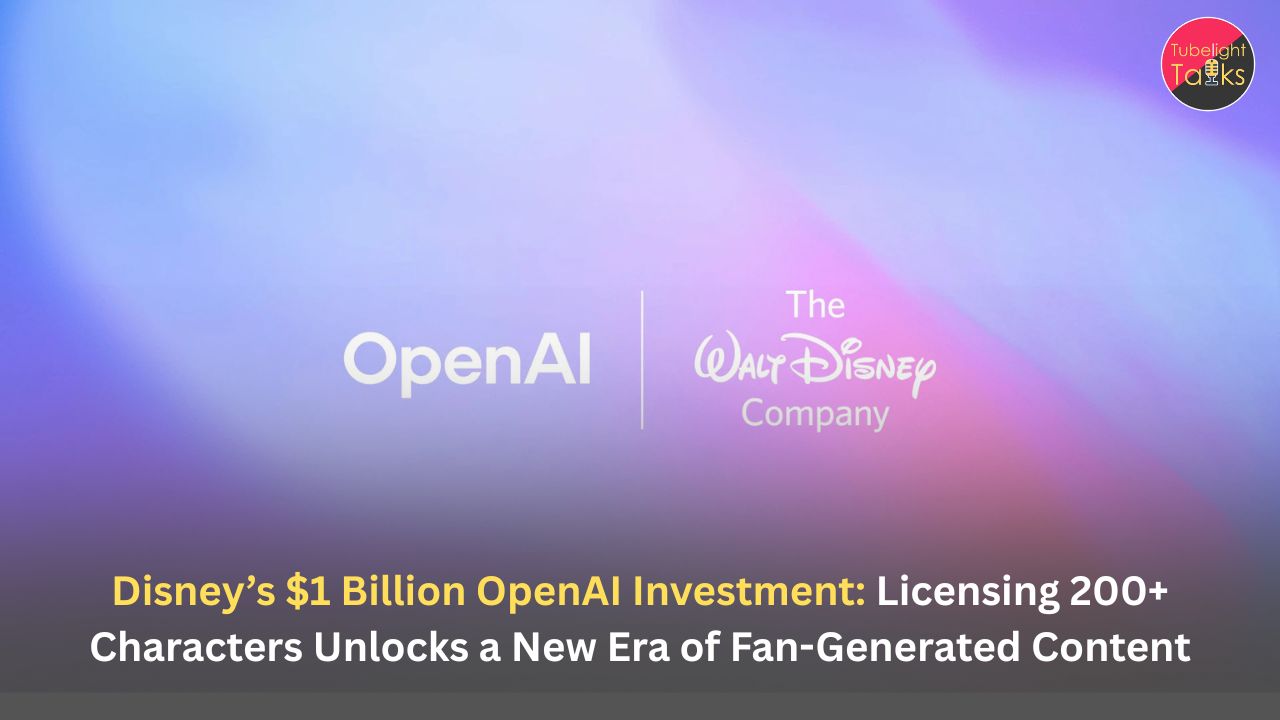
Disney’s $1 Billion OpenAI Investment: Licensing 200+ Characters Unlocks a New Era of Fan-Generated Content
Disney’s $1 Billion OpenAI Bet: Has the world’s most protective intellectual property (IP) giant finally realized that strategic cooperation, not endless litigation, is the future of the generative AI revolution? The Walt Disney Company’s announcement of a $1 Billion equity investment in OpenAI coupled with a groundbreaking three-year licensing agreement for over 200 of its iconic characters is the single most defining event in the media industry for India 2026.
This move marks a dramatic and highly strategic U-turn for the entertainment monolith, which had previously engaged in aggressive legal battles against AI firms for unauthorized use of its content. The Shocking Report 2026 is not the investment itself, but the revelation that the company – which keeps the tightest grip on characters like Mickey Mouse, Iron Man, and Darth Vader – is now willingly empowering fans to produce and share AI-generated short videos using these assets on OpenAI’s Sora platform.
The Pivot from Litigation to Licensing
The launch of OpenAI’s Sora, a highly realistic text-to-video generative AI model, sent shockwaves across Hollywood in late 2025, triggering deep anxiety about intellectual property infringement and job security. Disney was among the most vocal critics, reportedly sending cease-and-desist letters to tech giants and pursuing lawsuits against AI image generators for unauthorized use of its copyrighted material.
However, the rapid advancement of the technology forced a strategic recalculation. Disney CEO Bob Iger and OpenAI CEO Sam Altman hammered out a landmark agreement, making Disney the first major content licensing partner for Sora. The core of the deal is pragmatic: rather than fighting the inevitable wave of generative fan content, Disney is channeling it into a controlled, licensed, and revenue-generating environment.
This partnership is designed to “thoughtfully and responsibly extend the reach of our storytelling through generative AI” while simultaneously setting a new, high-water mark for the cost of licensed IP use, a move that will inform all future negotiations in the New India digital marketplace.
Empowering Fans and Setting Industry Standards
The primary positive outcome is the unprecedented empowerment of the global fanbase. Starting in early 2026, fans will be able to create short video clips using simple text prompts that legally feature:
200+ Characters: From classic Disney icons like Mickey Mouse and Cinderella to Marvel superheroes, Pixar favorites, and Star Wars creatures (Yoda, Groot, etc.).
Associated Assets: The license extends to costumes, props, vehicles, and iconic environments from these franchises.
Crucially, the agreement explicitly excludes the likenesses and voices of associated actors, addressing a major anxiety point in Hollywood and protecting the rights of performers. Furthermore, a curated selection of these fan-generated Sora videos will be made available for streaming on Disney+, creating a new, short-form content layer that enhances subscriber engagement.
This move transforms the relationship between the IP owner and the fan, turning the audience from passive consumers into active, though constrained, creators. This strategy perfectly aligns with the digital-first, participatory culture fueling the Viksit Bharat 2047 digital economy.
Creator Anxiety and Cannibalization Risk
Despite the official emphasis on “responsible use,” this massive deal intensifies the underlying anxieties in the creative industry, a Shocking Report 2026 that Hollywood unions are rapidly addressing.
Job Displacement: Generative video tools like Sora threaten the entry-level jobs of animators, special effects artists, and storyboarders. Creators fear that the ability to quickly generate complex shots via prompt could cannibalize traditional production pipelines, even if the current license is limited to short-form content.
IP Control Boundaries: While the deal is framed as controlled, any licensing of this scale introduces risks. Automated prompt filters will be deployed to prevent the characters from being depicted in inappropriate or harmful scenarios (e.g., violence, political content), but generative AI systems can be notoriously difficult to police fully, creating a constant tension between fan freedom and brand protection. The success of this partnership hinges on the Ground Reality effectiveness of these ‘guardrails.’
Also Read: Agentic AI Platforms: Gemini 2.0/2.5 vs OpenAI’s o3 & o4-mini What You Can Actually Do Now
The substantial $1 Billion equity investment also cements Disney as a major customer of OpenAI, signaling an internal shift where OpenAI’s models (including ChatGPT for employees) will be used to streamline internal production and efficiency. This internal adoption, while fiscally sound, fuels the fear that AI is displacing human creative work at the corporate level.
Global IP Protection & Tech Adoption
The timing of this global IP licensing deal has significant resonance with the tech policy priorities detailed in India’s Budget 2026. The PM Modi Latest push for digital public infrastructure and a robust AI ecosystem emphasizes the need for clear IP frameworks.
The Disney-OpenAI agreement establishes an international market price for the licensed use of creative assets in generative AI. This precedent is crucial for India, which is rapidly developing its own large language models (LLMs) and video generators. It provides a blueprint for Indian content creators and media companies – from Bollywood studios to regional IP owners – on how to engage with AI responsibly: license, invest, and control.
It indirectly supports the development of India’s domestic IP protection laws and frameworks, ensuring that the Viksit Bharat 2047 creative industry can both leverage and monetize generative AI without being exploited.
A Pragmatic Hegemon’s Survival Strategy
The deal is widely viewed by experts as Disney’s pragmatic strategy to maintain cultural and financial hegemony in the age of generative AI.
Ms. Kavita Sharma, Media Analyst, Mumbai: “Disney is making a brilliant move: it’s setting the rules of the game. By investing and licensing, they are essentially saying to every other AI company – Google, Meta, whoever – ‘This is what it costs to touch our IP.’ They are establishing a revenue stream where before there was only litigation cost. This is the gold standard for how legacy IP owners must adapt to survive the generative wave.”
Dr. Ethan Klein, Tech Ethics Professor: “The immediate risk of this Shocking Report 2026 is the psychological impact on human creators. This is a monumental validation of generative AI as a legitimate tool, not just a threat.
The exclusion of actor likeness and voice is a win for talent, but the industry must quickly create a compensation model for animators and designers whose stylistic work is now easily replicable via prompt, ensuring that the wealth generated by fan content is fairly distributed in this New India digital ecosystem.”
Creativity, Ownership, and Ethical Consumption
The spiritual wisdom (Satgyan) of Sant Rampal Ji Maharaj emphasizes that true creation is a divine gift and that ownership (swami-tva) must be respected. The ethical dilemma at the heart of the AI debate – unlicensed content use – is a failure to uphold dharma (righteous duty) and respect the hard work of the original creator.
Disney’s decision to transition to a controlled licensing model, backed by a massive investment, aligns with the principle of ethical commerce. It affirms that intellectual property has value and should not be expropriated for profit without compensation.
Sant Rampal Ji Maharaj’s teachings would endorse this framework, provided that the financial profits are shared justly with all human contributors (writers, artists, technicians) and that the fan-created content remains wholesome, avoiding the promotion of vices or unrighteous conduct. This ensures that the technological progress aligns with moral progress, a necessity for a morally sound Viksit Bharat 2047.
Disney-OpenAI Partnership (Early 2026 Rollout)
Disney Investment: $1 Billion (Equity investment in OpenAI).
Licensing Deal: Three-year agreement, making Disney the first major content licensing partner for Sora.
Licensed Assets: Over 200 characters from Disney, Marvel, Pixar, and Star Wars, plus associated props/vehicles.
Generative Tool Access: Sora (video generation) and ChatGPT Images (image generation).
Key Restriction: Explicitly excludes actor likenesses and voices.
Fan Content Display: Curated selection of Sora-generated videos will stream on Disney+.
FAQs: Decoding the Disney AI Strategy
Q: Does this deal mean fans can create full-length Disney movies with Sora?
A: No. The license is currently limited to generating short, fan-prompted social videos. It is explicitly designed not to cannibalize Disney’s long-form film and TV production.
Q: Which characters are covered in the 200+ license?
A: The license covers popular animated, masked, and creature characters, including Mickey Mouse, Cinderella, Ariel, Iron Man, Darth Vader, Simba, Moana, and characters from Toy Story, Frozen, and Encanto.
Q: Why did Disney invest $1 Billion instead of just licensing the characters?
A: The investment gives Disney an equity stake in OpenAI, ensuring it benefits directly from the growth of the AI platform. It also strengthens the partnership, granting Disney better access to OpenAI’s APIs for use in its internal production and customer experiences (like Disney+).
Q: Will the content created by fans be free to use?
A: Users will be able to generate and share the short videos on social media. The terms regarding commercial use by the fan remain to be fully detailed, but the IP is legally controlled by Disney.
Q: What is the main safety concern with this partnership?
A: The main concern is ensuring that the content guardrails effectively prevent users from prompting the AI to depict beloved characters in inappropriate, violent, or politically charged scenarios, which could harm the brand’s reputation.
Related Stories






Discussion (0)