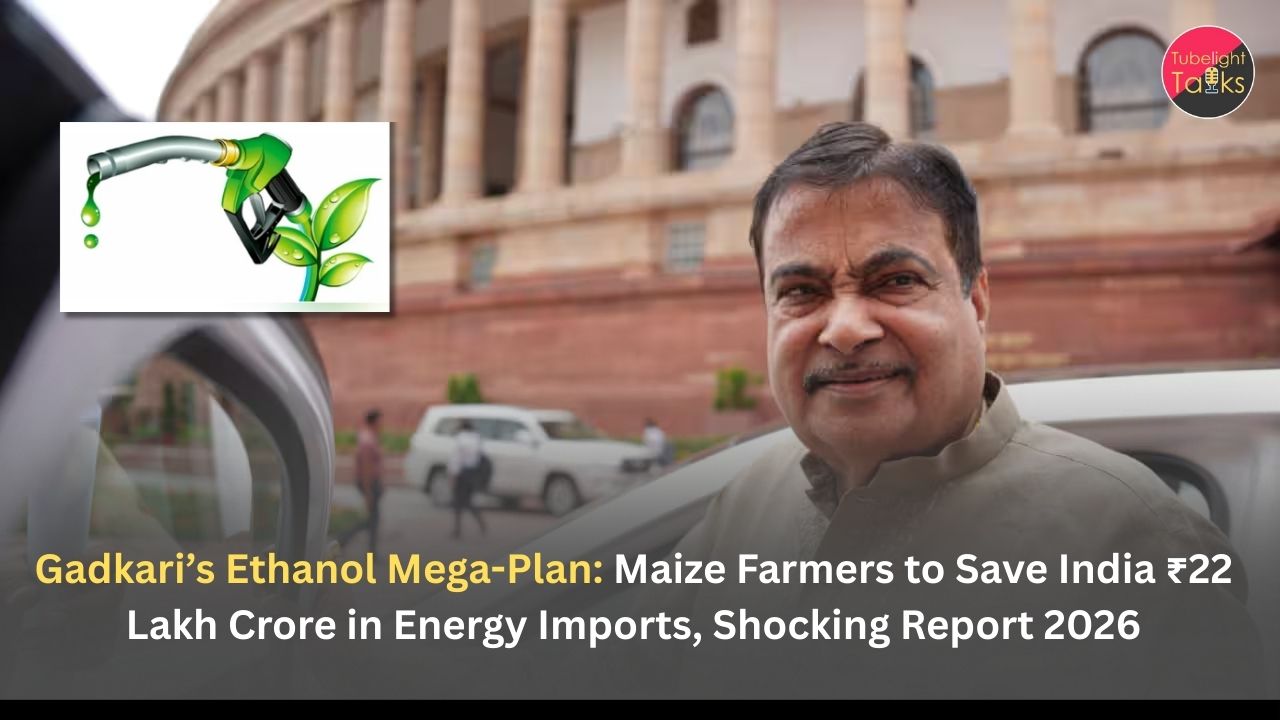
Gadkari’s Ethanol Mega-Plan: Maize Farmers to Save India ₹22 Lakh Crore in Energy Imports, Shocking Report 2026
Gadkari’s Ethanol Mega-Plan: Does India have the agricultural might to slash its crippling energy import bill of ₹22 Lakh Crores? Union Minister Nitin Gadkari has launched a powerful, statistics-driven challenge to the nation, revealing that India remains dangerously reliant on foreign sources for 87% of its energy needs. The financial haemorrhage, which funnels this colossal sum out of the country annually, is the single biggest impediment to achieving true economic independence.
However, the minister confirmed that the government’s aggressive push for the Ethanol Blending Programme (EBP) – specifically using surplus grains like maize – is not just an environmental solution, but a revolutionary farmer wealth creation scheme, set to generate ₹40,000 Crores directly for Indian farmers. The Shocking Report 2026 is the immediate, real-world impact seen on maize prices, which have skyrocketed, turning erstwhile subsistence farmers into national energy providers.
This comprehensive feature dives into how this agrarian pivot is the core of the PM Modi Latest vision for a self-reliant and pollution-free Viksit Bharat 2047.
The ₹22 Lakh Crore Energy Drain
Minister Gadkari’s frank admission – that 87% of India’s energy is imported at an astronomical cost of ₹22 lakh crores – serves as the stark backdrop for the ethanol movement. This figure, largely driven by crude oil, highlights India’s extreme vulnerability to global geopolitical volatility and exchange rate fluctuations. The dependency not only puts massive pressure on the rupee but also exports jobs and wealth that could be utilized domestically.
The Ethanol Blending Programme (EBP), targeting 20% blending of ethanol with petrol (E20) by 2025-26, is the government’s primary strategic weapon against this import dependency. Traditionally focused on sugarcane molasses, the policy expansion to include surplus food grains, particularly maize (corn), was the game-changer.
This move transformed maize from a simple food and feed crop into a critical energy commodity, creating a captive, massive industrial demand that bypassed volatile commodity markets. This regulatory foresight is now yielding exponential benefits, validating the pursuit of indigenous solutions for New India.
The ₹40,000 Crore Windfall for Farmers
The most compelling success story of the EBP is the immediate, life-altering impact on maize farmers, particularly in major growing states like Uttar Pradesh and Bihar. Minister Gadkari presented indisputable data demonstrating how government policy is translating into direct farmer profit:
- Pre-Ethanol Price: ₹1,200 per quintal (significantly below the Minimum Support Price (MSP) of ₹1,800 per quintal).
- Post-Ethanol Price (India 2026): ₹2,600 to ₹2,800 per quintal (a massive 116% surge).
The sheer economic incentive has triggered a cultivation boom. Gadkari confirmed that maize cultivation in UP and Bihar has seen a three-fold increase. This new cash crop status has instantly improved rural economic viability. The estimated saving of ₹22 lakh crores, the Minister stressed, will be diverted back into the domestic economy, with an estimated ₹40,000 Crores of profit directly entering the pockets of farmers who supply the feedstock.
This transformation of the farmer from Annadata (food provider) to Urjadata (energy provider) is a foundational pillar of the Viksit Bharat 2047 economic model.
The Food vs. Fuel Debate and the Lobby Crisis
Despite the overwhelming economic and environmental positives, the ethanol push faces two major hurdles: the food vs. fuel debate and a powerful fossil fuel lobby resistance, highlighted in a Shocking Report 2026.
Food Security Risk: Critics argue that diverting food grains, even surplus ones, for fuel production risks food security, especially if crop yields suffer or global prices spike. The government’s counter-argument – that only surplus grains and those unfit for human consumption are used – needs ironclad regulatory guarantees to reassure consumers, a challenge compounded by the marginal allocation in Budget 2026 for large-scale, automated grain analysis facilities.
The Lobby War: Minister Gadkari openly alleged that a “rich petrol lobby” is actively working against the ethanol blending program. The Ground Reality is that the shift to cost-effective, indigenous fuel directly impacts vested interests in the fossil fuel import chain. This lobby funds negative campaigns, generating misleading data on engine performance and fuel efficiency, creating unwarranted consumer fear and slowing the adoption of E20 compliant vehicles.
The government needs a more robust, state-funded counter-campaign to disseminate facts and secure consumer confidence.
Accelerating the Maize Mission
Recognising the strategic importance of maize-based ethanol, the Budget 2026 included key policy support aimed at boosting the supply chain and distillery infrastructure.
The ‘Kisan Urja Samridhi Yojana,’ restructured in Budget 2026, now provides greater capital subsidy and interest subvention schemes specifically for setting up decentralized, small-scale grain-based ethanol distilleries in farming belts of UP and Bihar. This scheme focuses on creating employment and direct farmer-distiller linkage. Additionally, the PM Modi Latest push for advanced agricultural technology has seen a 30% increase in the allocation for high-yield, drought-resistant maize seed research under the National Food Security Mission.
The goal is to maximize per-hectare yield, ensuring that the ethanol demand is met without impacting food grain availability for the Public Distribution System (PDS). However, the lack of significant public investment in ethanol storage and dedicated pipelines remains a bottleneck, slowing the final roll-out of E20 fuel across all rural pumps in India 2026.
The Economic and Environmental Dividend
The policy has won cautious praise from economists and environmentalists.
Dr. Sanjeev Singh, Energy Economist, NITI Aayog Advisory Panel: “The numbers speak for themselves. The ₹22 lakh crore saving is not just an import substitute; it is a massive fiscal stimulus waiting to happen. The EBP is a powerful tool to manage our trade deficit. We are replacing imported crude with domestically-grown maize. This is true economic sovereignty and a massive step towards Viksit Bharat 2047. The challenge in India 2026 is sustaining the MSP for maize alongside this market boom to provide long-term stability to farmers.”
Ms. Meenakshi Iyer, Environmental Policy Analyst: “Ethanol fuelled vehicles are not just cost-effective for consumers; they are also indigenous and will end pollution in our major cities by drastically cutting down carbon monoxide and hydrocarbon emissions. It’s a win-win: cleaner air for citizens and cleaner balance sheets for the nation. The government must, however, invest more heavily in mandatory engine conversions and compliance infrastructure.”
The Wealth of Ethical Production
The success of the ethanol programme resonates with the spiritual wisdom (Satgyan) taught by Sant Rampal Ji Maharaj, which stresses the ethical linkage between honest labour (dharm ki kamai) and societal benefit (parhit). The concept of farmers earning ₹40,000 Crores through honest cultivation that simultaneously reduces national dependence on foreign powers and lowers pollution is the perfect embodiment of Dharma in economics.
Sant Rampal Ji Maharaj advocates for an economy built on indigenous resources and mutual benefit, where the prosperity of the primary producer (the farmer) is prioritized.
The shift from a dependency model, which feeds the greed of international oil cartels, to a swadeshi model where the nation’s wealth circulates among its own citizens, aligns with the spiritual principle of righteous living. This transition, which brings economic stability to the rural poor while ensuring a cleaner environment for all, is the true meaning of illumination and righteousness in national governance, ensuring a holistic, moral path for Viksit Bharat 2047.
The Ethanol Economy in India 2026
- Total Energy Import Bill: ₹22 Lakh Crores (87% of national energy needs).
- Ethanol Blending Target: E20 (20% blending with petrol) by ESY 2025-26.
- Maize Price Increase (Pre vs. Post Ethanol): From ₹1,200 to ₹2,600-₹2,800 per quintal.
- Farmer Profit Projection: ₹40,000 Crores annually for raw material suppliers.
- Maize Cultivation Growth (UP/Bihar): Tripled (approx. 300% increase) in key districts.
- Status of EBP: Import substitute, indigenous, cost-effective, and pollution-free.
FAQs: Gadkari’s Ethanol Mega-Plan
Q: Is maize being diverted from food supply for fuel?
A: No. The policy primarily targets surplus grains and those unfit for human consumption. The massive price rise incentivizes farmers to increase production, potentially creating a sustainable surplus for both food and fuel.
Q: What is the cost-effectiveness advantage of ethanol fuel?
A: Ethanol, being domestically produced, is priced lower than imported petrol. This reduces the cost for the consumer and eliminates the foreign exchange outflow, making it cost-effective for both the individual and the nation.
Q: Are existing vehicles compatible with E20 (20% ethanol blend)?
A: All new vehicles sold in India 2026 are mandated to be E20-compliant. Older vehicles may require minor adjustments, though the government maintains that E10 (10% blend) has already been adopted without major issues.
Q: What is the biggest hurdle to achieving the 20% blending target by 2025-26?
A: The main hurdle is the rapid construction and operationalization of sufficient grain-based distillery capacity and establishing an efficient, large-scale supply chain and storage infrastructure.
Q: How does the new policy help in reducing pollution?
A: Ethanol burns cleaner than petrol, leading to lower emissions of carbon monoxide, hydrocarbons, and particulates, directly contributing to better air quality in major urban centres.
Related Stories








Discussion (0)