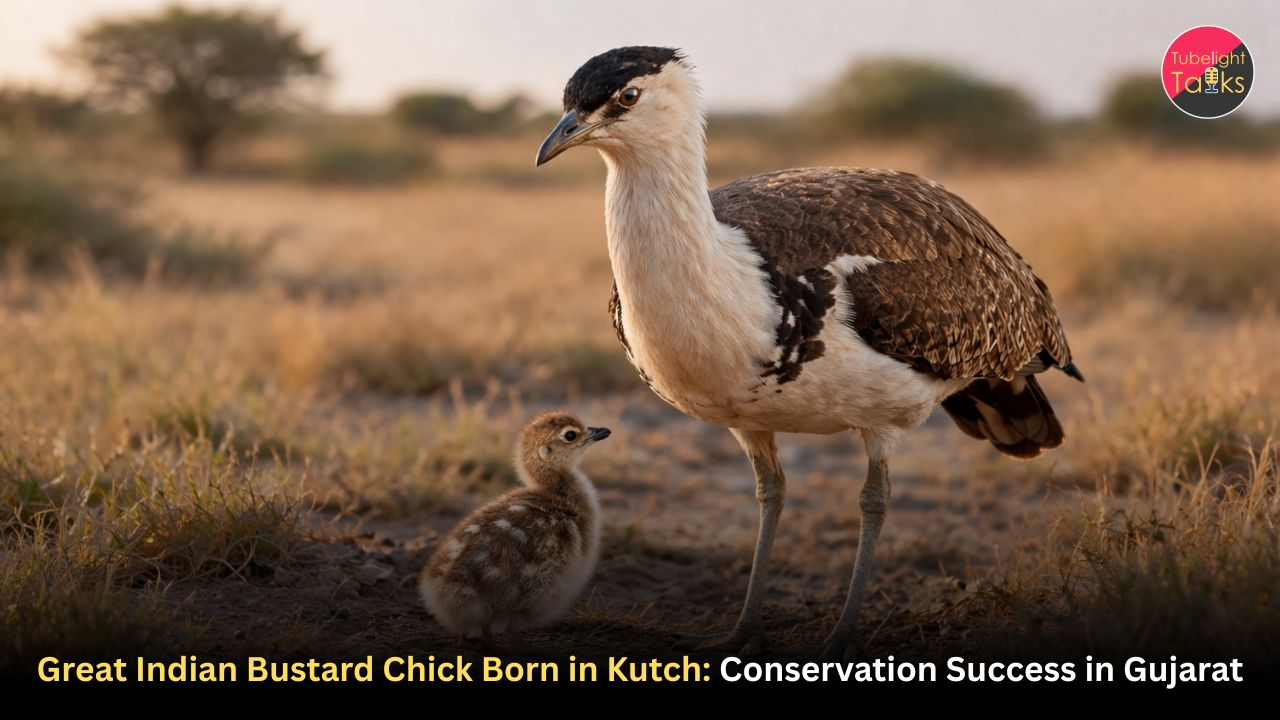
Great Indian Bustard Chick Born in Kutch: Conservation Gets a Rare Boost After 10 Years
India’s wildlife conservation effort has received an important and emotional boost with the Great Indian Bustard Chick Born in Kutch, Gujarat after nearly a decade. The development has been officially described as the result of a trans-state conservation effort and a special “jumpstart approach” that brought together the Union environment ministry, the forest departments of Rajasthan and Gujarat, and the Wildlife Institute of India. According to the official government statement, the chick hatched on March 26, 2026, after a fertile egg from Rajasthan was successfully placed under a female bird in Kutch for natural incubation.
For ordinary readers, this may sound like a small wildlife update. In reality, it is one of the most meaningful conservation developments of the year. The Great Indian Bustard is one of India’s most critically endangered birds, and every successful hatching matters enormously. When a chick is born in a landscape where the species had not seen such a birth for around 10 years, it signals not only biological survival but also the possibility of ecological revival. Gujarat’s Kutch, which once had only a handful of female birds and no breeding male population in the wild, has now become the site of a rare moment of hope.
Why this chick matters so much
The Great Indian Bustard is not just another rare bird. It is one of India’s most iconic grassland species and one of the most threatened birds in the world. Its numbers have dropped drastically over the years because of habitat loss, infrastructure pressure, collisions with power lines, and broader ecological change. That is why any successful hatching in a natural setting is treated as a major breakthrough. Current reporting and the official release both frame this birth as the first such hatching in Gujarat in about a decade.
The importance of the event also lies in where it happened. Kutch is a region with deep ecological value, but conservationists had been facing major challenges there because the local Great Indian Bustard population was too small and too imbalanced to sustain natural recovery easily. Reports say there were only three surviving females in the wild in Kutch, with no male present to enable a natural fertile egg in the ordinary course. That meant conservationists had to think beyond passive protection and move toward a more intervention-based strategy.
That is what makes this moment historic. The new chick is not being seen as a lucky accident. It is being seen as the result of a carefully planned conservation innovation. In a country where many endangered-species stories are filled with decline, this one stands out because it shows that active intervention, when done scientifically and patiently, can produce visible success. This is not a final victory. But it is a real gain.
How the “jumpstart approach” worked
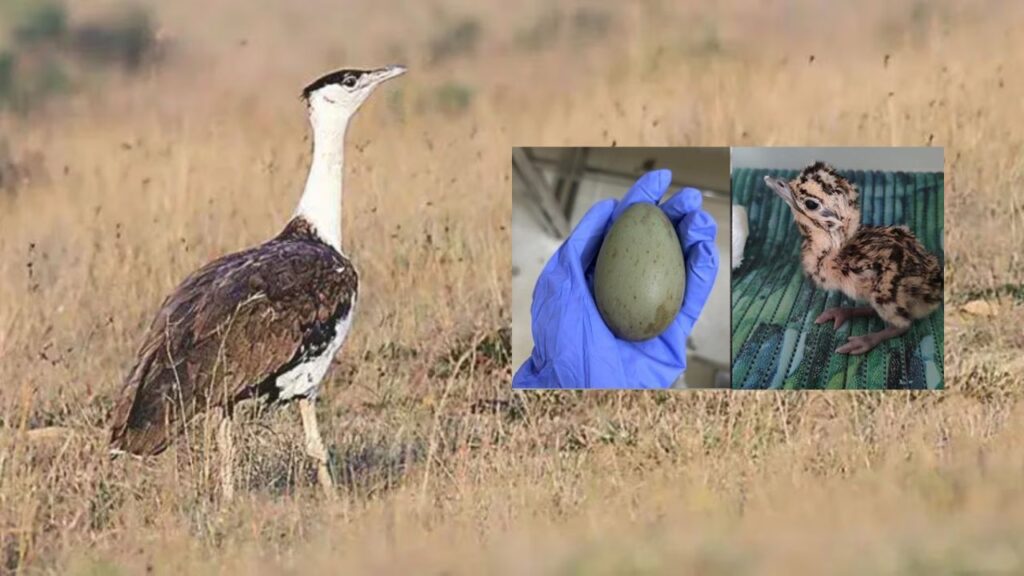
The official PIB statement explains that the hatching happened through what was described as a “jumpstart approach.” A fertile Great Indian Bustard egg from a captive breeding centre in Sam, Jaisalmer, Rajasthan was transported about 770 kilometres by road to Naliya in Gujarat’s Kutch. The transport was done under highly controlled conditions using a handheld incubator so the egg remained viable during the journey.
Once the egg reached Kutch, it was placed in the nest of a wild female Great Indian Bustard after replacing an infertile egg. The female then incubated the fertile egg naturally, and the chick hatched successfully on March 26. The field monitoring team later observed that the chick was being reared by its foster mother in its natural habitat. That is a very important detail because it means this was not only a hatch under human-managed care, but a hatch that returned immediately to a wild ecological setting.
This method matters because it combines captive breeding, translocation, and natural maternal incubation. In simple terms, it uses science to compensate for the missing pieces in a broken wild breeding system, while still allowing the bird to grow within a natural behavioral context. That makes the approach particularly valuable for species recovery, because survival is not only about getting an egg to hatch.
It is also about helping the young bird grow within conditions that preserve wild instincts and habitat connection. This explanation is partly interpretive, based on the process described in the official release and related reporting.
A wider conservation system is beginning to show results
The government’s official statement did not stop at announcing the chick. It also said the number of Great Indian Bustards in conservation breeding centres has now reached 73. Union Environment Minister Bhupender Yadav said that rewilding of birds is planned in the near future. That tells us the current success in Gujarat is part of a much larger conservation architecture, not a one-off field experiment.
This broader context is crucial. Species like the Great Indian Bustard cannot be saved by isolated good news events. They need layered conservation systems: breeding programmes, habitat management, field monitoring, inter-state coordination, scientific support, and long-term political backing. The Gujarat chick matters because it shows those layers are beginning to connect in a meaningful way. The breeding centres are producing viable eggs.
The transport protocols are working. The field teams can coordinate across states. And the wild females can still play a role in recovery when the conditions are carefully set up. This is an inference from the official and reported facts.
The Times of India report also emphasized that this was a trans-state success story, describing it as a conservation achievement that linked Rajasthan’s breeding infrastructure with Gujarat’s grassland habitat. That kind of coordination is often harder than it sounds. Wildlife conservation in India is frequently limited by fragmented administration, funding stress, and differing local priorities.
So when two states and central institutions successfully align around a single endangered-species intervention, that itself becomes a sign of institutional progress. This is an inference supported by the official description of the collaboration.
Also Read: India Moves to Tackle Invasive Alien Species in India as NBA Sets Up National Expert Committee
Why Gujarat’s Kutch is central to the story
Kutch’s grasslands are ecologically important, but they are also fragile. The Great Indian Bustard depends on open landscapes, low-disturbance breeding grounds, and a habitat structure that many development models do not easily accommodate. Over time, the species has suffered because grasslands are often undervalued compared to forests or wetlands in mainstream public imagination.
Yet for birds like the bustard, grasslands are not “empty land.” They are life-support systems. This is background ecological reasoning informed by the conservation context around the species.
The birth of a chick in Kutch therefore carries symbolic weight. It is a reminder that landscapes often dismissed as barren can be biologically precious. It also highlights that saving a species is not only about protecting the animal itself, but also about protecting the ecosystem that allows it to breed, feed and survive.
If Kutch becomes a stronger recovery landscape for the Great Indian Bustard, the implications will go far beyond one chick. It could reshape how grassland conservation is understood in western India. This is an inference based on the role of habitat in the current success.
The emotional and national significance of this success
There is also a deeper emotional side to this story. Endangered-species conservation often unfolds slowly and painfully. Years of effort may produce no visible gain. Populations may remain low, and each breeding season may bring uncertainty. That is why one healthy chick can mean so much. It offers proof that the species is still capable of renewal if humans act wisely enough.
Union Minister Bhupender Yadav publicly described the event as a milestone and linked it to broader efforts to save the species. Current coverage has also connected the progress to the long-term conservation vision around Project GIB. When political leadership, scientific institutions and field teams all begin describing one event as a milestone, it usually means the conservation community sees it not as symbolic optimism alone, but as evidence of a method that may be repeated or scaled. This is an inference from the tone of the official and reported responses.
What still makes the Great Indian Bustard vulnerable
This success does not remove the crisis facing the species. The Great Indian Bustard remains critically endangered, and a single chick does not change the hard biological reality that populations are still extremely fragile. Species recovery at this stage is not only about births, but about survival to maturity, successful future breeding, habitat safety, and reduction of external threats. This is a reasoned conservation point based on the species’ critically endangered status and the scale of intervention being used.
That means the real test begins now. The chick must survive, the habitat must remain protected, field monitoring must continue, and more such successes must follow if the species is to move from emergency management to actual recovery. Conservation history is full of moments that looked hopeful but could not be sustained. What makes this story truly important is not only the hatch itself, but whether it becomes the beginning of a repeatable pattern. This is an inference grounded in the current state of the species and the official emphasis on future rewilding.
What this teaches about conservation in India
The Kutch hatching offers a larger lesson for Indian conservation. It shows that endangered-species work cannot rely only on declarations, slogans or symbolic observances. It needs field science, patient logistics, cross-state cooperation, institutional continuity and local habitat attention. The success of the jumpstart approach suggests that creative intervention, when based on ecological understanding rather than quick publicity, can work.
It also highlights the importance of long-term state capacity. A conservation result like this is built on years of groundwork that most people never see: breeding management, veterinary support, egg viability assessment, transport planning, nest selection, and field supervision. When a chick finally hatches, it is the visible tip of a much larger invisible system. That is why this birth deserves national attention. It is not just a wildlife photo opportunity. It is the visible outcome of sustained conservation work. This is an inference based on the documented process behind the event.
The duty to protect creation
Teachings associated with Sant Rampal Ji Maharaj repeatedly emphasize compassion, responsibility and the understanding that life in all forms has value. In that spirit, wildlife conservation is not just an environmental duty but also a moral one. When a species stands close to disappearance, protecting it becomes an act of both wisdom and humanity.
The birth of a Great Indian Bustard chick in Kutch reminds us that nature responds when human action is guided by care instead of neglect. Sat Gyaan encourages a way of living that does not exploit creation carelessly, but seeks balance, preservation and respect for the life systems that sustain the world. This is a spiritual reflection, not a scientific claim.
Call to Action
The birth of a Great Indian Bustard chick in Gujarat should be celebrated, but it should also push citizens, institutions and policymakers to think more seriously about what conservation really demands. Endangered species cannot be saved by emotion alone. They need protected habitat, sustained funding, scientific intervention where necessary, and public respect for landscapes that are often ignored.
If this moment leads to stronger support for grassland conservation and more patience for long-term wildlife recovery, then one chick in Kutch will have already changed more than its own future.
FAQs: Great Indian Bustard Chick Born in Kutch
1. What happened in Kutch, Gujarat?
A Great Indian Bustard chick hatched in Kutch on March 26, 2026, marking the first such birth in Gujarat in about a decade.
2. Why is this birth so important?
Because the Great Indian Bustard is critically endangered, and Gujarat had not seen such a hatching in the wild for nearly 10 years.
3. What is the “jumpstart approach”?
It is the conservation method used here, in which a fertile egg from Rajasthan was transported in controlled conditions to Kutch and placed in the nest of a wild female for natural incubation.
4. Which institutions were involved in this success?
The Ministry of Environment, the forest departments of Rajasthan and Gujarat, and the Wildlife Institute of India were all part of the coordinated effort.
5. How far was the egg transported?
Reports and the official release say the egg was moved about 770 kilometres from Sam in Rajasthan to Naliya in Kutch, Gujarat.
6. Does this mean the species is now safe?
No. It is a major success, but the species remains critically endangered and still needs long-term protection, habitat support and further recovery efforts. This is an inference based on the species’ status and the official framing of the event as a milestone rather than final recovery.
Related Stories









Discussion (0)