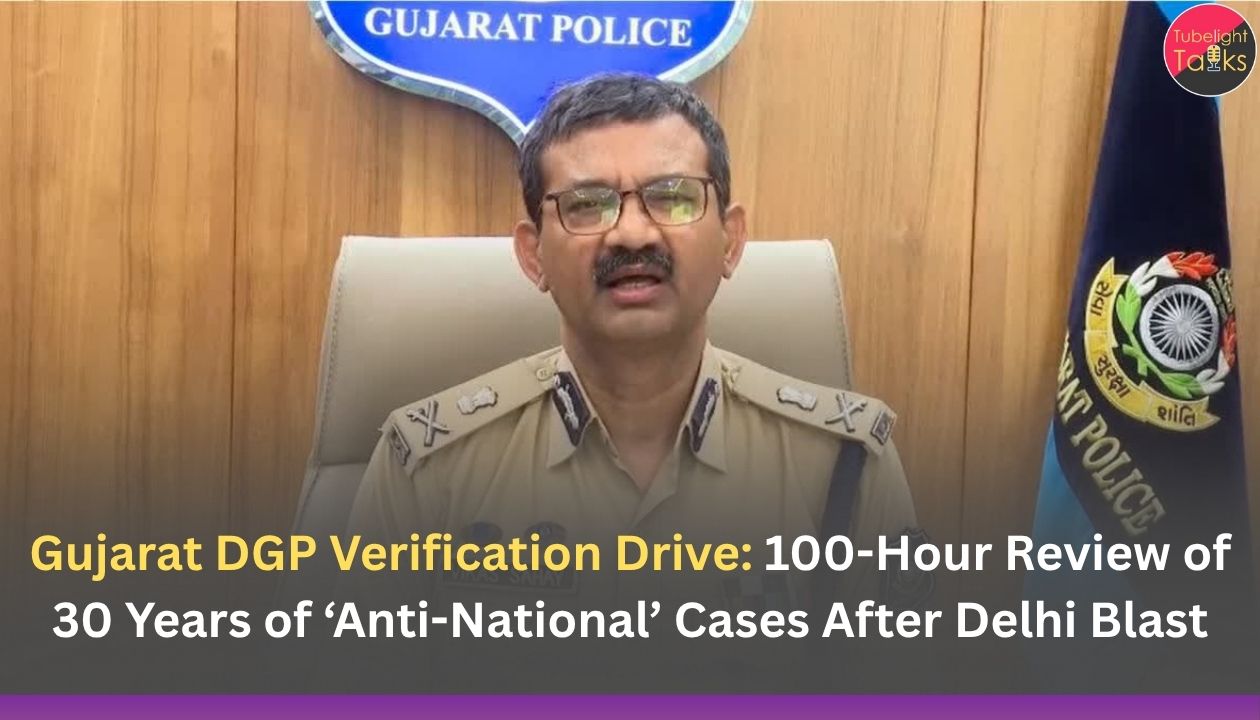
Gujarat DGP Verification Drive: 100-Hour Review of 30 Years of ‘Anti-National’ Cases After Delhi Blast
Gujarat DGP Verification Drive: Gujarat has launched one of its most aggressive security audits in recent years. State Director General of Police (DGP) Vikas Sahay has directed all police stations to identify and verify every individual booked for “anti-national activities” in the last 30 years, and to submit a consolidated dossier within 100 hours.
The move comes in the wake of recent Anti-Terrorist Squad (ATS) arrests, including a Hyderabad-based doctor accused of plotting a chemical attack using ricin, and the car blast near Delhi’s Red Fort that killed multiple people—developments that have triggered heightened vigilance nationwide.
What exactly has Gujarat Police ordered?
According to multiple reports and internal communications:
- The DGP has set a 100-hour deadline for Commissioners of Police and District Superintendents of Police to submit a 30-year dossier of ‘anti-national’ arrests.
- Each police unit must:
- Compile a list of all individuals booked in cases related to ‘anti-national activities’ in the last three decades.
- Verify the current status, background and activities of these individuals through record checks and field enquiries.
- Submit a final, updated dossier with profiles, case details and risk assessments to the state DGP office.
- Compile a list of all individuals booked in cases related to ‘anti-national activities’ in the last three decades.
A tweet from the Gujarat Police account states that the force has “vigorously started checking all accused of last 30 years who were involved in anti national activities” and that the department “remains ever vigilant to safeguard our country from anti national elements.”
Officials quoted in regional media describe this as an “urgent state-wide compliance order” aimed at building an updated, centralised database of individuals linked to offences “deemed against national interests.”
Why now? ATS arrests, ricin plot and the Red Fort blast
The timing of the order is not random. It is closely tied to a cluster of recent security incidents:
- ATS ricin case
- On 8 November 2025, Gujarat ATS arrested a doctor from Hyderabad and two others from Uttar Pradesh, alleging they were part of a terror plot involving ricin, a highly toxic compound derived from castor beans.
- Investigators claim to have seized material related to ricin preparation from the doctor’s residence, suggesting plans for a potential chemical attack.
- On 8 November 2025, Gujarat ATS arrested a doctor from Hyderabad and two others from Uttar Pradesh, alleging they were part of a terror plot involving ricin, a highly toxic compound derived from castor beans.
- Delhi Red Fort car blast
- Two days later, a car blast near the Red Fort in Delhi killed multiple people, leading to a heightened security alert across several states, including Gujarat.
- Two days later, a car blast near the Red Fort in Delhi killed multiple people, leading to a heightened security alert across several states, including Gujarat.
- Follow-up checks and weapon seizures
- In Gir-Somnath district, Gujarat police teams conducting verification checks later recovered sharp-edged weapons—including swords, an axe and a dagger—from the compound of a dargah, further underlining the security concerns driving the current exercise.
- In Gir-Somnath district, Gujarat police teams conducting verification checks later recovered sharp-edged weapons—including swords, an axe and a dagger—from the compound of a dargah, further underlining the security concerns driving the current exercise.
In a video message shared with media, DGP Sahay said that after the ATS arrests, follow-up action in Faridabad and the blast in Delhi, Gujarat Police decided to “update the list of all anti-national elements booked in the last 30 years” and verify their current activities.
How will the 100-hour operation work?
From the available orders and media reports, the drive appears to have three main stages:
- Data mining from past records
- Each police station and district unit retrieves 30 years of case records involving charges commonly classified as “anti-national” (often including UAPA, terror-related IPC offences and similar provisions).
- A preliminary list of all such accused is drawn up.
- Each police station and district unit retrieves 30 years of case records involving charges commonly classified as “anti-national” (often including UAPA, terror-related IPC offences and similar provisions).
- Ground-level verification
- Police teams conduct field visits and background checks to determine:
- Whether the person is alive and at the same address,
- Current occupation and movements,
- Whether they are believed to be in contact with any active networks.
- Whether the person is alive and at the same address,
- Inputs may be cross-checked with ATS, Special Operations Group, intelligence units and local informants.
- Police teams conduct field visits and background checks to determine:
- Consolidated dossier
- All updated entries are merged into a state-wide dossier for use by police, ATS and other agencies.
- State-level officers say the objective is to enhance “coordinated vigilance” and ensure that no high-risk person escapes monitoring owing to old or fragmented records.
- All updated entries are merged into a state-wide dossier for use by police, ATS and other agencies.
What does “anti-national activities” mean in law?
The term “anti-national” is not precisely defined in criminal law, but in practice it is often linked to cases under:
- The Unlawful Activities (Prevention) Act (UAPA), India’s main anti-terror law designed to handle activities that threaten the sovereignty and integrity of the country;
- Specific chapters of the Indian Penal Code dealing with waging war, terrorism and related conspiracies.
Legal experts and rights groups have repeatedly flagged that such broad labels can sometimes blur lines between genuine national-security threats and political dissent or over-broad use of harsh laws like UAPA, which allows prolonged pre-trial detention and makes bail difficult.
In this case, however, the Gujarat order is focused on people already booked in past cases, not new arrests—though the intensity and speed of verification may still raise questions for civil-liberties advocates about surveillance, profiling and due process.
Security And Justice
From a Satgyan-inspired lens as taught by saints like Sant Rampal Ji Maharaj, the situation invites two parallel truths:
- The state must protect citizens from violence, terror and plots against the nation. Quick verification and better intelligence can prevent innocent lives from being lost.
- Satgyan reminds us that every soul is capable of transformation. Systems must ensure that innocents are not harassed, and those who have served their sentence or been acquitted are not endlessly treated as culprit .
In simple words: protecting the nation is vital, but doing it with fairness is itself an act of higher dharma.
Read Also: Car Explosion in Delhi Near Red Fort Metro Station Sparks Panic; Multiple Vehicles Damaged
FAQs: Gujarat DGP Verification Drive
1. What has Gujarat Police ordered?
All police stations in Gujarat must, within 100 hours, verify individuals booked for “anti-national activities” over the last 30 years and submit a consolidated dossier to the DGP.
2. Why now?
The order follows ATS arrests in an alleged ricin-based terror plot and the car blast near Delhi’s Red Fort, which together triggered a heightened security alert.
3. Who signed the order?
The instructions come from Gujarat DGP Vikas Sahay, the state’s top police officer.
4. Does this mean new arrests?
The directive is specifically about verification of past accused and updating records. New arrests, if any, would depend on what current investigations reveal.
5. Why is it controversial?
Supporters see it as a strong security measure; critics worry that broad terms like “anti-national” and such a fast-track drive could lead to overreach, profiling or harassment if not carefully supervised.
Related Stories










Discussion (0)