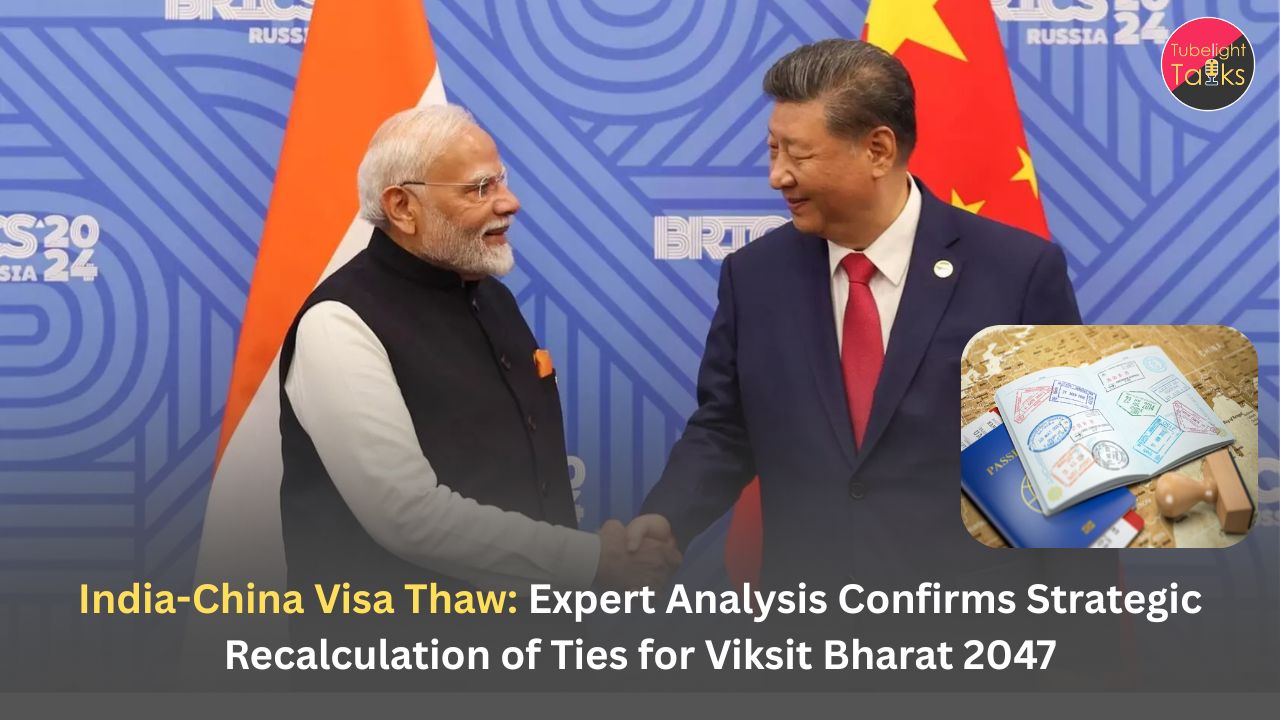
India-China Visa Thaw: Expert Analysis Confirms Strategic Recalculation of Ties for Viksit Bharat 2047
India-China Visa Thaw: Is economic pragmatism finally succeeding where decades of diplomacy have struggled? The decision by the Government of India to significantly free up tourist, and more importantly, expedite business visas for Chinese professionals marks a critical pivot that, according to leading geopolitical experts, confirms both nations are deep into a strategic “recalculation of their relationships.”
Following years of frozen ties after the Galwan clash, this move is not merely a gesture but a calculated risk aimed at unlocking the economic potential critical for the PM Modi Latest vision of Viksit Bharat 2047. However, this economic thawing occurs amidst a complex and precarious backdrop, raising troubling questions about the long-term stability of a relationship that continues to be shadowed by unresolved territorial disputes on the Line of Actual Control (LAC).
The Cost of the Cold Shoulder
Relations between India and China plummeted to a six-decade low following the deadly military confrontation in the Galwan Valley in May 2020. This freeze was immediately followed by a suspension of tourist and later a tightening of business and professional visas for Chinese nationals, which lasted until July 2025 for tourists and later into late 2025 for business professionals.
The expert assessment of “recalculation” stems from the mutual realization that the continued freeze, while a necessary response to border aggression, was inflicting significant self-harm, particularly on India’s burgeoning manufacturing and electronics sectors.
A Shocking Report 2026 compiled by industry bodies revealed that chronic delays in visa issuance for skilled Chinese technicians and engineers – essential for installing and servicing imported machinery – led to billions of dollars in output losses and crippling delays in ‘Make in India’ projects. The move to expedite short-term business visas, reducing approval times from months to less than four weeks, is a direct, pragmatic response to this economic Ground Reality.
Economic Necessity and People-to-People Exchange
The primary positive driver of this visa thaw is the recognition of economic necessity. India’s rapid infrastructure and manufacturing growth, central to Viksit Bharat 2047, demands a continuous, if managed, flow of Chinese components, technology, and specialized labor.
Supply Chain Stability: Expediting business visas for Chinese professionals in manufacturing, electronics, and renewables signals a priority for supply chain resilience. As industry leaders noted, this move reflects an acceptance of their recommendations to address critical skill gaps.
Tourism and Soft Power: The resumption of tourist visas (first in July 2025, then expanded globally in November 2025) and the agreed-upon revival of the Kailash Mansarovar Yatra – a key pilgrimage for Indian Hindus – are powerful confidence-building measures (CBMs). They aim to restore people-to-people exchanges, which both nations view as essential for mutual understanding and stability. China has welcomed the move, stating it “serves the common interests of all parties,” providing a positive reciprocal response in a cautious process of normalisation.
This pragmatic de-coupling of economic engagement from the immediate border dispute is seen by diplomats as a sophisticated hedging strategy for New India.
The Border Shadow and Bureaucratic Hurdles
While the diplomatic gestures are positive, experts caution that this is a tactical adjustment, not a strategic transformation. The core structural contradictions – the unresolved border dispute, deep security mistrust, and the massive trade asymmetry – remain.
The Ground Reality of the visa process itself still presents a challenge. Despite the official ‘thaw,’ visa applications from Chinese nationals remain under stringent vetting by the Ministry of Home Affairs, with quotas limiting the number of daily applications accepted by Indian missions. Tour operators report that initial optimism is undercut by slow processing times, high application rejection rates, and the costly requirement for biometrics collection in a market with massive potential demand (pre-2020 Chinese tourist arrivals reached 300,000 annually).
This lingering bureaucratic friction highlights the security-first approach that continues to govern New Delhi’s policy toward Beijing, demonstrating that full trust is yet to be restored in India 2026. The border, despite agreements to hold the next round of talks in China in 2026, continues to be the most significant variable that could instantaneously reverse all CBMs.
Trade Facilitation Frameworks
The “recalculation” strategy is subtly supported by provisions and frameworks detailed in Budget 2026 and related trade policy announcements.
The Department for Promotion of Industry and Internal Trade (DPIIT) has been actively coordinating with the Ministries of Home and External Affairs to create a new framework that shortens visa processing times for professionals from land-bordering countries – a policy designed to primarily benefit China without explicitly naming it.
Furthermore, the Budget 2026 focuses on trade facilitation measures, including expediting pending import approvals for Chinese goods, particularly high-tech components, raw materials, and electronics. These measures are designed to ensure that the economic momentum needed to fuel Viksit Bharat 2047 is not throttled by bureaucratic red tape, reinforcing the strategic pivot toward economic pragmatism under the PM Modi Latest leadership.
Tactical Reset vs. Structural Transformation
The consensus among foreign policy experts is that 2025-2026 represents a critical phase of “reset” that provides diplomatic breathing room, but lacks the structural resolution required for true partnership.
Mr. Robinder Sachdev, Foreign Affairs Expert: “This resumption of tourist and professional visas is undoubtedly ‘one more inch of normalisation,’ a goodwill step. It shows that both countries are committed to the Modi-Xi consensus to view each other as development partners rather than rivals. However, the movement is tactical. The strategic issues – territory, security mistrust – require genuine political will to resolve, not just visa expediting. The long-term durability depends on maintaining peace along the LAC.”
Dr. Aruna Ramaswamy, Geopolitical Analyst, India 2026: “India’s calculus is clear: strategic autonomy. We are simultaneously strengthening partnerships with the US and others while engaging Beijing out of economic necessity and regional balancing. The easing of business visas is a rational economic move to recover lost output. The challenge in India 2026 is to ensure this economic engagement does not compromise national security or lead to increased technological dependence that would undermine the New India vision.”
The Foundation of Goodwill and Trust
The spiritual wisdom (Satgyan) of Sant Rampal Ji Maharaj underscores that true peace and stable relationships between nations – or individuals – can only be built upon the foundation of genuine goodwill (preeti) and trust (vishwas). The current “recalculation” driven primarily by economic compulsion, while pragmatic, lacks the spiritual depth of true reconciliation.
Sant Rampal Ji Maharaj advocates for a moral and ethical approach in international relations, where disputes are resolved not through military posturing or economic coercion, but through peaceful dialogue based on righteousness (dharma). The easing of visas and the resumption of the Kailash Mansarovar Yatra are positive steps, as they facilitate parhit (mutual benefit) through human connection.
For the relationship to be truly stable and beneficial to Viksit Bharat 2047 and beyond, the leadership of both nations must embrace the spiritual principle of putting humanity and justice above power and territorial greed, ensuring that the ideals of illumination and righteousness guide their diplomatic decisions.
India-China Visa Thaw & Normalization Steps
Nature of Move: Easing of tourist visas (expanded globally November 2025) and expediting business visas (shortened processing time to <4 weeks).
Expert Assessment: Both nations are “recalculating their relationships.”
Primary Economic Driver: Recovering lost output and facilitating supply chains for Viksit Bharat 2047 projects.
Key Confidence-Building Measures (2025): Resumption of direct flights (October), agreement to restart Kailash Mansarovar Yatra (June), and high-level leader meetings (SCO Summit).
Ongoing Hurdles (Ground Reality): Strict visa vetting, daily application quotas, and unresolved LAC border tensions.
Chinese Response: Welcomed as a “positive move” that serves the common interests of both parties.
FAQs: The India-China Diplomatic Thaw
Q: Was the visa easing a unilateral decision by India?
A: India’s decision to resume tourist visas and expedite business visas was initiated after a series of high-level diplomatic and military talks, indicating a mutually agreed-upon phased normalization process.
Q: Will the increase in Chinese tourists help India’s economy?
A: Yes. Before 2020, Chinese tourists were a significant source of high-spending visitors. The revival is expected to boost India’s tourism sector and cultural exchanges, directly supporting the services sector.
Q: Does this visa thaw mean the border tensions are fully resolved?
A: No. Experts are clear that the border tensions on the LAC are not fully resolved. This is a tactical de-coupling of the economic and people-to-people sphere from the security sphere.
Q: What is the main benefit of faster business visas for Chinese professionals?
A: The main benefit is the elimination of bureaucratic red tape that was delaying the installation, maintenance, and inspection of specialized Chinese machinery crucial for India’s manufacturing and infrastructure projects.
Q: Will the diplomatic thaw lead to the lifting of the ban on Chinese apps and investments?
A: Not necessarily. The security vetting processes for Chinese technology and investments, including the ban on certain apps, operate under a separate national security framework that is unlikely to be fully relaxed soon, maintaining India’s strategic autonomy.
Related Stories







Discussion (0)