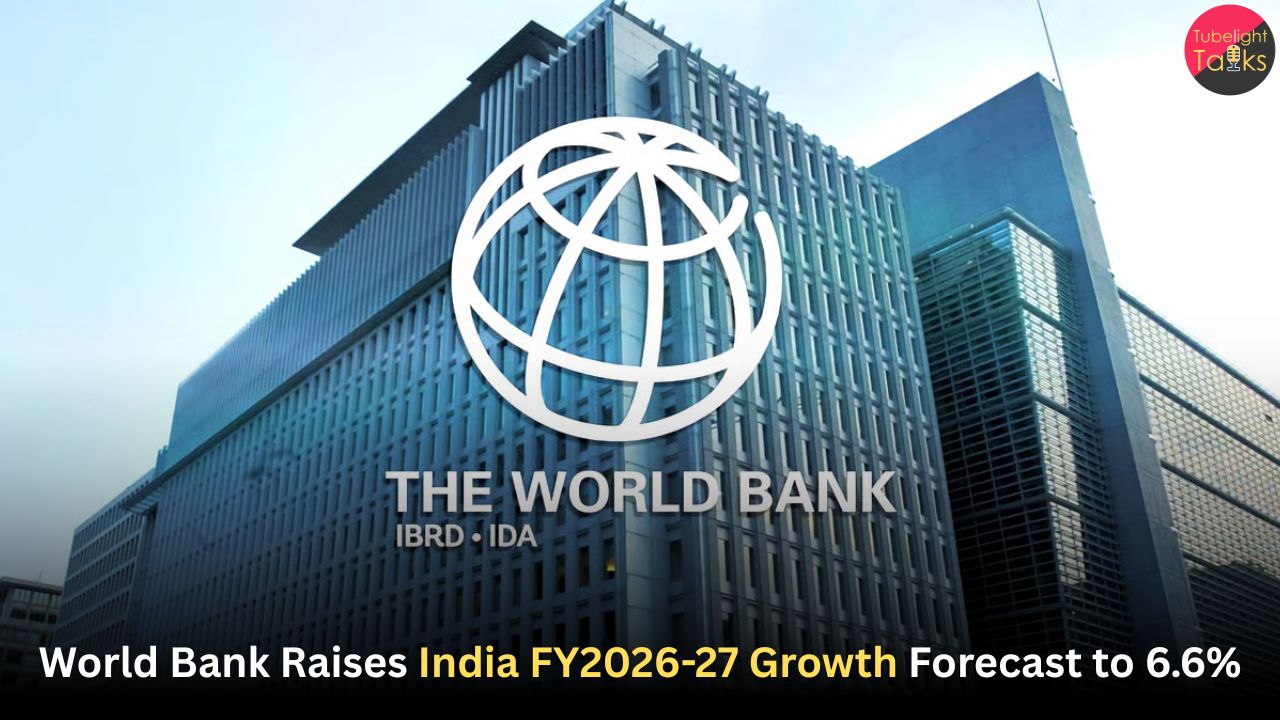
Economic Milestone: World Bank Upgrades India’s Growth Outlook
India FY2026-27 Growth: The World Bank has raised India’s growth forecast for FY2026-27 to 6.6%, reinforcing the view that India remains among the fastest-growing major economies despite heightened external risks from the West Asia conflict. In its latest regional update, the Bank said strong domestic demand has been a key support, while official reporting also highlighted resilient services exports and sustained reforms. At the same time, the Bank warned that India remains exposed to oil-price shocks because of its heavy dependence on imported crude.
What is driving the upgrade
The World Bank’s assessment points to consumption strength and macroeconomic resilience. DD News, summarizing the latest South Asia Economic Update, said India’s economy continues to show strong growth momentum, with domestic demand, services performance and reform continuity supporting the outlook. Reuters added that well-capitalized banks and sizeable foreign-exchange reserves are important policy buffers as geopolitical stress builds.
What could still go wrong
The optimism is not without caution. Reuters reported that risks remain tilted to the downside because of the Middle East conflict, including possible energy disruptions, inflationary pressure and renewed stress on the rupee and capital flows. In simple terms, India’s internal demand is strong, but imported inflation and oil shocks could still slow momentum.
Domestic Demand Continues to Anchor India’s Growth Story
The World Bank’s improved outlook for India reflects a broader pattern that has kept the economy relatively resilient despite global uncertainty. Consumption demand, services activity and public investment continue to support momentum, while banks and financial institutions remain better placed than in previous stress cycles.
Also Read: Market Relief Arrives as Ceasefire Lifts Equities, Softens Oil Shock and Supports Gold
For policymakers, this upgrade is significant because it validates the argument that India’s internal market strength can cushion some of the shocks coming from global trade tensions, energy volatility and geopolitical disruptions.
Risks Remain Even as the Outlook Improves
A stronger forecast does not mean the economy is free of pressure. India’s dependence on imported crude means any prolonged rise in oil prices can quickly affect inflation, transport costs and household budgets. In addition, global uncertainty can reduce investor appetite, affect exports and tighten financial conditions. That is why the latest upgrade should be seen as a sign of resilience, not a guarantee. The challenge now is to convert short-term stability into durable, job-rich and inclusive long-term growth.
Growth, contentment and Sat Gyaan
Economic growth is important, but it does not automatically bring peace, equality or inner security. Sant Rampal Ji Maharaj explains that material progress without spiritual wisdom leaves society anxious and dissatisfied. A nation needs strong institutions, honest effort and ethical living, but individuals also need spiritual clarity. True prosperity is not only higher output; it is a life lived with restraint, truth and devotion.
Call to Action
Track the economy with facts, not hype
Follow credible policy updates, read official economic reports, and understand both opportunities and risks. A balanced view of growth is better than blind optimism or fear.
FAQs: World Bank Raises India FY2026-27 Growth Forecast to 6.6%
Q1. What is the new World Bank forecast for India?
The World Bank now projects 6.6% growth for FY2026-27.
Q2. Why did the World Bank upgrade India’s outlook?
Because of strong domestic demand and broader macroeconomic resilience.
Q3. What is the main risk?
Higher oil prices and conflict-related external shocks remain major risks.
Related Stories








Discussion (0)