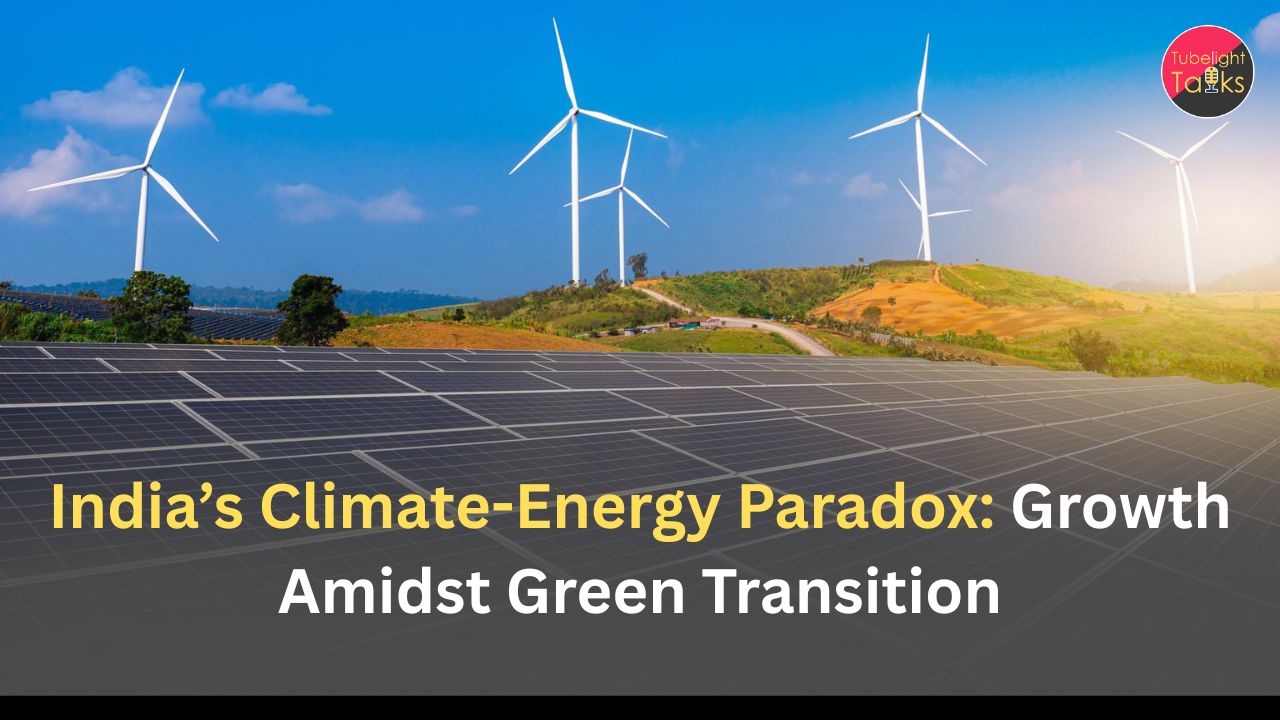
India’s Climate-Energy Paradox: Growth Amidst Green Transition
India’s Climate-Energy Paradox: As India enters COP31 in 2026, it carries a paradox at the heart of its climate and energy narrative. While the country has successfully expanded its non-fossil fuel power capacity to over 50 percent—the highest for any major developing economy—overall greenhouse gas emissions continue to increase.
This challenge reflects India’s dual imperative to sustain rapid economic development and improve living standards for its large population, even as it invests heavily in renewable energy and decarbonization.
Achieving Renewable Capacity Milestones Amid Rising Energy Demand
Renewable Capacity Surpasses Half of Electricity Mix
India’s power generation portfolio has made remarkable strides with solar, wind, hydro, and nuclear sources constituting more than half of installed capacity. Aggressive renewable energy auctions, government incentives, and international collaborations underpin this success, positioning India as a global clean energy leader.
Expanding Energy Demand and Emissions
However, the nation’s growing economy, rising urbanization, and expanding manufacturing base drive unprecedented energy consumption and emissions growth. Coal-based power generation, industrial activity, and transportation sectors remain significant contributors, making decarbonization a delicate balancing act.
The Emissions Growth Dilemma and Policy Responses
Structural Challenges of Development
India must reconcile rising energy needs with climate commitments, addressing infrastructure deficits, energy access for underserved communities, and poverty alleviation goals. Transitioning a large, still coal-dependent economy while ensuring energy reliability and affordability is inherently complex.
Policy Innovations and Climate Commitments
The government continues to widen clean energy investments, introduce stricter emissions norms, foster electric mobility, and support carbon capture technologies. Long-term net-zero strategies emphasize flexibility, just transition, and international finance to sustain momentum.
Balance in Progress and Responsibility
Sant Rampal Ji Maharaj’s Satgyan teaches that real progress balances ambition with truth and responsibility. India’s energy paradox calls for wise stewardship rooted in Satgyan’s principles, encouraging sustainable growth that honors natural harmony and protects future generations.
The path to climate justice requires embracing righteousness, transparency, and collective welfare, guiding India to manage competing demands with compassion and integrity.
Key Facts
- India’s non-fossil fuel power capacity crossed 50 percent in 2026, driven by renewables and nuclear.
- Overall greenhouse gas emissions continue to rise due to economic growth and energy demand expansion.
- Coal-fired power plants remain in operation, contributing significantly to emissions.
- Government policies include renewables expansion, emissions regulation, and electric vehicle promotion.
- International financing and technology cooperation support India’s clean energy transition.
Expert Views on India’s Energy and Emissions Challenge
Energy Economists
Experts note India’s renewable capacity growth as exemplary but stress the urgent need to accelerate coal phase-out and industrial decarbonization to meet global climate goals.
Climate Policy Analysts
Analysts highlight the importance of a just transition ensuring social equity while maintaining economic growth, with integrated energy and climate policies critical for sustainable progress.
Looking Ahead: COP31 and India’s Climate-Energy Future
Navigating Transition Complexities
India faces the challenge of aligning its development trajectory with ambitious emission reduction targets through technological innovation, policy reform, and stakeholder engagement.
Global Leadership with National Context
India’s leadership in renewable deployment coupled with unique socio-economic realities makes its COP31 position pivotal in global climate negotiations, advocating for equity and support mechanisms.
Also Read: India’s Climate Turning Point 2026: From Reactive to Proactive
FAQs: India’s Climate-Energy Paradox Ahead of COP31 2026
What percentage of India’s power is non-fossil fuel based?
Just over 50 percent as of 2026.
Why are emissions still rising?
Due to increasing energy demand, industrial growth, and coal use.
What is India doing to reduce emissions further?
Expanding renewables, regulating emissions, supporting EVs, and promoting innovation.
How does India balance growth and climate goals?
Through a just transition approach emphasizing equity, technology, and finance.
What does Sant Rampal Ji Maharaj’s Satgyan suggest?
Walk the path of righteousness and balance for sustainable development.
The article synthesizes official energy statistics, government climate policies, and independent expert analyses to illuminate India’s complex energy transition as it prepares for COP31 in 2026.
Related Stories










Discussion (0)