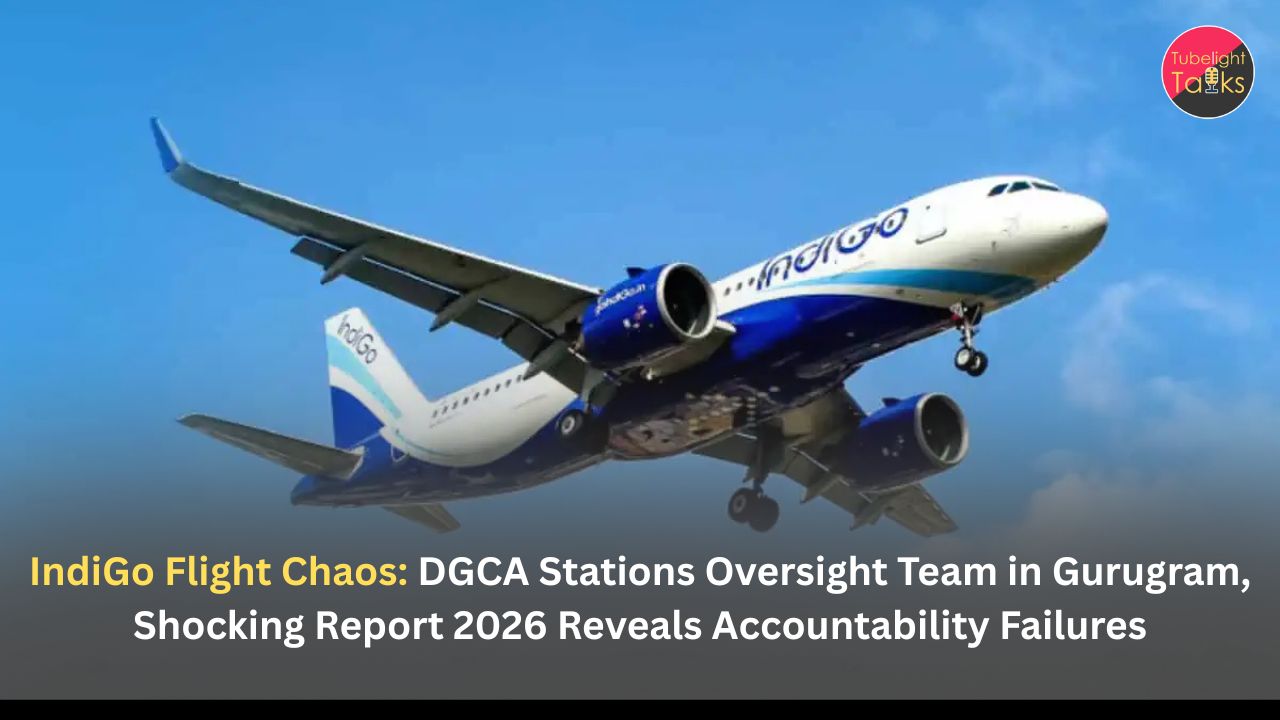
IndiGo Flight Chaos: DGCA Stations Oversight Team in Gurugram, Shocking Report 2026 Reveals Accountability Failures
IndiGo Flight Crisis: Did India’s largest airline intentionally gamble with passenger safety and convenience, leading to a massive operational meltdown? The official deployment of an eight-member Directorate General of Civil Aviation (DGCA) Oversight Team at IndiGo’s corporate office in Gurugram is an unprecedented regulatory invasion, confirming that the airline’s recent widespread flight delays and cancellations constitute a crisis of national importance.
While the government passionately drives the vision of Viksit Bharat 2047, where world-class infrastructure is paramount, the Shocking Report 2026 on IndiGo’s operational failure – with its On-Time Performance (OTP) plummeting below 20% during the peak travel week – exposes a gaping hole in corporate accountability and regulatory oversight in the pursuit of profit.
This exhaustive investigation reveals the razor-sharp mandate of the DGCA team, the cynical planning gaps that caused the crisis, and the crippling systemic flaws that Budget 2026 failed to address.
The Crew Crisis That Brought IndiGo to its Knees
The root cause of IndiGo’s operational chaos lies squarely in a massive, self-inflicted crew shortage, exacerbated by a sudden lack of preparedness for the second phase of stricter Flight Duty Time Limitation (FDTL) norms. These revised rules, designed for enhanced pilot safety and fatigue management – a non-negotiable step for a New India’s aviation sector – required airlines to significantly increase their pilot headcount and standby crew capacity.
IndiGo, operating on a famously lean model, failed spectacularly to anticipate or staff for this change, forcing thousands of cancellations in late 2025 and early India 2026.
The consequence was passenger suffering on a massive scale. With thousands of flights cancelled between November and December 2025, and refunds totalling over ₹1,150 Crores, the lack of transparency and abysmal communication became a national talking point.
The DGCA’s intervention, deploying a physical, high-powered oversight team led by Deputy Chief Flight Operations Inspector, Capt. Vikram Sharma, is the regulator’s most aggressive move to date, signalling that the era of passive monitoring is over.
DGCA’s Iron Fist Signals End of Corporate Complacency
The deployment of the DGCA Oversight Team is a decisive, welcome step that fundamentally shifts the Ground Reality of aviation regulation. By physically stationing Captain Sharma’s team at the airline’s nerve centre, the DGCA is ensuring real-time scrutiny of the very metrics that IndiGo previously manipulated or obfuscated.
The team’s mandate is surgically precise:
- Real-time Crew Audit: Closely monitoring the actual availability of cockpit and cabin crew against the daily flight schedule, specifically tracking ‘unplanned leaves’ that frequently masked underlying shortages and FDTL non-compliance.
- Safety First: Reviewing crew utilisation hours to ensure strict adherence to the new FDTL norms, preventing fatigued pilots from compromising safety.
- Passenger Justice Squad: Dedicated officers, Aishveer Singh and Mani Bhushan, are tasked with tracking daily cancellations, the speed of refund processing, and the quantum of passenger compensation – metrics that directly impact the common traveler’s faith in New India’s services.
This move reinforces the commitment of PM Modi Latest directives on consumer protection and safety, demonstrating that even the largest corporate entities are subject to the government’s unwavering focus on governance and accountability in the push for Viksit Bharat 2047.
Core Negative Angle: The Shocking Reality of OTP and Systemic Underfunding
While the DGCA intervention is commendable, the crisis revealed a Shocking Report 2026 on the airline’s performance during the meltdown. IndiGo’s On-Time Performance (OTP) at major metropolitan airports plummeted to as low as 19.7% on some critical days, a catastrophic drop for an airline that once boasted over 85% OTP. This collapse underscores a cynical operational model that prioritised maximum capacity over safe capacity, leading to a brittle system that shattered under the pressure of new safety rules.
The deeper crisis, however, is systemic. India needs over 30,000 pilots in the next decade, yet our training capacity and the meagre regulatory budget cannot support this growth. The DGCA itself has faced massive budget cuts and staffing challenges, hindering its ability to conduct frequent, unannounced audits.
Pilot associations have voiced their anger, questioning why the DGCA approved a bloated winter schedule for IndiGo just months before the FDTL rules came into effect, suggesting a lapse in proactive regulation. The current crisis is a direct consequence of this under-regulation and corporate risk-taking.
Also Read: IndiGo CEO Summoned 2025 Fury: 10% Route Cuts End Cancellation Nightmare or New Norm?
Government Schemes & Budget 2026 Updates: A Missed Opportunity?
Despite the ambitious aviation growth targets, the Budget 2026 allocation for the Ministry of Civil Aviation remains disappointingly low, failing to adequately address the structural deficiencies that caused the IndiGo crisis. While the ‘UDAN’ regional connectivity scheme continues to receive support, the capital outlay for the DGCA and related safety/training infrastructure saw only marginal increases – a move that aviation experts deem insufficient.
The allocation for the DGCA saw only a minimal uplift to approximately ₹330 Crores in the Budget 2026. This budget is tasked with certifying a massive fleet of new aircraft, training thousands of safety inspectors, and overhauling ancient regulatory processes. Industry leaders argue that compared to global counterparts like the US FAA or European EASA, the Indian aviation regulator is critically underfunded, leaving it perpetually playing catch-up.
For Viksit Bharat 2047 to fly, the government must view regulatory and training infrastructure as a priority investment, not a cost to be minimised. A separate, high-corpus fund for ‘Aviation Skill India 2026’ remains an unaddressed demand.
Passenger Anger and Pilot Fatigue
The Ground Reality across major airports remains tense. While IndiGo claims its OTP is now recovering to above 90% due to schedule cuts, passengers stranded during the chaos are still fighting for full compensation.
Mrs. Geeta Menon, Stranded Passenger, Bengaluru: “My flight to Kolkata was cancelled with just two hours’ notice. They gave us a hotel, but the refund is still ‘processing’ after three weeks. ₹10,000 compensation is mandated, yet getting it is a war. The DGCA team must ensure money is credited automatically, not just tracked on paper. The DGCA needs to make their presence count beyond Gurugram.”
Captain R. K. Singh (Name changed), Senior Pilot: “The FDTL rules are essential, but the crisis happened because IndiGo was squeezing us till the last minute. We welcome the DGCA intervention, but they must maintain the new FDTL norms and not grant any more exemptions. Pilot fatigue is a safety issue. The Oversight Team needs to focus on adequate standby crew, not just crew utilisation. This is the only way to safeguard flight safety in India 2026.”
The Need for Honesty and Service
The operational meltdown at a major carrier reflects a societal breakdown in the principle of seva (selfless service) and ethical conduct. Sant Rampal Ji Maharaj’s Satgyan provides a spiritual corrective, teaching that true service lies in honest labour and prioritizing the well-being of others (parhit). The failure of the airline to staff adequately, leading to the cancellation of thousands of flights, is a manifestation of lobh (greed) and short-sightedness – placing profit before passenger safety and employee welfare.
His teachings emphasize that true progress and prosperity are achieved only when business practices are rooted in dharma and truthfulness. If corporate governance were guided by the principles of service and justice – where the needs of employees (pilots) and customers (passengers) are paramount – such systemic failures and widespread distress would be impossible.
The pursuit of Viksit Bharat 2047 must be paralleled by an internal reformation guided by spiritual ethics, ensuring that professional excellence is matched by moral integrity. Only then can the national aviation sector truly achieve both safety and efficiency, becoming a symbol of righteous conduct.
The IndiGo Meltdown in Numbers
- DGCA Oversight Team Size: 8 members (led by Capt. Vikram Sharma).
- Total Flights Cancelled (November-December 2025): Approximately 5,700 (Affecting over 12.5 lakh passengers).
- Estimated Refunds Paid (2025-26 data): Over ₹1,158 Crores.
- OTP during Peak Crisis (Shocking Report 2026): Plunged to 19.7% (compared to industry average of 80%+).
- DGCA Budget Allocation (Budget 2026): Marginal increase to approximately ₹330 Crores (Still critically low vs. global peers).
- Deadline for Stable Operations: IndiGo assured DGCA of full stability by February 10, 2026.
FAQs: IndiGo Flight Crisis
Q: What power does the DGCA Oversight Team have inside IndiGo’s office?
A: The team has full authority for real-time data inspection, auditing crew rosters, fleet deployment, and monitoring the processing of refunds and compensation, effectively establishing a regulatory command centre within the airline.
Q: Are the new FDTL (Flight Duty Time Limitation) rules responsible for the cancellations?
A: Yes, the enforcement of stricter FDTL rules exposed IndiGo’s major planning failure and acute shortage of pilots, which was the direct operational cause of the cancellations.
Q: How does this crisis affect the vision of Viksit Bharat 2047?
A: Such disruptions hinder the ‘ease of travel’ and damage India’s image as a reliable global hub. Achieving Viksit Bharat 2047 requires robust, safe, and accountable air travel infrastructure.
Q: Why is the compensation process so slow, despite DGCA rules?
A: The process often involves manual verification, bureaucratic delays, and reliance on intermediary travel agents (OTAs), which allows airlines to slow the disbursement of mandated passenger compensation.
Q: Has the DGCA taken action against the top management?
A: The DGCA summoned IndiGo’s CEO and senior management and issued formal notices, demanding a detailed roadmap for recovery and accountability for the planning failures.
Are you waiting for a refund or compensation from the IndiGo chaos? Do you believe the DGCA’s intervention is enough to fix the long-term pilot and operational problems in New India’s aviation sector?
Drop your state/city name in comments | Tag a friend who needs to see this Shocking Report 2026!
Related Stories






Discussion (0)