
India Moves to Tackle Invasive Alien Species in India as NBA Sets Up National Expert Committee
India’s environmental governance architecture has taken an important turn with the National Biodiversity Authority constituting an Expert Committee on Invasive Alien Species in India. The move, announced on March 21, 2026, follows directions from the National Green Tribunal and is aimed at addressing the growing ecological and socio-economic risks posed by such species across the country.
At a time when biodiversity protection is no longer a niche issue but a national development concern, this committee could become the basis for India’s first more coordinated, science-led response to one of the most persistent threats to native ecosystems.
Why this new committee matters
The issue is not just environmental, but also economic and public-facing
The Ministry of Environment, Forest and Climate Change has made clear that the problem extends far beyond wildlife conservation. According to the official announcement, invasive alien species threaten native biodiversity, key ecosystems, agriculture, food security, and human and wildlife health.
That framing is important because it shows the government is treating the issue as a cross-sector national challenge rather than a narrow conservation debate. When invasive alien species spread unchecked, the damage is not limited to forests or wetlands; it can affect farms, water systems, public health conditions, and local livelihoods too.
Globally, the concern is well established. The Convention on Biological Diversity describes invasive alien species as a main driver of biodiversity loss worldwide, while also noting their severe negative impacts on biodiversity, health, and economic activities. That international context explains why India’s latest move is more than an internal administrative adjustment. It is part of a larger recognition that biodiversity loss now has direct consequences for development, resilience, and quality of life.
The committee was triggered by legal and policy pressure
This committee did not emerge in a vacuum. The official PIB release says the decision follows a suo motu proceeding by the National Green Tribunal, identified as O.A. No. 162/2023, in which the tribunal underlined the seriousness of the threat and directed the NBA to undertake a comprehensive study.
The release also says that this was reinforced by advice from the Ministry of Environment, Forest and Climate Change to establish a dedicated expert body. In practical terms, that means judicial concern, ministry backing, and biodiversity governance have now converged into one structured national response.
That sequence matters because it gives the committee institutional weight. A panel born out of tribunal concern and ministry support is more likely to shape real policy than a purely academic consultation. It also suggests that the Centre wants documented evidence, prioritisation, and standardised guidance rather than leaving states to respond in an uneven or ad hoc way. That is an inference based on the official mandate and the legal context described in the government release.
What exactly the Expert Committee will do
It will prepare a consolidated national list
One of the committee’s most important tasks is to prepare a consolidated national list of invasive alien species using state-wise inputs. This is a foundational step. Without a shared national list, policy can become fragmented, with one state treating a species as a major threat while another lacks the same classification, urgency, or control method. The official announcement makes it clear that the committee is expected to unify this picture and create a national baseline.
That kind of list matters for regulation, research, early warning, and budget priorities. A species cannot be managed properly at scale unless authorities first agree on what exactly needs monitoring, where it is spreading, and which ecosystems are under the greatest pressure. So while a “list” may sound bureaucratic, it is actually the backbone of any serious invasive alien species strategy. This is an analytical reading of why the committee’s first mandate is so central.
It will identify and rank high-risk species
The committee has also been tasked with identifying and prioritising high-risk invasive alien species. That prioritisation is crucial because not all biological invasions create the same level of harm. Some may spread quickly but remain locally manageable, while others can transform habitats, damage agriculture, displace native species, or create long-term restoration costs. The government’s emphasis on “high-risk” species signals that India wants a threat-based approach instead of a generic one-size-fits-all response.
This is where science becomes especially important. Risk ranking can shape surveillance, quarantine, removal, restoration, and research funding. It can also help governments decide where prevention should come first and where active eradication or control is already overdue.
If the committee succeeds in building a credible prioritisation framework, it could save time and resources by directing action to the species and landscapes where intervention matters most. That conclusion is inferred from the official mandate and standard biodiversity-management logic reflected in global IAS frameworks.
Also Read: Two New Earthworm Species Discovery in Kerala’s Silent Valley
It will recommend prevention, control, eradication, and restoration strategies
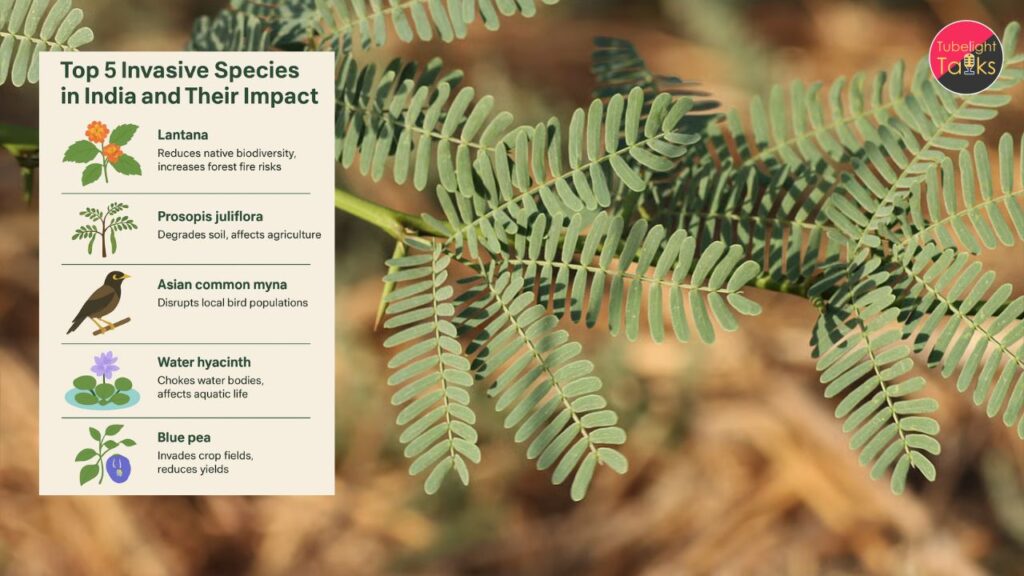
The official brief says the committee will recommend science-based management strategies, ecological restoration measures, and national-level guidelines for prevention, control, and eradication. This makes the committee broader than a documentation panel. It is not only being asked to diagnose the problem, but also to propose an action framework.
That breadth is significant because invasive alien species are not managed by a single action. In some cases, prevention works best. In others, containment is the only realistic option. In still others, partial eradication followed by ecological restoration may be necessary. The IPBES invasive alien species assessment describes management as including prevention, preparedness, eradication, containment, control, and ecosystem restoration.
India’s committee mandate closely mirrors that wider global understanding, which suggests the response is being shaped around internationally recognised principles rather than short-term reactive measures.
It will also identify knowledge gaps
Another important part of the mandate is that the committee will identify critical knowledge gaps and propose research and data-generation programmes. News On AIR reported that it will also document and disseminate best practices. This is an important signal because invasive alien species management often fails not only from lack of intent, but from weak monitoring, poor data, and fragmented institutional knowledge.
India is a country with enormous ecological diversity, ranging from mountains and coasts to wetlands, deserts, forests, and densely farmed landscapes. That means one state’s experience may not automatically translate into another’s. A formal mechanism to collect best practices and pinpoint data gaps could help India move away from scattered local responses toward a more evidence-based national model. That is an inference grounded in the committee’s research-oriented mandate.
What are invasive alien species, and why are they dangerous?
The definition is straightforward, but the effects can be severe
The Convention on Biological Diversity defines an invasive alien species as an alien species whose introduction or spread threatens biological diversity. In simpler terms, these are species introduced outside their natural range that begin to establish, spread, and cause harm. That harm can be ecological, agricultural, economic, or even health-related.
The reason they are dangerous is that they often enter ecosystems without the natural checks and balances that exist in their original habitat. Once established, they can outcompete local species, alter soil or water conditions, clog waterways, damage crops, or reshape habitat structure. This is why global institutions now place invasive alien species among the major direct drivers of biodiversity loss.
The global warning signs are already clear
The WHO biodiversity fact sheet says invasive alien species contribute to 60% of species extinctions and cause annual global economic damage of US$423 billion. IPBES and UNEP have similarly described invasive alien species as a severe and growing global threat to nature, economies, food security, and human health. These are not abstract international statistics; they show that once invasive spread becomes entrenched, the cost of inaction rises sharply.
That is what makes India’s committee timely. By moving now toward a national list, risk-based prioritisation, and scientific control guidelines, the government appears to be recognising a central lesson from the global experience: prevention and early management are far cheaper and more effective than delayed crisis response. That is an inference supported by the official mandate and the broader international evidence on IAS impacts and management.
Why this could become a major biodiversity governance reform
It brings multiple disciplines into one policy process
The PIB release says the committee’s composition reflects expertise across ecology, forestry, agriculture, fisheries, marine sciences, and biodiversity conservation. That multi-disciplinary design is important because invasive alien species do not respect administrative boundaries. A plant invasion in a forest can alter water flow; an aquatic invasion can affect fisheries; a pest outbreak can hit agriculture; and a species spread in one landscape can affect adjoining ecosystems.
By bringing these disciplines together, the government is signaling that invasive alien species management should be coordinated rather than siloed. That whole-of-government approach may end up being one of the most important features of the reform. India has often had strong scientific capability in individual sectors, but translating that into integrated national action has been more difficult.
This committee could become a mechanism for bridging that gap. That is an inference drawn from the official description of the panel’s composition and mandate.
It may help India meet national and global biodiversity commitments
The official statement says the committee is expected to support national and global biodiversity commitments. That line matters because invasive alien species are directly linked to international biodiversity frameworks under the Convention on Biological Diversity.
A national response that is backed by data, prioritisation, and restoration measures can strengthen India’s credibility in both domestic environmental governance and global biodiversity diplomacy.
It also suggests that the committee is meant to produce outcomes that last beyond immediate publicity. A two-year tenure, a national list, research mapping, and national guidelines point toward institutional groundwork rather than a symbolic announcement. Whether that promise is realised will depend on follow-through, but the structure of the move suggests the government wants something more durable than a one-off advisory.
What challenges the committee is likely to face
Detection is only the first step
Even the best national list will not solve the problem by itself. The harder part begins after mapping and prioritisation: surveillance, coordination with states, funding, local implementation, and ecological restoration. A species may be identified nationally, but actual control often requires district-level action, continuous monitoring, and community participation.
That means the expert committee’s recommendations will matter only if they are converted into operational systems. This is an inference based on the nature of invasive-species management and the committee’s mandate.
Prevention is easier than cleanup
Another challenge is public and institutional behavior. Once a harmful alien species becomes well established, eradication is often difficult, expensive, or impossible. That is why the committee’s focus on prevention, control, and eradication must be read in the right order: prevention is usually the most efficient response, while eradication becomes harder after spread.
The longer a biological invasion remains untracked, the more restoration costs tend to rise. This is an inference supported by the management logic described in the IPBES material and India’s own emphasis on prioritisation and national guidelines.
Sat Gyaan, Nature, and the Duty to Protect Creation
Teachings published through platforms associated with Sant Rampal Ji Maharaj repeatedly connect spiritual wisdom with responsible conduct, compassion, and social responsibility. Those teachings emphasize that human life should not be guided by careless exploitation, but by disciplined action that protects life and promotes balance.
Read in that light, the invasive alien species issue is not only an ecological challenge; it is also a moral reminder that negligence toward nature eventually harms society itself. Protecting native ecosystems, food systems, and biodiversity can therefore also be seen as part of righteous living guided by Sat Gyaan.
Call to Action
The new Expert Committee on Invasive Alien Species is a promising step, but its real value will depend on how quickly its recommendations are translated into action. Policymakers, states, researchers, and local authorities will need to treat invasive alien species as a development issue, not a side topic.
Citizens, too, should pay closer attention to biodiversity governance, because ecosystem decline eventually shows up in water stress, crop losses, habitat damage, and public-health pressures. India now has a formal opportunity to build a serious national response. I should use it well.
FAQs: National Biodiversity Authority Announced
1. What has the National Biodiversity Authority announced?
The NBA has constituted an Expert Committee on Invasive Alien Species to address ecological and socio-economic risks from such species across India.
2. Why was this committee formed now?
It was formed following directions from the National Green Tribunal in a suo motu proceeding, along with advisory support from the Ministry of Environment, Forest and Climate Change.
3. What are invasive alien species?
They are species introduced outside their natural range whose introduction or spread threatens biological diversity.
4. What will the committee do?
It will prepare a consolidated national list, identify high-risk species, recommend science-based management and restoration strategies, and help frame national guidelines for prevention, control, and eradication.
5. How long will the committee function?
The committee has been set up for a period of two years.
6. Why is this issue important for ordinary citizens?
Because invasive alien species can affect biodiversity, agriculture, food security, ecosystem resilience, and even human and wildlife health.
Related Stories










Discussion (0)