ISRO Advances Reusable Launch Vehicle Test for Cost-Effective Space Missions
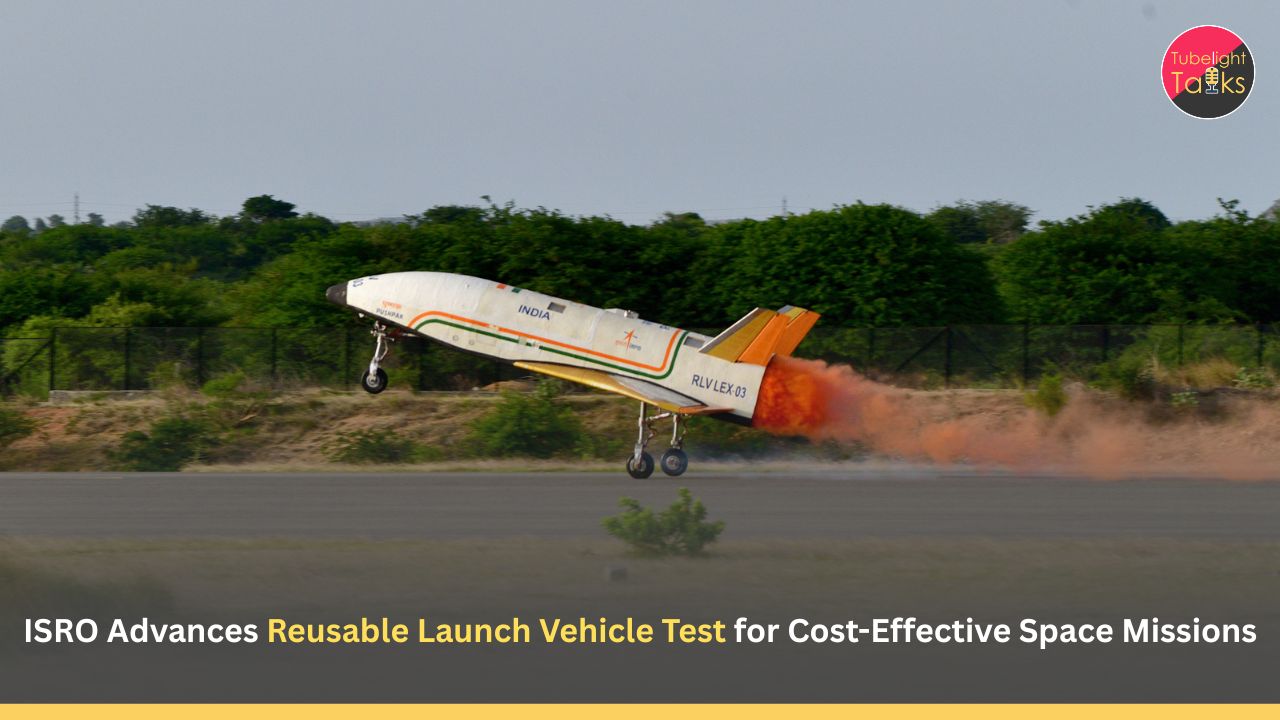
ISRO Pushpak RLV Tests: India’s push toward cost-effective space missions is getting a practical boost as ISRO advances its reusable launch vehicle work through Pushpak (RLV-TD), a winged technology demonstrator designed to return and land like an aircraft. In a series of autonomous runway landing experiments—LEX-01, LEX-02, and LEX-03—ISRO has validated high-speed, unmanned landings, tougher off-nominal release conditions, and, crucially, the re-use of flight hardware and systems.
As the government now confirms that technology demonstration flights are planned for stage recovery, the focus is shifting from “can we land?” to “can we recover, refurbish, and fly again at scale?”
What’s New in ISRO’s Reusable Launch Vehicle Push
ISRO’s most visible progress on the ISRO reusable launch vehicle front has come through the Landing EXperiment (RLV LEX) campaign at the Aeronautical Test Range (ATR), Chitradurga, Karnataka—where Pushpak is carried under an Indian Air Force Chinook helicopter, released at about 4.5 km altitude, and made to execute a fully autonomous approach and runway landing.
LEX-01 (April 2, 2023) marked the breakthrough: ISRO demonstrated an autonomous runway landing of a winged space vehicle under high-speed, unmanned conditions meant to resemble the final approach of a returning re-entry craft.
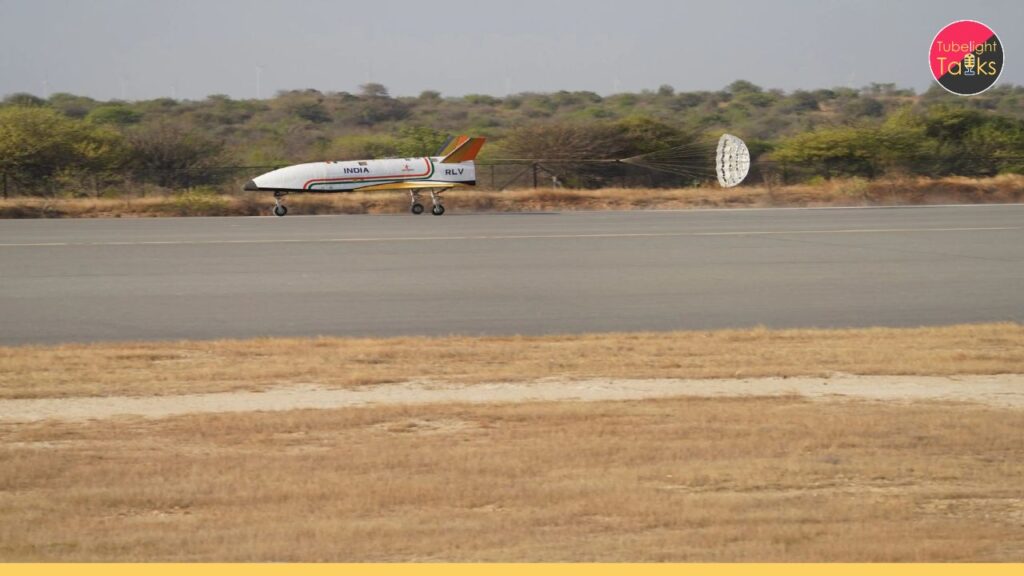
LEX-02 (March 22, 2024) raised the difficulty by forcing Pushpak to correct both cross-range and downrange dispersions from off-nominal release conditions—still landing precisely and coming to a halt using a brake parachute, landing gear brakes, and nose wheel steering.
LEX-03 (June 23, 2024) delivered a third consecutive success under harsher conditions, including a larger cross-range challenge and more severe winds—while validating advanced guidance that ISRO says is essential for a future orbital re-entry mission.
The “Re-use” Signal That Makes LEX More Than a Landing Show
A standout takeaway—especially for cost-effective space missions—is that ISRO has been repeatedly proving reusability in a very literal way during testing.
In LEX-02, ISRO explicitly highlighted that “reuse capability of flight hardware and flight systems is also demonstrated.”
In LEX-03, ISRO noted that the mission reused the winged body and flight systems from the earlier test without modifications—an engineering confidence-builder that moves reusability from concept to demonstrated practice.
That matters because reusable space transportation is not just about landing once; it’s about designing systems robust enough to fly, be checked, and fly again—without a redesign cycle every time.
Why ISRO Is Betting on Reusability for Low-Cost Access to Space
India already has operational launchers (PSLV, GSLV, LVM3), but the next leap is lowering the cost per kilogram to orbit and increasing launch cadence. In government statements to Parliament, reusable launch vehicle technologies are positioned as a key pillar of “low-cost access to space,” alongside the Next Generation Launch Vehicle (NGLV) and a winged body stage that can fly back from orbit and land on a runway.
Reusability affects the economics of space in three direct ways:
- Hardware cost amortisation: if major stages (or winged upper stages) can be recovered and reused, the same expensive structures and avionics can support multiple missions.
- Higher launch frequency: faster turnaround enables more missions per year, helping commercial and national payload demand.
- Competitive pricing: lower mission costs can make India a more attractive global launch option, especially for smallsat and constellation customers.
In short, a reusable launch vehicle is an economic strategy as much as an engineering project—especially when India’s broader space roadmap includes ambitious targets like a space station and a crewed lunar landing in the coming decades.
Also Read: ISRO Gaganyaan Mission 2026: India’s Historic Leap into Human Spaceflight
Cost-Effective Space Missions: What “Cheaper” Really Means in Practice
In the near term, “cost-effective” doesn’t necessarily mean “dramatically cheaper tomorrow.” It usually means:
- fewer single-use components in each flight profile,
- fewer rebuilds between missions,
- more standardised systems,
- and a reliable recovery architecture that can scale.
LEX is best understood as ISRO proving the hardest part of a winged vehicle’s return: the terminal phase—energy management, navigation, and precision landing—without a pilot.
That terminal phase is unforgiving: high speed, steep glide angles, limited margins, and no second attempt if guidance drifts.
The Tech Behind Pushpak’s Autonomous Runway Landing
Pushpak’s runway landings are not “aircraft landings” in the usual sense; they are designed to mimic the final approach of a space-returning vehicle, including high speed and unmanned precision. ISRO describes LEX-01 as achieving autonomous landing under “high speed, unmanned, precise landing” conditions aligned with a re-entry vehicle’s landing profile.
The Navigation Stack: Multisensor Fusion, Pseudolites, and NavIC
ISRO has detailed that RLV-LEX relies on multisensor fusion—integrating inertial sensing, radar altimetry, flush air data systems, a pseudolite system, and NavIC-based navigation inputs.
This matters because a reusable launch vehicle test is not just validating aerodynamics; it’s validating decision-making under uncertainty—how the vehicle “knows” where it is, how fast it’s moving, and how to correct errors in real time.
High-Speed Touchdown and Deceleration
LEX-03, for example, involved an autonomous approach from roughly 4.5 km away from the runway, with cross-range corrections, followed by touchdown at speeds exceeding 320 kmph—then a controlled slowdown using a brake parachute and wheel braking while maintaining runway alignment.
LEX-02 similarly used a brake parachute, landing gear brakes, and nose wheel steering to stop on the runway after a precise landing.
These details show why ISRO’s reusable launch vehicle programme is a systems engineering challenge: flight controls, landing gear, sensors, and software all have to work together—every time.
From Landing Experiments to Orbital Return: The Next Technical Step
Landing experiments are only one rung on the ladder. The government has stated that, toward reusable launch vehicle development, ISRO is developing a winged body Orbital Re-entry Vehicle (ORV)—to be placed in orbit by an ascent vehicle and then re-enter Earth’s atmosphere for an autonomous approach and runway landing.
LEX-03, in ISRO’s own framing, validates guidance algorithms that are essential for this future orbital re-entry mission.
Why Orbital Re-entry Is Harder Than LEX
LEX begins with a helicopter release and a glide/approach profile. Orbital return adds:
- intense re-entry heating and plasma blackout phases,
- hypersonic aerodynamics across a wider speed envelope,
- stricter thermal protection requirements,
- and a longer chain of autonomous decision-making before the runway phase.
ISRO has also referenced earlier hypersonic work (HEX) as part of the RLV-TD pathway, underscoring that LEX is building on a longer technology-demonstration arc.
Booster Stage Recovery and VTVL: The Other Half of Reusability
Winged vehicles are one reusability route. Another is Vertical Take-off and Vertical Landing (VTVL) recovery of booster stages—where a spent first stage returns and lands vertically for reuse.
In a Parliament reply, the government stated that ISRO is designing and developing critical technologies for booster stage recovery in VTVL mode, enabling recovery and reuse of spent booster stages multiple times.
A Fresh 2026 Signal: Demonstration Flights for Stage Recovery Are Planned
The latest official push is captured in a February 4, 2026 government release: “technology demonstration flights are planned to demonstrate stage recovery.”
This line is significant because it ties RLV-style learning (guidance, autonomy, recovery operations) to a concrete next phase—actual stage recovery demos, supported by ground tests (including engine throttling work referenced in the same release).
For cost-effective space missions, VTVL can be transformative: if a first stage becomes reusable, the most expensive hardware in many rockets stops being single-use.
NGLV and the Road to Operational Reusable Space Transportation
Reusability is also being designed into India’s next big launcher architecture. The government has confirmed approval for the Next Generation Launch Vehicle (NGLV)—including a partially reusable variant aimed at low-cost access to space.
Key official points include:
- NGLV is planned with up to 30 tons to Low Earth Orbit (LEO) capability.
- A partially reusable NGLV variant is referenced with 14 tons to LEO.
- In a Parliament reply, the government also described NGLV as a three-stage vehicle with a recoverable and reusable first stage.
- Another development highlighted is a winged body upper stage that can fly back from orbit and land on a runway.
Put together, these points show a two-track approach: winged return for an upper stage/vehicle class, and VTVL recovery for boosters—both feeding into reusable space transportation.
What This Means for India’s Space Economy and Private Players
Government statements also reiterate India’s post-2020 space sector reforms and IN-SPACe’s role in enabling and regulating private participation—suggesting that as reusable launch vehicle technologies mature, there will be room for industry co-development, productionisation, and operations support.
In practical terms, cost-effective space missions don’t happen only inside one government lab. They depend on:
- supply chains that can build repeatable flight hardware,
- inspection and certification workflows for re-flight,
- reliable recovery operations and range safety,
- and a market that can absorb more frequent launch opportunities.
What ISRO’s RLV Progress Unlocks for Cost-Effective Space Missions
The clearest near-term value of the ISRO reusable launch vehicle progress is that it de-risks the “return and recover” part of future systems. Once recovery is reliable, several mission types benefit:
1) More affordable Earth observation and climate monitoring
Lower-cost launches can expand the number of Earth observation satellites and refresh cycles—helping agriculture, urban planning, water management, and disaster response. Government releases have also pointed to the value of space-based datasets for disaster management, highlighting how expanded infrastructure and capability have national-level utility.
2) Stronger commercial launch competitiveness
As the global market grows for small satellites and constellations, launch price and schedule reliability matter. Reuse can help both—especially when stages can be recovered and reflown rather than rebuilt from scratch.
3) Enabling bigger national missions
Official documents outline long-term ambitions—space station plans and a crewed Moon landing target—where launch cadence, reliability, and cost control become central. Reusable space transportation systems are a natural enabler for these high-frequency, high-mass mission futures.
4) A culture of iterative engineering
LEX is also a sign of ISRO’s “test, learn, reuse” engineering culture: LEX-02 strengthened structures based on LEX-01 observations, and LEX-03 validated tougher conditions while reusing prior systems—exactly the kind of iteration needed to make reusability operational rather than experimental.
Purposeful Innovation and Responsible Progress
A reusable launch vehicle test is ultimately about doing more with less—less waste, fewer throwaway systems, and more value per mission. This idea connects smoothly with the guidance shared in Sant Rampal Ji Maharaj’s teachings, which repeatedly emphasise disciplined living, right conduct (good karmas), and moving away from greed-driven choices toward actions that benefit society.
When technology is built with reusability and service at the centre, it mirrors that principle: progress should reduce harm, increase efficiency, and support collective welfare rather than ego or extravagance. Those interested in Sat Gyaan and practical life guidance can explore the teachings and satsang resources shared through the official platforms.
Call to Action: Stay Updated on India’s Reusable Space Future
Track updates directly from official releases and mission pages, especially ISRO’s detailed LEX write-ups and government briefings that confirm upcoming stage-recovery demonstration flights. Share verified information, encourage students to explore aerospace and robotics, and support India’s growing space ecosystem—where reusability can unlock truly cost-effective space missions over the next decade. (Publishing format aligned with the team’s standard content style guide.)
FAQs
1) What is Pushpak in ISRO’s reusable launch vehicle programme?
Pushpak is ISRO’s winged Reusable Launch Vehicle-Technology Demonstrator (RLV-TD) used to test autonomous approach and runway landing—key steps toward reusable space transportation.
2) What happened in RLV LEX-03?
On June 23, 2024, ISRO completed LEX-03 at ATR, Chitradurga, proving autonomous landing under more challenging release and wind conditions, and validating guidance needed for future orbital re-entry missions.
3) Why are the LEX tests important for cost-effective space missions?
LEX validates the hardest part of reuse: safe, precise, unmanned return and landing—plus the ability to reuse flight systems across tests. This reduces technical risk for operational reusability, which can lower launch costs over time.
4) What is the Orbital Re-entry Vehicle (ORV) mentioned by the government?
The ORV is a winged body vehicle ISRO is developing to be launched into orbit and then re-enter Earth’s atmosphere for an autonomous runway landing—building on LEX learnings.
5) What is booster stage recovery, and what has been announced recently?
Booster stage recovery is retrieving and reusing spent rocket stages, potentially using VTVL methods. A February 4, 2026 government release stated that technology demonstration flights are planned to demonstrate stage recovery.
6) How does NGLV connect to reusable launch vehicle technology?
Government statements confirm NGLV development with a partially reusable variant and a reusable first stage configuration, alongside work on winged stages that can return from orbit and land—linking directly to India’s low-cost access to space strategy.
Related Stories








Discussion (0)