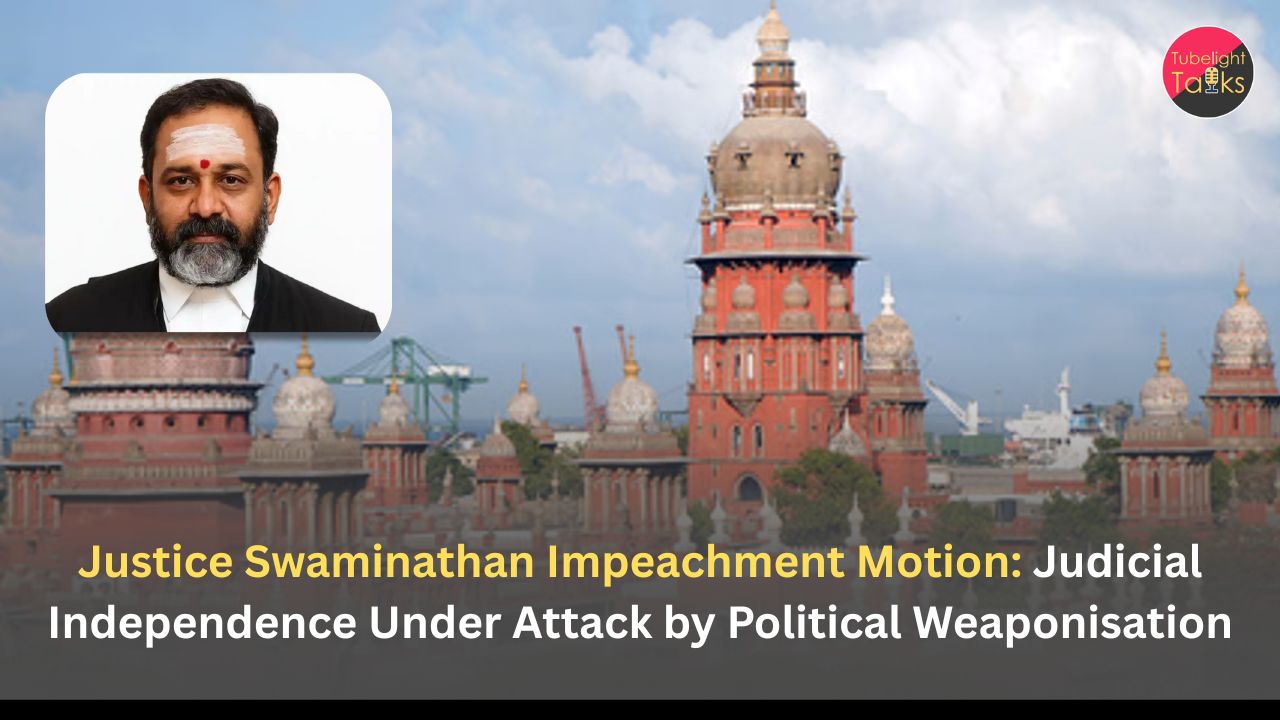
Justice Swaminathan Impeachment Motion: Judicial Independence Under Attack by Political Weaponisation
Justice Swaminathan Impeachment: Is the sacred, rarely-used power of judicial impeachment being deliberately weaponized as a political battering ram against inconvenient court verdicts? The submission of a motion notice to the Lok Sabha Speaker, signed by over 100 Members of Parliament from the Opposition bloc, seeking the removal of Madras High Court Justice G.R. Swaminathan, marks a gravely disturbing moment in the history of New India’s constitutional architecture.
The official reason cited is ‘misconduct,’ but the immediate provocation is unquestionably the Justice’s robust judgment in the highly sensitive Tirupparankundram Deepam case, which directed the lighting of the traditional Karthigai Deepam lamp atop the hill where the Subramaniya Swamy Temple and a nearby Sikkandar Badhusha Dargah coexist.
The Shocking Report 2026 is not just the political move itself, but the terrifying Ground Reality that what was once the last resort for judicial malfeasance has now become a first resort for political disapproval, threatening the very foundation of Viksit Bharat 2047’s commitment to the rule of law.
The Deepam Verdict That Sparked a National Row
The controversy stems from the judgment delivered by Justice G.R. Swaminathan in early December 2025. The case concerned the centuries-old ritual of lighting the Karthigai Deepam lamp at the Thirupparankundram hill in Madurai, Tamil Nadu. For decades, the lamp was lit at a lower mandapam. However, petitioners sought the revival of the tradition to light the lamp at the ancient stone pillar known as the Deepathoon, located atop the hill, which is claimed to fall under the temple’s property.
Justice Swaminathan’s judgment was categorical: he ruled that the Deepathoon was within the temple’s limits, was not encroaching on the demarcated area of the neighbouring Dargah, and that lighting the lamp was a symbolic religious act that “cannot offend anyone’s sensibilities.” He quashed the Temple Executive Officer’s decision to restrict the lighting and directed the ritual to be performed at the Deepathoon immediately, ordering police protection to ensure compliance.
The situation escalated into a full-blown political crisis when the State government, citing ‘law and order’ concerns, repeatedly failed to implement the court’s direction, leading the Judge to initiate contempt proceedings and even call upon the Central Industrial Security Force (CISF) for enforcement – a clear escalation of judicial-executive conflict.
Impeachment Weaponisation and Assault on Judicial Independence
The move by the Opposition bloc to submit an impeachment motion notice against Justice Swaminathan for his judgment is a direct, undeniable assault on the constitutional principle of Judicial Independence.
Impeachment, under Article 124(4) (extended to High Courts by Article 218) of the Constitution, is strictly reserved for ‘proved misbehaviour’ or ‘incapacity.’ It is not a mechanism for overturning a judicial verdict that an executive or legislature finds politically or ideologically unpalatable. Legal scholars across the country have issued sharp warnings, stating that:
- Lowering the Bar: Allowing an impeachment motion over a judicial outcome sets a dangerous precedent, effectively reducing the constitutional safeguard to a simple tool of political intimidation against the bench.
- Ideological Test: The notice, reportedly listing allegations of ‘ideological bias’ and deciding cases based on a ‘particular political ideology,’ effectively attempts to impose a political litmus test on a judge’s judicial philosophy, a concept anathema to a free judiciary.
- Executive Evasion: Critics argue that the motion is an attempt by the political executive to evade the contempt of court proceedings initiated by the judge over the failure to implement his order. The political attack is thus a means of escaping constitutional accountability.
This action jeopardizes the constitutional balance of power, suggesting that in India 2026, the legislature will use its ultimate constitutional power to punish disagreement, thereby creating a climate of fear among judges handling sensitive cases.
Highlighting the Constitutional Rigour of the Process
While the initiation of the motion is worrying, the Constitution has deliberately made the removal process extraordinarily difficult, providing a necessary check on such political overreach. This rigour is the ultimate safeguard for judicial independence.
The process, governed by the Judges (Inquiry) Act, 1968, mandates several stringent steps:
- Admission: The Speaker of the Lok Sabha must first admit the motion. The Speaker has the power to reject the notice if the grounds do not prima facie constitute ‘proved misbehaviour’ or ‘incapacity.’
- Inquiry Committee: If admitted, the Speaker must form a three-member committee (consisting of a Supreme Court Judge, a Chief Justice of a High Court, and a distinguished jurist) to investigate the charges.
- Proved Misbehaviour: Only if the committee finds the judge guilty of ‘proved misbehaviour’ can the motion proceed to Parliament.
- Special Majority: Finally, both the Lok Sabha and the Rajya Sabha must pass the motion by a special majority – a majority of the total membership and a majority of not less than two-thirds of the members present and voting.
Historically, no judge in India has ever been successfully removed through this process. This high constitutional bar is the bulwark that is now expected to resist the current political pressure, reinforcing that judicial accountability must be proven on legal and ethical grounds, not political whims.
Also Read: Justice Surya Kant Assumes Helm as 53rd Chief Justice: A Tenure Rooted in Equity and Reform
The Danger to Democratic Health
The move has drawn strong reactions from the legal and constitutional fraternity.
Mr. Fali S. Nariman (Senior Constitutional Expert, 2026): “This is more than a warning shot; it’s a declaration of war on the independence of the Judiciary. When a judge is sought to be impeached merely for the content of a judgment, the political class is signalling to the entire judicial system: toe the line or face destruction. The Speaker must immediately reject this motion to protect the Constitution. Allowing it to proceed legitimizes political disagreement as ‘misbehaviour.'”
Dr. Priya Sankar (Constitutional Law Professor, India 2026): “The allegations of ‘ideological bias’ in the motion are particularly pernicious. Judges, like all citizens, have philosophical leanings. What matters is that their judgment is legally sound and free from extraneous influence. Justice Swaminathan’s order was upheld on appeal.
If every judgment that touches upon identity or religion becomes grounds for removal, the Judiciary will cease to be an independent check on the executive and legislature. This move is antithetical to the principles guiding Viksit Bharat 2047.”
Justice and Dharma as True Governance
The ethical teachings of Sant Rampal Ji Maharaj underscore the fundamental importance of Dharma (righteous duty) and Satya (truth) in all forms of governance, including the judiciary and legislature. True justice, as per the Satgyan, must be impartial, fearlessly protecting the rights of all, regardless of political or communal pressure.
The current attempt to use a constitutional mechanism to punish a judicial officer for upholding an order based on ancient property rights and religious continuity – even amidst political opposition – reflects a failure to uphold Dharma. Sant Rampal Ji Maharaj emphasizes that politicians and judges alike must operate without lobh (greed/bias) and dvesh (malice/enmity). The pursuit of political advantage over the sanctity of the Constitution weakens the nation’s moral fabric.
A judge who upholds the rule of law, even against the State, is fulfilling his dharma. The political class, likewise, must adhere to its duty of upholding the constitutional separation of powers, ensuring that the ideals of illumination and righteousness, as sought by PM Modi Latest initiatives for Viksit Bharat 2047, are preserved in every democratic institution.
The Impeachment Motion & Legal Framework
- Judge: Justice G.R. Swaminathan (Madras High Court, Madurai Bench).
- Triggering Judgment: Order on December 1, 2025, directing the lighting of Karthigai Deepam at the Deepathoon (stone pillar) atop the Thiruparankundram Hill.
- Initiating Body: Over 100 Members of Parliament from the Opposition bloc (including DMK, Congress, etc.).
- Constitutional Basis for Removal: Proved misbehaviour or incapacity (Article 124(4) / 218).
- Motion Submission Date: December 9, 2025 (Submitted to Lok Sabha Speaker Om Birla).
- Key Allegations: Judicial overreach, lack of impartiality/secular functioning, and deciding cases based on a ‘particular political ideology.’
FAQs: Justice Swaminathan Impeachment Motion
Q1: What is the exact difference between ‘impeachment’ and ‘removal’ for judges?
A: Constitutionally, the term is ‘removal’ (Articles 124(4)/218). ‘Impeachment’ is the popular term, but the process is formally initiated in Parliament and culminates in a Presidential order following a special majority vote in both Houses.
Q2: Can a judge be impeached simply for giving a controversial verdict?
A: No. The grounds are strictly ‘proved misbehaviour’ or ‘incapacity.’ Disagreement with the content or outcome of a judgment does not qualify as misbehaviour unless the verdict is demonstrably linked to corruption, lack of integrity, or abuse of judicial office.
Q3: Who decides if the impeachment motion is valid?
A: The Speaker of the Lok Sabha (or Chairman of Rajya Sabha) must first admit the motion. If admitted, a three-member judicial Inquiry Committee investigates and reports whether the charge of ‘proved misbehaviour’ is established.
Q4: Have any judges been successfully impeached in India?
A: No. Several motions have been initiated (e.g., Justice V. Ramaswami, Justice Soumitra Sen, Justice J.B. Pardiwala), but none have been successfully passed by the required special majority in both Houses of Parliament.
Q5: What happens next with the motion against Justice Swaminathan?
A: The motion is now with the Lok Sabha Speaker, Om Birla, who must decide whether the allegations prima facie meet the constitutional standard of ‘proved misbehaviour’ and whether to admit the motion for further inquiry.
Do you believe a judge should face removal proceedings for a verdict that goes against a government or political party? How does this political attack on the Judiciary affect your faith in New India’s democratic checks and balances?
Drop your state/city name in comments | Tag a friend who needs to see this analysis of the constitutional crisis!
Related Stories







Discussion (0)