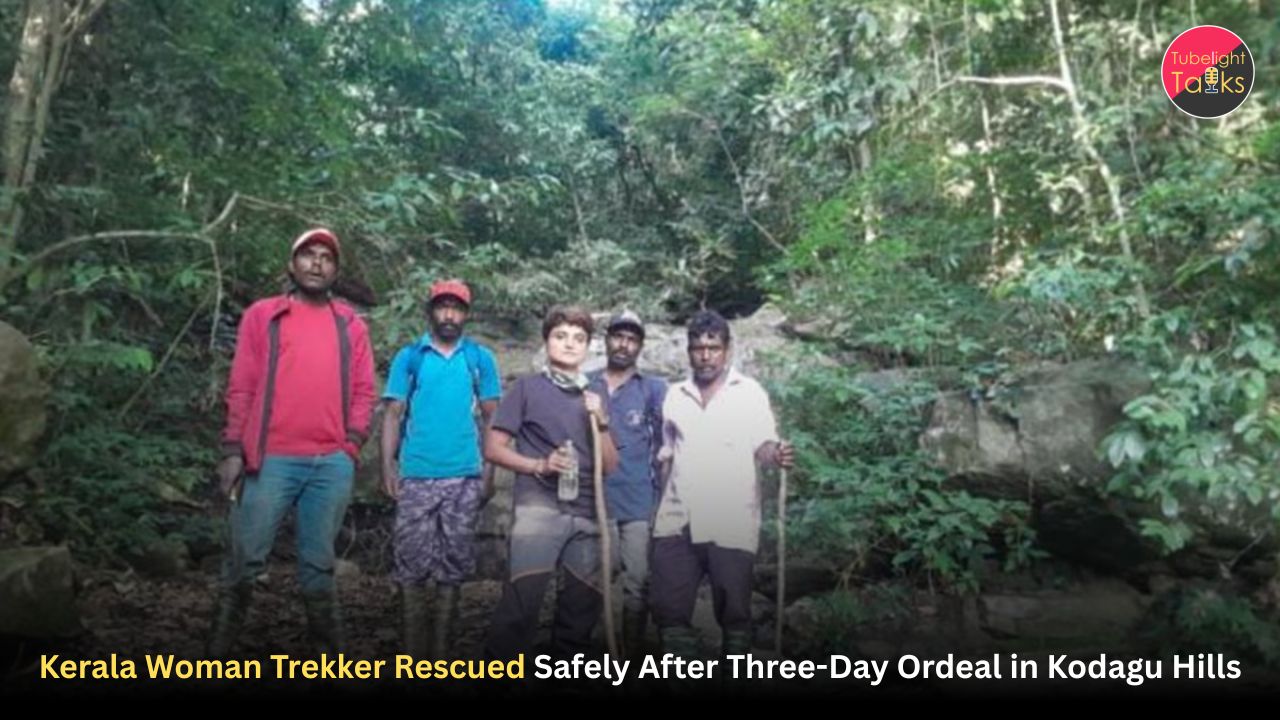
Rescue Success: Indian Woman Trekker Safely Brought Back After Three Days Lost in Kodagu Hills
A difficult and emotionally charged search operation in Karnataka’s Kodagu district ended in success after 36-year-old Kerala trekker G S Sharanya was rescued on Sunday, three days after she went missing while trekking to Tadiandamol Peak. Officials quoted in current reports said she was safe and not facing serious complications. She had disappeared on April 2 after losing her way during the trek, triggering a large forest search across rugged terrain in the Western Ghats.
A solo trek turned into a three-day survival ordeal
She went missing while returning from Tadiandamol
Sharanya, a 36-year-old IT professional from Kerala, had joined a trek to Tadiandamol, one of the best-known peaks in Kodagu district. Indian Express reported that she went missing on April 2 while trekking to Tadiandamol Peak, and that she was part of a scheduled trek under the Madikeri Forest Division that included 15 participants and an authorised nature guide. The same report said she had called her team and told them she was lost and unable to find her way back.
Times of India reported that she lost her way while descending Tadiandamol, which it described as the highest peak in Kodagu district. It added that she had stayed at a homestay in Kodagu and had travelled as a solo trekker. Taken together, the reports make clear that this was not a reckless off-route expedition but a legitimate trek that turned dangerous when she got separated and lost her bearings in difficult terrain.
She survived with limited resources in harsh terrain
Indian Express reported that Sharanya later said she had only a 500-ml bottle of water, no mobile connectivity, and a phone that soon ran out of charge. She said she walked until evening on the first day, then stayed in an open space near a stream, and in the following days kept moving in the hope of finding someone. That account shows how narrow the margin was between survival and a more serious outcome.
The same report said she was eventually found in a remote patch of the forest where rescuers normally do not go. Times of India reported that she had taken shelter in an abandoned shack, while Indian Express said she was found inside an abandoned temple in the forest. The exact description of the shelter differs slightly across reports, but both point to the same underlying fact: she survived by staying put for periods of time and using what cover she could find in dense forest conditions.
A massive multi-agency rescue operation made the difference
Police, forest teams, ANF and local communities joined the search
This was not a small or routine rescue. Indian Express reported that the forest department initiated search operations around 2 pm on April 2, with police joining the effort, and that the search later expanded into a full-scale operation involving nearly 70 personnel from the police, Anti-Naxal Force, forest staff and local volunteers. The same report said thermal imaging drones, mobile phone tracking, call data record analysis and sniffer dogs were deployed.
Times of India added that nine teams carried out the operation in close coordination and that tribal community members played a crucial role in tracing Sharanya in the hilly terrain. It also said the Kodagu district police sought help from the Anti-Naxal Force because of its familiarity with rugged forest environments. These details show that the rescue succeeded because of coordination across agencies with different skills rather than because of one isolated breakthrough.
Also Read: 345 Indian Fishermen Return Safely to Chennai After Iran Evacuation via Armenia
Technology helped, but local knowledge proved vital
One of the strongest themes emerging from the reporting is that advanced search tools were important, but local human intelligence was equally decisive. Indian Express said residents of a tribal hamlet informed the rescue team about a woman they had spotted earlier, while Times of India said tribal community members found her around 4 pm on Sunday. That means the search succeeded through a blend of modern rescue tools and traditional ground-level knowledge of the forest.
This matters because rescue stories in difficult terrain often reveal a basic truth: drones and thermal cameras can expand reach, but local residents and forest communities often provide the final lead that turns a search into a recovery. In Sharanya’s case, that combination appears to have saved critical time and made the rescue possible before conditions worsened further. This is an inference, but it is strongly supported by the reporting from Indian Express and Times of India.
Officials described her condition as stable and safe
The rescue ended without major medical complications
Indian Express reported that Karnataka Forest, Ecology and Environment Minister Eshwar Khandre said Sharanya was safe, healthy and not facing complications. Times of India similarly reported that Kodagu Superintendent of Police Bindu Mani said Sharanya was healthy and unhurt. It also said she was first taken to Virajpet hospital and later moved to a homestay in Kakkabe.
That outcome is especially significant because she had spent more than 72 hours in dense forest terrain facing weather exposure, hunger and uncertainty. Times of India explicitly said she battled extreme weather and hunger while surviving alone. Given those conditions, the fact that she was rescued without reported serious injury makes the operation all the more remarkable.
Her own words reflected unusual calm
Indian Express reported that after being rescued, Sharanya said she “lost her way somehow” but “did not feel scared.” She described how she kept walking and hoping to meet someone. That response has attracted attention because it suggests a level of calm and emotional control that likely helped her survive in an environment where panic could have made things worse.
Rescue operations often focus on the teams who find the missing person, but survivability also depends on the decisions made by the lost person while waiting to be found. In this case, Sharanya’s ability to preserve movement, water and composure appears to have helped her endure until the search teams closed in. This is an inference grounded in her own description of the ordeal and the fact that she survived three days in the forest.
Why this rescue has wider significance
It highlights the risk of trekking in forested highland terrain
Tadiandamol is a popular trekking destination, but the Sharanya case shows how quickly a routine outdoor trip can become dangerous in forested hill environments. Even when a trek is organised and authorised, separation from the group, fading daylight, patchy network coverage and difficult slopes can turn a minor navigation error into a survival crisis. Indian Express and Times of India both point to exactly those factors in explaining how the incident unfolded.
That is important because trekking culture is growing in India, especially among solo and small-group travelers. The lesson here is not to discourage outdoor travel, but to underline how quickly forest conditions can overwhelm even educated and prepared visitors when communication and orientation break down. This is an inference, but it follows directly from the circumstances described in the reports.
It also showcases institutional readiness when agencies work together
The rescue also tells a positive story about coordinated emergency response. Forest staff, police, ANF teams, local volunteers, tribal residents and state officials all played visible roles. Indian Express said the operation was scaled up into a major mission, and Times of India reported that even the Chief Minister directed officials to use more resources as the search continued.
In many rescue cases, the public focus turns to what went wrong before the person was lost. That is valid. But it is equally worth noting when state machinery and local communities come together fast enough to produce a safe outcome. Sharanya’s case became a success because the response did not remain limited or delayed. It grew in scale as the danger became clearer. This is an inference supported by the reporting on the expanding operation.
Calmness in crisis becomes a form of strength
This rescue story also carries a deeper human lesson. When a person is trapped in fear and uncertainty, inner steadiness can become as important as physical help. Teachings associated with Sant Rampal Ji Maharaj often emphasize courage with humility, patience in difficulty, and the value of keeping the mind stable rather than surrendering to panic.
That principle fits naturally here. Sharanya’s own words suggest that even in a frightening situation, she did not let fear dominate her thinking. In many moments of crisis, survival begins with that kind of inner control. Call to Action
Trekkers should prepare for disorientation, not just for the climb
Outdoor enthusiasts should treat this incident as a serious reminder to plan for getting lost, not only for reaching the summit. Clear communication plans, extra water, a charged phone, emergency contact sharing, guide coordination and awareness of turnaround time can all matter when conditions shift unexpectedly.
The Sharanya case shows that once contact is lost in dense forest terrain, survival and rescue can depend on very small decisions.
Rescue agencies and trekking authorities should review protocols
This case should also lead to a practical review of trekking safety systems in Kodagu and similar destinations. Authorities may need to look again at group accountability, route monitoring, network dead zones and emergency response triggers for solo participants or separated trekkers. A successful rescue is something to celebrate, but it should also become a reason to strengthen prevention.
FAQs: Kerala Woman Trekker Rescued Safely After Three-Day Ordeal in Kodagu Hills
1. Who was the trekker rescued in Kodagu?
Current reports identify her as G S Sharanya, a 36-year-old IT professional from Kerala.
2. How long was she missing?
She was rescued on Sunday after being missing for about three days, having disappeared on April 2 during the trek.
3. Where did she go missing?
She went missing while trekking to or descending from Tadiandamol Peak in Kodagu district, Karnataka.
4. Who carried out the rescue?
The search involved forest department personnel, police, Anti-Naxal Force members, local volunteers and tribal community members.
5. How was she finally found?
Reports say local tribal residents or hamlet members alerted rescuers after spotting her, and she was found in the forest on Sunday evening.
6. Was she injured?
Officials quoted in current reports said she was healthy, safe and not facing major complications after the rescue.
Related Stories







Discussion (0)