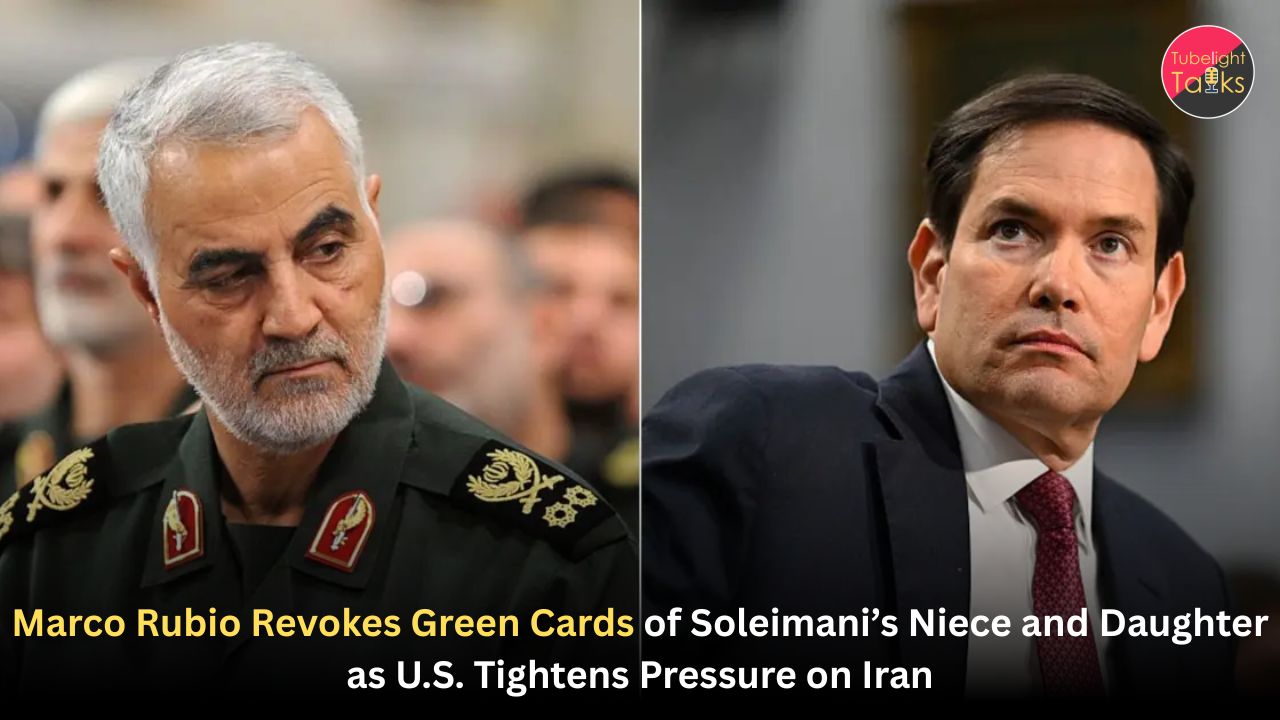
Marco Rubio Revokes Green Cards of Soleimani Relatives as U.S. Expands Pressure on Iran-Linked Figures
U.S. Secretary of State Marco Rubio has revoked the green cards of Hamideh Soleimani Afshar, the niece of late Iranian military commander Qasem Soleimani, and her daughter. Reuters reported that both were subsequently detained by U.S. Immigration and Customs Enforcement in Los Angeles, while the State Department publicly confirmed the action.
The action was not a general “residency” move, but a green-card revocation
The strongest verified reporting shows that Rubio revoked the pair’s lawful permanent resident status, meaning their green cards, rather than taking a vague or unspecified action against “residency.” Reuters reported that Afshar and her daughter were arrested after Rubio revoked their green cards, and the official State Department statement used the same terminology.
That distinction matters because immigration enforcement language can easily be overstated in headlines. In this case, the verified action was the revocation of lawful permanent resident status followed by ICE detention, not a broader family-wide removal order affecting an unspecified group of relatives.
Who was targeted and why
Reuters identified the detainee as Hamideh Soleimani Afshar, the niece of Qasem Soleimani, along with her daughter. AP reported that Rubio determined they were no longer eligible to reside in or enter the United States and said they had been linked by U.S. officials to support for the Iranian regime.
In the State Department statement, Rubio said the Trump administration would not allow the country to become “a home for foreign nationals who support anti-American terrorist regimes.” The official release specifically tied the action to Iranian-regime links, making this both an immigration enforcement step and a political signal in the wider U.S.-Iran confrontation.
Also Read: Iran Pushes Back Against Trump’s 48-Hour Ultimatum as Retaliation Threats Rise
This appears to be part of a broader pressure campaign
AP reported that the administration also revoked visas or green cards of at least four Iranian nationals connected to the current or former Iranian government, including other high-profile relatives of senior Iranian officials. That suggests the Soleimani-related case is not isolated, but part of a wider tightening campaign against Iranian-linked individuals in the United States.
Reuters’ reporting and the State Department statement also place the arrests in the context of the current U.S.-Iran crisis, where Washington has been escalating diplomatic, military and immigration pressure simultaneously. Calling it a “maximum pressure” move is a fair summary of the policy direction, though the strongest official language in the sources I reviewed focuses on barring supporters of hostile regimes rather than using that exact phrase in the Soleimani case itself.
Also Read: Jaishankar-Rubio Meeting at G7 FMM: Trade, Security, and the Signals for India–US Ties
Why the Soleimani name carries such weight
Qasem Soleimani remains one of the most symbolically charged figures in U.S.-Iran relations. Reuters identified him as the late Iranian military commander whose killing by a U.S. drone strike in 2020 sharply escalated tensions between Washington and Tehran. That history helps explain why action against his relatives carries political resonance beyond ordinary immigration enforcement.
The current step therefore serves two purposes at once. Legally, it removes permanent resident status from specific individuals. Politically, it signals that the administration wants to show zero tolerance toward family members of figures seen as central to anti-American military activity, especially during an active regional confrontation. This second point is an inference, but it is strongly supported by the timing, the State Department’s public language, and the identity of those targeted.
The bigger message from Washington
The administration’s message is that links to hostile foreign power structures can now carry immigration consequences even for people already living in the U.S. with permanent resident status. AP reported that Rubio also recently revoked visas tied to other Iranian-linked individuals, reinforcing the sense of a wider crackdown.
That may have broader implications for how the U.S. uses immigration tools in geopolitical confrontation. Instead of relying only on sanctions and public condemnation, Washington is also signaling that immigration status itself can become a lever in foreign-policy pressure campaigns. This is an inference, but it is well supported by the pattern reported by AP and Reuters.
Pressure without balance deepens hostility
When nations use every instrument of power in a conflict, including immigration and identity, hostility can harden quickly. A wiser path always distinguishes necessary security from actions that deepen division without building peace. Strength is meaningful when guided by justice, restraint and truth.
Call to Action
The key thing to watch now is whether this remains a narrow case focused on a few Iranian-linked individuals or becomes part of a much broader immigration-based pressure campaign. Readers should follow official State Department and ICE updates closely, because the next actions will show whether Washington intends to expand this approach further.
FAQs: Marco Rubio Revokes Green Cards of Soleimani’s Niece and Daughter as U.S. Tightens Pressure on Iran
1. Did Marco Rubio revoke “residency” or green cards?
The verified action was the revocation of green cards, meaning lawful permanent resident status, for Hamideh Soleimani Afshar and her daughter.
2. Which Soleimani relatives were affected?
Reuters reported that the action targeted Qasem Soleimani’s niece, Hamideh Soleimani Afshar, and her daughter.
3. What happened after the green cards were revoked?
Both were detained by U.S. Immigration and Customs Enforcement in Los Angeles.
4. Did the U.S. say why it took this step?
Yes. The State Department said the U.S. would not allow foreign nationals who support “anti-American terrorist regimes” to remain in the country.
5. Is this part of a bigger crackdown?
AP reported that the administration also revoked visas or green cards of other Iranian nationals linked to the current or former Iranian government.
6. Why is the Soleimani name so significant?
Reuters noted that Qasem Soleimani was the Iranian commander killed in a 2020 U.S. drone strike, a turning point in modern U.S.-Iran tensions.
Related Stories





Discussion (0)