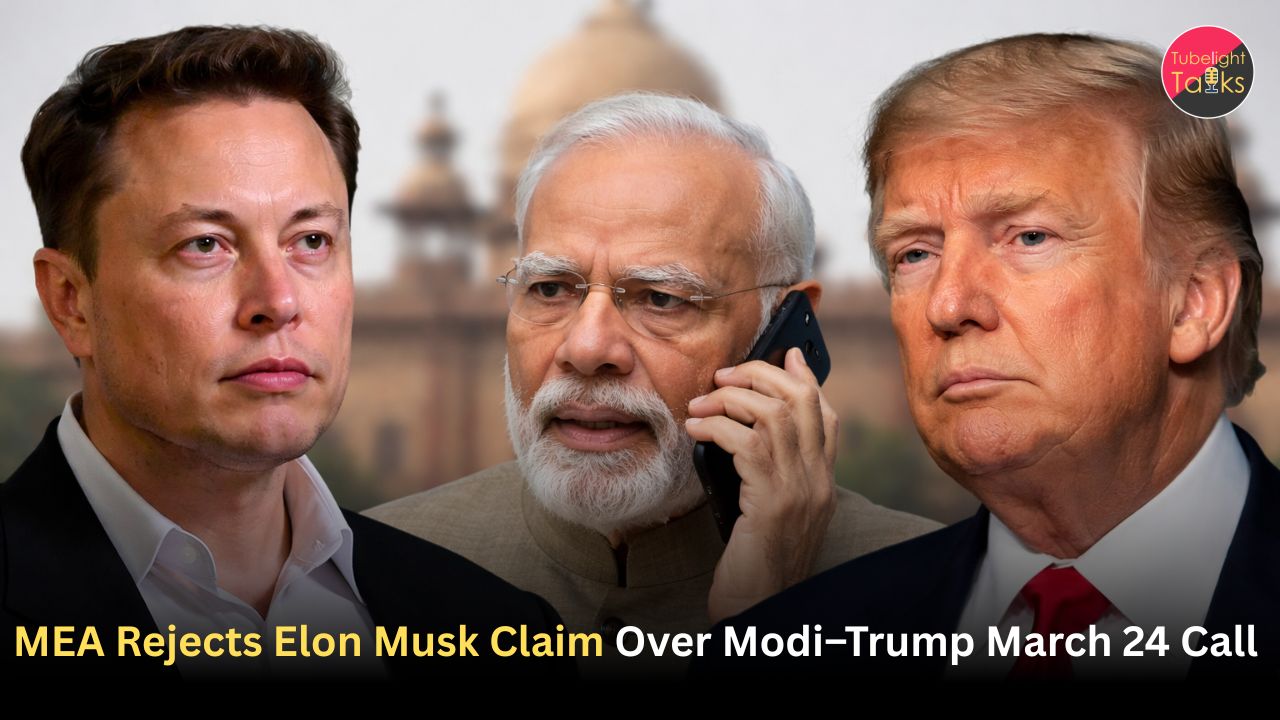
MEA Rejects Elon Musk Claim, Says Modi–Trump Call Was Between the Two Leaders Only
India’s Ministry of External Affairs has formally rejected reports that Elon Musk participated in the March 24 phone call between Prime Minister Narendra Modi and U.S. President Donald Trump. News On AIR reported that the MEA clarified the conversation was one-on-one, while PM Modi’s March 24 official readout had already described the exchange simply as a call from President Trump on the West Asia situation, as MEA Rejects Elon Musk Claim.
The clarification matters because the original report quickly turned a diplomatic exchange into a political controversy. Reuters reported that The New York Times, citing two U.S. officials, said Musk joined the call about the Iran war, although his role in the conversation was not clear. India has now publicly contradicted that version.
What exactly the MEA said
The clearest current Indian formulation came through government-linked and national reporting. News On AIR said the MEA clarified that the March 24 call was only between Prime Minister Modi and President Trump and denied Elon Musk’s participation. Business Standard and other Indian outlets quoted the ministry as saying it had “seen the story” and that the telephone conversation on March 24 was between Modi and Trump only.
That wording is important because it is narrow and direct. India is not merely saying Musk’s role was unclear. It is saying the call itself was bilateral. That makes the response a straightforward denial, not a diplomatic half-step. This is an inference based on the way the MEA’s clarification has been reported.
What the March 24 call was about
PM Modi’s official March 24 statement said he received a call from President Trump and had a “useful exchange of views” on the situation in West Asia. The PMO said India supports de-escalation and early restoration of peace, and Modi stressed that keeping the Strait of Hormuz open, secure and accessible is essential for the whole world.
That official readout matters because it establishes the subject of the call before the Elon Musk controversy began. The issue under discussion was not business or technology cooperation. It was a high-stakes geopolitical crisis involving war risk, shipping security and energy stability. That is one reason the reported presence of a private businessman immediately drew attention. This is an inference grounded in the PMO’s account of the call.
Why the Musk report caused such a stir
Reuters reported that the New York Times said Musk joined the call and cited two U.S. officials, while also noting that it was not clear why he was involved or whether he spoke. In ordinary circumstances, that would already be unusual. In the middle of a war-linked diplomatic conversation between two heads of government, it became far more sensitive.
The controversy grew because the idea of a private businessman joining a leader-level strategic conversation raises questions about protocol, confidentiality and influence. Opposition voices in India quickly seized on that possibility, while the MEA moved to shut the matter down with a categorical denial. This is an inference supported by the sequence of the Reuters report and the MEA response.
Also Read: PM Modi West Asia Crisis Meeting Signals National Preparedness Push
Why India may have moved so quickly to clarify
Diplomatic calls between heads of government are not only about what is said. They are also about who is in the room, or on the line. By insisting the call was only between Modi and Trump, India appears to be defending the formal character of the exchange and avoiding any suggestion that unofficial participants shaped a strategic discussion on West Asia. This is an inference based on the MEA’s wording and the subject matter of the call.
There is also a domestic political reason for speed. The moment such a report appears, it creates space for opposition attacks about transparency and propriety. A direct denial limits that space and reasserts that the conversation remained a standard head-of-government diplomatic exchange. This is an inference based on the immediate political reactions reported in Indian media.
What remains unresolved
One unresolved point is whether the discrepancy reflects different accounts on the Indian and U.S. sides or whether the original report itself was incomplete or inaccurate. India’s official position is now clear, but the Reuters report shows that the New York Times attributed its account to U.S. officials. That means the story may not end simply with one clarification, especially if further details emerge from the American side.
For now, though, India’s diplomatic record is unambiguous: the March 24 call, according to the MEA and the PMO framing, was between Modi and Trump only and was focused on West Asia, de-escalation and the importance of keeping Hormuz open.
The value of clarity in public life
From a Sat Gyaan perspective, moments of controversy test whether public life is guided by truth or by confusion. In diplomacy especially, clarity matters because uncertainty can quickly become mistrust. When facts are contested, the duty of institutions is to speak plainly and reduce needless doubt.
Call to Action
Stories involving global leaders, war and private influence can spread fast and get politicized even faster. The best way to assess them is to compare the official readouts with credible reporting and note where they align or diverge. In this case, the key point is simple: India’s official position is a categorical denial.
FAQs: MEA Rejects Elon Musk Claim
1. Did the MEA deny Elon Musk joined the Modi–Trump call?
Yes. News On AIR and other Indian reports said the MEA clarified that the March 24 telephone conversation was only between Prime Minister Modi and President Trump.
2. What was the March 24 call about?
The PMO said the call focused on the situation in West Asia, de-escalation, restoration of peace, and the importance of keeping the Strait of Hormuz open and secure.
3. Where did the Elon Musk claim come from?
Reuters reported that The New York Times said Musk joined the call, citing two U.S. officials.
4. Did India say Musk had a limited role or no role at all?
India’s reported wording was stronger than saying his role was limited. It said the call was between Modi and Trump only.
5. Why is this controversy significant?
Because it concerns a strategic wartime diplomatic exchange between two leaders, where the presence of any unofficial participant would be highly unusual and politically sensitive. This is an inference based on the subject of the call and the reaction it triggered.
6. Is the matter fully settled?
India’s official position is clear, but the discrepancy remains notable because Reuters reported that the original claim was attributed to U.S. officials in the New York Times report.
Related Stories








Discussion (0)