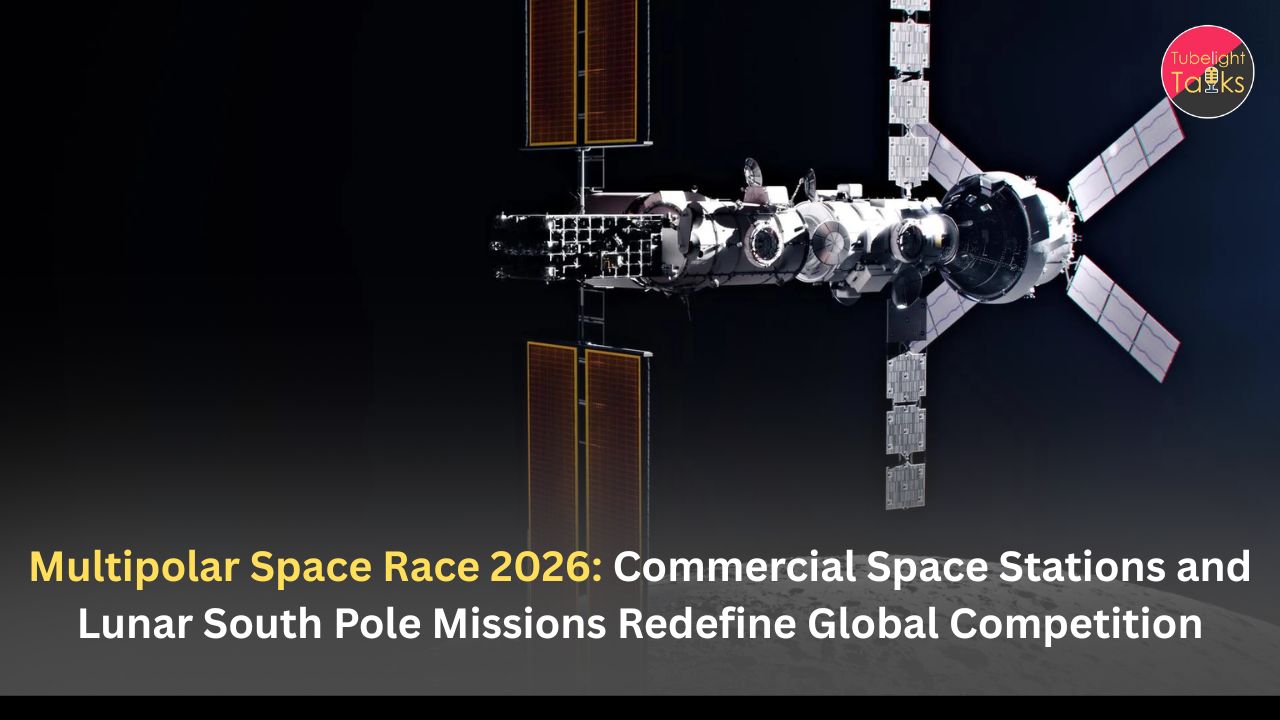
Multipolar Space Race 2026: Commercial Space Stations and Lunar South Pole Missions Redefine Global Competition
Multipolar Space Race 2026: The year 2026 is shaping up as a landmark in the increasingly diverse global space race, spotlighting commercial ventures and ambitious lunar explorations. California-based Vast aims to launch Haven-1, the world’s first commercial space station, ushering in a new era of private sector presence in low Earth orbit.
Simultaneously, China plans to deploy its Chang’e-7 mission to explore the lunar South Pole, while NASA prepares for SunRISE, a cutting-edge solar observatory mission. These multifaceted efforts reflect the emerging multipolar landscape of space exploration driven by technological innovation, strategic ambitions, and international collaboration.
Commercial Space Stations: Vast’s Haven-1 Initiative
Vast is on track to launch Haven-1 in May 2026, a pioneering single-module commercial space station in low Earth orbit designed to host short-duration crewed missions and advanced scientific research. Partnered with SpaceX for launch and crew transport, Haven-1 is a testbed for Vast’s broader ambitions to create modular, long-term private space habitats succeeding the aging International Space Station.
This commercial approach aims to foster innovation and reduce dependence on government-operated infrastructure, signaling a shift in space operations.
Lunar South Pole Missions: China’s Chang’e-7 and Beyond
China’s Chang’e-7 mission targets the lunar South Pole, focusing on detailed surface and subsurface studies in one of the Moon’s most strategically and scientifically significant regions. The mission plans include deploying landers, rovers, and sensors to assess water ice deposits and lunar geology, advancing China’s lunar exploration program and ambitions for sustainable extraterrestrial presence.
NASA’s SunRISE Solar Observatory
NASA’s SunRISE mission, planned for 2026, will undertake unprecedented multi-point observations of the Sun’s magnetic fields and solar wind through a constellation of small satellites. By analyzing solar dynamics, SunRISE aims to deepen understanding of space weather phenomena critical to safeguarding Earth’s technological infrastructure and supporting crewed spaceflight safety.
Multipolar Space Race: Global and Strategic Context
2026’s milestones underscore a multipolar space race driven not only by traditional space powers but increasingly by private companies and emerging nations. The diversification of actors and missions expands scientific horizons and strategic competition, highlighting the importance of international cooperation and norms to maintain space as a domain for peaceful use and exploration.
Experts’ Views
Space analysts note that Vast’s commercial station introduces a paradigm shift toward privatized orbital habitats, while China’s focused lunar exploration elevates its leadership ambitions. NASA’s SunRISE symbolizes continued U.S. scientific excellence and Earth protection priorities. Together, these efforts demonstrate complementary yet competitive pathways shaping the near-future of space exploration.
Unity in Exploration for Universal Benefit
Sant Rampal Ji Maharaj’s Satgyan encourages that advancements in science and exploration be pursued with righteousness and for the welfare of all humanity. The unfolding multipolar space race in 2026, with collaborative possibilities and responsible innovation, reflects this vision – where knowledge and technology unite diverse actors in a shared quest to expand human understanding while promoting peace and ethical progress.
Key Facts
- Vast’s Haven-1 commercial space station is scheduled for launch in May 2026 with a 3-year mission and crewed short stays.
- China’s Chang’e-7 mission targets the lunar South Pole for detailed scientific exploration and resource assessment.
- NASA’s SunRISE will study the Sun’s magnetic field using multiple satellites to advance space weather forecasting.
- The International Space Station is expected to be decommissioned around 2030, enhancing the importance of new commercial stations.
- 2026 highlights an era of diverse global and private actors competing and cooperating in space.
2026 Evolving Space Exploration
The year 2026 is pivotal in the evolution of space exploration, marked by the rise of commercial space stations and strategic lunar and solar missions from multiple global players. Vast’s private orbital habitat, China’s Chang’e-7 lunar endeavor, and NASA’s SunRISE solar constellation exemplify how a multipolar space race is reshaping humanity’s approach to space, blending competition with cooperation.
Guided by ethical considerations and shared scientific aspirations, this new frontier promises expanded discoveries and deeper collaborative potential for the benefit of all humankind.
Also Read: The Rise of Space Tourism in 2025: Humanity’s Journey to the Stars
FAQs: Multipolar Space Race 2026
1. What is Vast’s Haven-1 space station?
A planned first standalone commercial space station in low Earth orbit for short crewed missions and scientific research.
2. What is the focus of China’s Chang’e-7 mission?
Exploration of the lunar South Pole focusing on surface and subsurface studies including water ice detection.
3. What will NASA’s SunRISE mission study?
The Sun’s magnetic fields and solar wind to better understand space weather impacts.
4. Why is 2026 important in the space race?
It marks the launch of new commercial stations and ambitious lunar and solar missions by multiple global actors.
5. How does this reflect the multipolar space race?
Multiple countries and private companies are advancing independently yet simultaneously, diversifying space leadership.
Related Stories










Discussion (0)